
NEW
Font size
 Worksheets
Chromosomes and Meiosis
Total questions: 22
Worksheet time: 11mins
What is the correct sequence of structures from smallest to largest?
Chromosomes, Gene, DNA, Nucleus, Cell
Cell, Nucleus, Chromosomes, DNA, Genes
DNA, Gene, Nucleus, Chromosome, Cell
Gene, DNA, Chromosomes, Nucleus, Cell
Gene Nucleus, DNA, Chromosome, Cell

What are the structures in this image called?
chromosomes
centromere
sister chromatids
chromatin

DNA is an acronym for _____
Diphosphorus Nucleic Acid
Ribose Nucleic Acid
Deoxyribonucleic Acid
Deoxyribonucleic Acetate

A nucleotide is composed of
A phosphate, sugar and nitrogenous base
A protein, protein and Guanine
A phosphate, Adenine, and nitrogenous base
A protein, Adenine and nitrogenous base

Which of the following is a base pair?
Adenine - Cytosine
Cytosine - Thymine
Deoxyribose - Cytosine
Cytosine - Guanine
How many chromosomes are found in each cell of your body?
46
23
40
45
How many pairs of chromosomes do human cells contain?
23
46
16
32
What is a short segment of a DNA strand that codes for our characteristics?
chromosome
DNA
RNA
gene
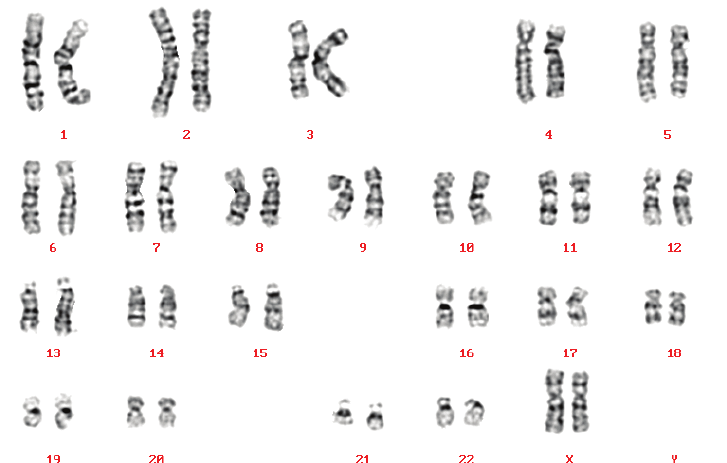
By looking at the chromosomes how can you tell that this person is biologically female?
Because there are two X chromosomes
Because there are more chromosomes than in a male
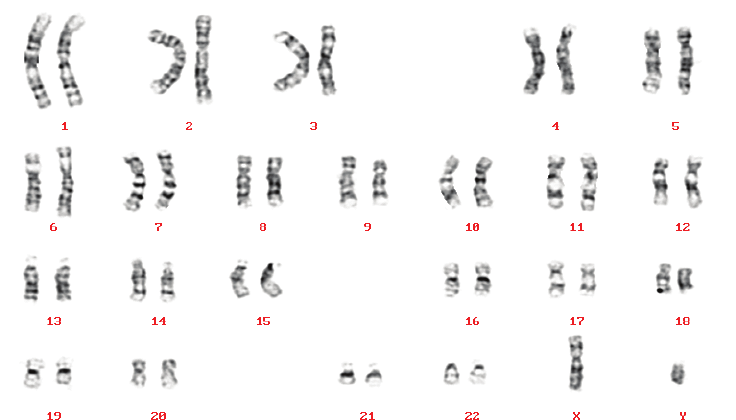
By looking at the chromosomes is this individual biologically male or female? How do you know?
Female, because they have two X chromosomes
Male, because they have one X and one Y chromosome
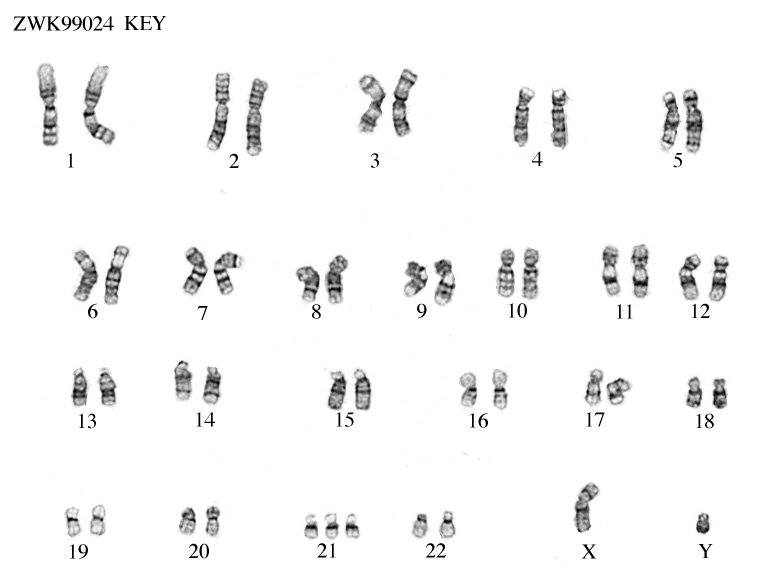
What is the mutation in this persons chromosomes?
There is only one X
7 is shaped like a hockey stick
There's an extra 21
1 is too curved
In which phase of Meiosis does crossing-over happen?
Prophase I
Metaphase I
Anaphase I
Telophase I

Which phase of meiosis is shown in the picture?
Prophase I
Metaphase I
Anaphase I
Telophase I

Which phase of meiosis is shown in the picture?
prophase I
metaphase I
anaphase I
telophase I
After meiosis II, which of the following is true about the cells that are produced?
Four cells are produced. They are identical to each other and each contains half the number of chromosomes that the parent cell has.
Four cells are produced. Each is unique and contains half the number of chromosomes that the parent cell has.
Four cells are produced. Each is unique and contains the same number of chromosomes that the parent cell has.
Two cells are produced. Each is unique and contains the same number of chromosomes that the parent cell has.
What effect does crossing over has in terms of traits of offspring?
Results in identical traits of offsprings.
Causes variation in the traits of offsprings.
It really does nothing to the traits of offspring.
The four cells that are produced after Meiosis are _______.
haploid because they contain just half the number of chromosomes as the parent cell.
diploid because they contain as many chromosomes as the parent cell.
diploid because they contain twice as many chromosomes as the parent cell.



