

wayground logo

Free Printable Worksheets

NEW

Font size

S
M
L
XL
Worksheets

AP Biology Replication

Total questions: 28

Worksheet time: 25mins

Name
Class
Date
1.
Which of the following best describes a DNA molecule?
a)
double helix
b)
contains ribose
c)
made of amino acids
d)
contains Uracil
2.
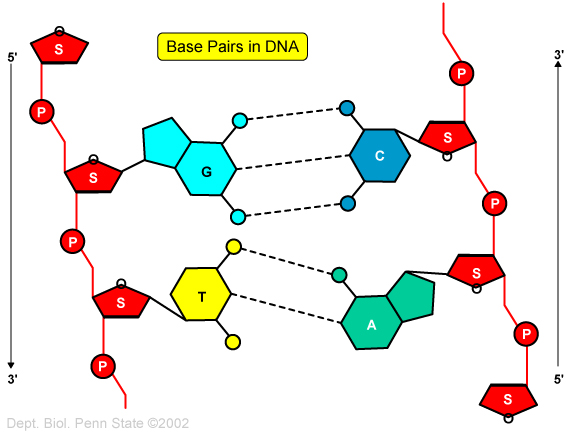
Which sequence of DNA bases would pair with this partial strand
ATG TGA CAG
a)
ATG TGA CAG
b)
TAC ACT GTC
c)
GTA AGT GAC
d)
CAT TCA CTG
3.
Seals the Okazaki fragments together
a)
DNA Polymerase
b)
ligase
c)
helicase
d)
primase
4.

How do the leading and the lagging strands differ?

a)

The leading strand is synthesized in the same direction as the movement of the replication fork, and the lagging strand is synthesized in the opposite direction.

b)

The leading strand is synthesized at twice the rate of the lagging strand.

c)

The leading strand is synthesized in short fragments that are ultimately stitched together, whereas the lagging strand is synthesized continuously.

d)

The leading strand is synthesized by adding nucleotides to the 3' end of the growing strand, and the lagging strand is synthesized by adding nucleotides to the 5? end.
5.
Which enzyme is needed to start DNA replication?
a)
DNA Polymerase
b)
Topoisomerase
c)
Ligase
d)
Primase
6.
Which of the following help(s) to hold the DNA strands apart while they are being replicated?
a)
RNA primase
b)
single–strand binding proteins
c)
DNA polymerase I
d)
DNA ligase
7.
What is meant by the description "antiparallel" regarding the strands that make up DNA?
a)
The twisting nature of DNA creates nonparallel strands.
b)
One strand is positively charged and the other is negatively charged.
c)
The 5' to 3' direction of one strand runs counter to the 5' to 3' direction of the other strand.
d)
Base pairings create unequal spacing between the two DNA strands
8.
What is meant that DNA replication follows a “semi-conservative” model?
a)
After DNA replication, each strand contains one side that is a parental strand and the other side is a daughter strand.
b)
After DNA replication, one completed strand contains only parental DNA while the other contains only daughter DNA.
c)
None of these identify the “semi-conservative” model.
d)
After DNA replication, one completed strand contains a mixture of both parental DNA and daughter DNA dispersed throughout the strand.
9.
Suppose a double-stranded DNA molecule was shown to have 15% adenine bases. What would be the expected percentage of guanine bases in that molecule?
a)
15%
b)
35%
c)
85%
d)
Not enough information
10.
Which component of DNA determines the traits of an organism? 
a)
Nitrogen Bases
b)
Sugar-Phosphate Backbone
c)
Hydrogen bonds
11.
What are the nucleotides made of?
a)
Sugar, Phosphate, nitrogen base
b)
Phosphate, Adenine, nitrogen base
c)
Thymine, Adenine, Cytomine
d)
Phosphate, Nitrogen, Adenine
12.
DNA is replicated during ______ of the cell cycle.
a)
G1
b)
S
c)
G2
d)
G0
13.
In analyzing the number of different bases in a DNA sample, which result would be consistent with the base-pairing rules?
a)
A = G
b)
A + G = C + T
c)
A + T = G + G
d)
A = C
14.
The enzyme that unzips the DNA to prepare for replication
a)
helicase
b)
replicase
c)
polymerase
d)
synthase
15.
Which enzyme is responsible for adding nucleotides?
a)
Topoisomerase
b)
DNA Polymerase
c)
Ligase
d)
Primase
16.
One difference between DNA and RNA is that....
a)
Only RNA has the base Uracil
b)
only RNA contains the base Thymine
c)
only RNA contains the base Cytocine
d)
only RNA contained the base Guanine
17.
This nucleic acid is single stranded
a)
DNA
b)
RNA
c)
Both
18.
Which of the following units are repeatedly joined together to form a strand of DNA?
a)
amino acids
b)
nucleotides
c)
fatty acids
d)
polysaccharides
19.
Nitrogenous bases are joined by which type of bond?
a)
polar bonds
b)
ionic bonds
c)
covalent bonds
d)
hydrogen bonds
20.
Which is the best description of a gene?
a)
a DNA sequence that is expressed to form a functional product; either RNA or polypeptide
b)
a DNA subunit that codes for a single complete protein
c)
a DNA-RNA sequence combination that results in an enzymatic product
d)
a descrete unit of hereditary information that consists of a sequence of amino acids 
21.
order of replication
a)
3, 2, 1, 4
b)
2, 1, 4, 3
c)
2, 3, 1, 4
d)
3, 4, 1, 2
22.
direction new nucleotides are synthesized on the new strand
a)
5' to 3' (new nucleotides added to the 3' end)
b)
3' to 5' (new nucleotides added to the 5' end)
23.
Which 2 molecules form the sides (backbone) of the DNA ladder?
a)
deoxyribose sugar and adenine
b)
deoxyribose sugar and a hydrogen bond
c)
deoxyribose sugar and the nucleus
d)
deoxyribose sugar and phosphate
24.
DNA replication results in two DNA molecules,
a)
each one with two original strands
b)
each one with two new strands
c)
each one with one new strand and one original strand
d)
one with two new strands and the other with two original strands
25.
Which is larger guanine or cytosine
a)
guanine because it's a purine
b)
guanine because it's a pyrimidine
c)
cytosine because it's a purine
d)
cytosine because its a pyrimidine
26.

** A model of a process involving nucleic acids is shown in Figure 1. Which of the following best explains what process is represented in Figure 1 ?

a)

New DNA strands are being synthesized in the 3' to 5' direction from their DNA templates.

b)

New DNA strands are being synthesized in the 5' to 3' direction from their DNA templates.

c)

A new RNA strand is being synthesized in the 3' to 5' end from its DNA template.

d)

Two new RNA strands are being synthesized in both directions from their DNA templates.

27.

** Figure 1 shows some relevant details of a model of how a deoxynucleotide, in this case dTMP, is added to a growing strand of DNA. The features of this model provide evidence for which explanation of why all growing strands are synthesized in a 5′ to 3′ direction?

a)

The two strands need to be antiparallel to bond properly.

b)

Thymine and adenine would not bond properly if the strand grew from 3′ to 5′.

c)

The translation of mRNA occurs in the 5′ to 3′ direction; therefore, the growing DNA strand must also grow in the 5′ to 3′ direction.

d)

The phosphate group, attached to the 5′ carbon of the dTMP, forms a covalent bond with the oxygen atom attached to the 3′ carbon of the growing strand.

28.

** Figure 1 illustrates a model of the molecules involved in DNA replication and their placement relative to each other. Which of the following correctly explains where DNA

replication will begin on the strand oriented 5'→3', reading from left to right?

a)

DNA replication will be randomly initiated along the unwound portion of the DNA strand since base pairing will occur.

b)

DNA replication cannot occur since there is already RNA base pairing with the template strand.

c)

DNA replication will be initiated immediately to the left of the RNA, since DNA polymerase requires an RNA primer.

d)

DNA replication will be initiated at the site of the topoisomerase since that is where DNA begins to uncoil.
