
 Worksheets
Mechanical Waves and Sound
Total questions: 24
Worksheet time: 2hrs 11mins
Name
Class
Date
1.
Which type of wave has a wave perpedicular to the disturbance?
a)
surface
b)
mechanical
c)
transverse
d)
longitudinal
2.
What happens when a mechanical wave travels through a medium?
a)
Waves are transferred
b)
Energy is transferred
c)
Mass is transferred
d)
Particles are transferred
3.
Energy can be transferred from one medium to another through _________.
a)
vibrations
b)
stacking objects
c)
an ordered sequence
d)
colors
4.
Which is true of a mechanical wave?
a)
It must have a medium
b)
It must travel in empty space.
c)
It can travel in a vacuum.
d)
Both sound and light are examples.
5.
What is the amplitude of a wave?
a)
the amount of time that occurs in one full cycle
b)
the distance traveled by the wave during one full cycle
c)
the amount of cycles that occur in a given time
d)
the size of the disturbance
6.
What is the wavelength of a wave?
a)
the size of the disturbance
b)
the amount of time that occurs in one full cycle
c)
the distance between two crests of a wave
d)
the amount of cycles that occur in a given time
7.
Unlike a transverse wave, the disturbance in a longitudinal wave is
a)
in a circular motion.
b)
parallel to the wave motion.
c)
perpendicular to the wave motion.
d)
in the opposite direction of the wave motion
8.
Unlike a longitudinal wave, the disturbance in a transverse wave is
a)
perpendicular to the wave motion.
b)
in a circular motion.
c)
parallel to the wave motion.
d)
in the opposite direction of the wave motion.
9.
A transverse wave can be created in a Slinky® by moving it
a)
side to side.
b)
in a circular motion.
c)
together and apart.
d)
up and down.
10.
When on a flat surface, giving the Slinky® a push or pulse will create a disturbance
a)
in the opposite direction of the wave motion.
b)
parallel to the wave motion.
c)
in a circle.
d)
perpendicular to the wave motion.
11.
Which is true about a surface wave?
a)
It only has properties of transverse waves.
b)
It only has properties of longitudinal waves.
c)
has neither properties of transverse or longitudinal waves.
d)
It has properties of both transverse and longitudinal waves.
12.

What is the speed of a wave if the wavelength is 100 m and the period is 20 s?
a)
2,000 m/s
b)
120 m/s
c)
80 m/s
d)
5 m/s
13.
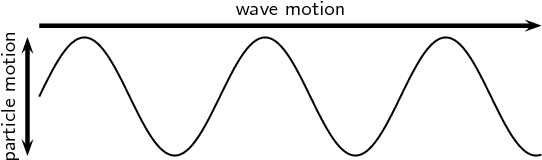
What kind of wave is pictured below?
a)
compressional wave
b)
transverse wave
c)
sound wave
d)
mechanical wave
14.
Waves are a transfer of what?
a)
Heat
b)
Light
c)
Energy
d)
Food
15.
Amplitude reflects the amount of ____________________ in a wave.
a)
energy
b)
compression
c)
rarefaction
d)
speed
16.

The units for frequency are measured in _____________.
a)
hertz
b)
seconds
c)
m/s
d)
m
17.
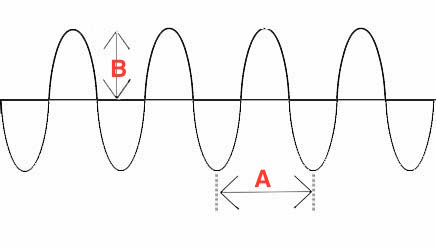
What property of this wave is represented by the letter "A"
a)
amplitude
b)
crest
c)
trough
d)
wavelength
18.
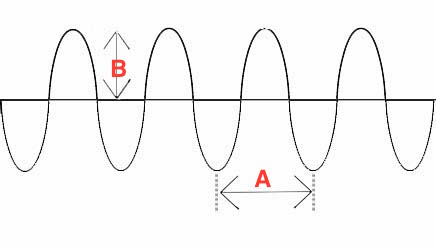
What property of the wave is represented by the letter "B"?
a)
amplitude
b)
crest
c)
trough
d)
wavelength
19.
The highest point on a wave is:
a)
the crest
b)
the trough
c)
the top
d)
the coast
20.
The lowest point on a wave is the:
a)
Amplitude
b)
Crest
c)
Trough
d)
Wavelength
21.
The number of wavelengths that pass a point each per second is:
a)
frequency
b)
period
c)
longitudinal
d)
transverse wave
22.

Which vocabulary term is used to identify the distance between points C & G?
a)
Amplitude
b)
Crest
c)
Frequency
d)
Wavelength
23.
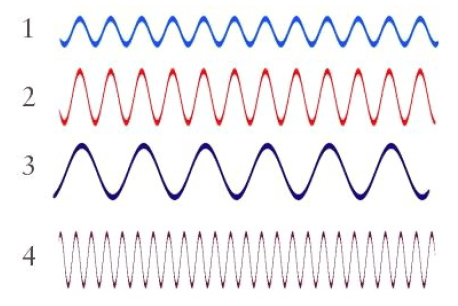
Which wave in the diagram has the greatest frequency?
a)
1
b)
2
c)
3
d)
4
24.
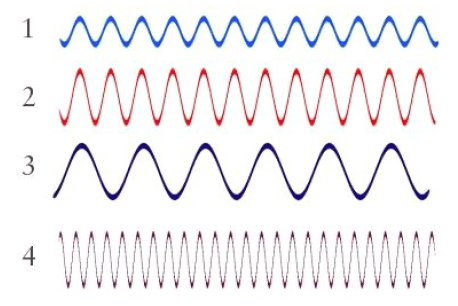
Which wave in the diagram has the greatest wavelength?
a)
1
b)
2
c)
3
d)
4
100 %

