
Font size
 Worksheets
Light
Total questions: 60
Worksheet time: 1hrs 22mins

Sami is 50 cm from a vertical mirror. He moves 20cm away. The distance between his image and himself is then ………….
100cm
120cm
140cm
40cm
The imaginary line perpendicular to the mirror is called the:
Incident ray
reflected ray
normal line
The angle between the reflected ray and the normal line is called the:
Angle of incidence
Angle of reflection
angle of convergent
Angle of divergent.
If the angle of incidence is 45 degree, what is the angle of reflection?
90°
45°
180°
The Law of reflection states that - The angle of incidence is .................. the angle of reflection.
equal to
double
half
The ray of light that strikes a mirror is called ________.
an incident ray
a reflected ray
a normal ray
none of the above
Which of the following is not a source of light?
A. candle
B. caver’s lamp
C. mirror
D. sun
What is reflection?
Reflection is the bouncing of light off the surface that it strikes on.
Reflection is the absorbing of light off the surface that it strikes on.
Reflection is the bending of light off the surface that it strikes on.
Reflection is the transmission of light off the surface that it strikes on.
The angle between the reflected ray and the normal line is called the:
angle of incidence
angle of reflection
angle of convergent
angle of divergent
Straight lines with arrows that represent light waves:
rays
image
reflection
visible light
A copy of an object formed by reflected or refracted rays of light
image
reflection
regular reflection
diffuse reflection

What is A?
Angle of incidence
Angle of reflection
Incident ray
Reflected ray
Normal line
We can see images in _________ surfaces
smooth
rough
shiny
bumpy
A ray of light is incident on a plane mirror and the angle of incidence is 25 degrees. What is the angle of reflection?
0 degrees
50 degrees
90 degrees
25 degrees
Which color shirt would keep you cooler on a hot day?
black
white
gray
navy blue
The bending of light is called:
refraction
light
opaque
reflection
A _________ forms when the path of light is blocked.
sun
circle
line
shadow
Materials that do not allow light to pass through are called:
clear
opaque
transparent
translucent
The change in the ________ of light causes it to bend
speed
distance
length
color
Materials that let some of the light pass through are called:
transparent
opaque
clear
translucent


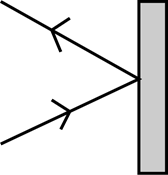
The angle of incidence is _________ the angle of reflection

How does light behave as it enters these mediums?
continue its path as straight line.
bends toward the normal
bends away from the normal
reflects

A beam of light travels from one material into another material. The light can travel faster in the second material, so:
it is bent toward the normal.
it is unaffected.
it always lies along the normal.
it is bent away from the normal.
In the illustration, the light ray striking the object is-

Which of the following in the diagram is the refracted ray?
Light energy is absorbed by a substance, and then light is slowly released by the substance (example: glow in the dark toys).
bioluminescence
fluorescence
phosphorescence
chemiluminescence
incandescence
UV light is produced by passing electricity through mercury gas, phosphor coating absorbs the UV and gives off light we can see:
bioluminescence
fluorescence
phosphorescence
chemiluminescence
incandescence
Light is produced when 2 or more chemicals combine.
bioluminescence
fluorescence
phosphorescence
chemiluminescence
incandescence
Light is produced by living organisms.
bioluminescence
fluorescence
phosphorescence
chemiluminescence
incandescence
Reason (s) why organisms use bioluminescence. Check all that apply.
to avoid predators
to find a mate
to find food


The picture here is an example of...
incandescence
chemiluminescence
bioluminescence
fluorescence

Glo-Sticks are an example of a __________ light source.
chemiluminescence
bioluminescence
fluorescence
incandescence

The picture shows an example of a ________________ light source.
chemiluminescence
fluorescence
incandescence
bioluminescence
phosphorescence
What is B?
Angle of incidence
Angle of reflection
Incident ray
Reflected ray
Normal line
What is C?
Angle of incidence
Angle of reflection
Incident ray
Reflected ray
Normal line
What is D?
Angle of incidence
Angle of reflection
Incident ray
Reflected ray
Normal line
What is E?
Angle of incidence
Angle of reflection
Incident ray
Reflected ray
Normal line
Light is produced by heating a material until it glows.
bioluminescence
fluorescence
phosphorescence
chemiluminescence
incandescence

