
NEW
Font size
 Worksheets
Georgia Biology EOC Review
Total questions: 15
Worksheet time: 15mins

In pea plants, the tall allele is dominant to the short allele. What key would demonstrate this?
Tall = T
Short = S
Tall = T
Short = t
Tall = t
Short = T
Tall = TT
Short = tt

A heterozygous long-tusked elephant is crossed with a homozygous recessive short-tusked elephant. What is the probability of the offspring having short tusks?
0%
25%
50%
75%
Which of the following genotypes is homozygous dominant?
Yy
yY
yy
YY
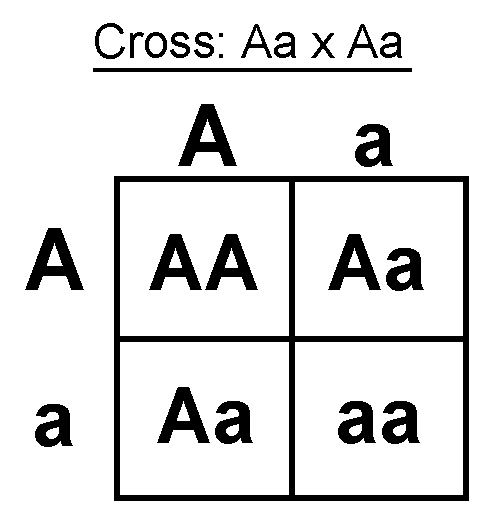
What are the phenotype percentages of the offspring?
50 % Brown fur and 50% White fur
25 % Brown fur and 75% White fur
75 % Brown fur and 25% White fur
0% Brown fur and 100% White fur

If you cross a black guinea pig with a white guinea pig and the offspring are gray, what type of dominant trait would that be.
incomplete dominance
codominance
codependant
cooperative
What percent of the offspring would be tan when you cross BbxBb?
75%
25%
50%
100%

In rabbits, black fur (B) is dominant over brown fur (b). If a rabbit has brown fur, what can you conclude about its genotype?
It is BB.
It is Bb
It is brown
It is bb.

This is an example of
Complete dominance
Mendelian Genetics
Codominance
Incomplete Dominance

Why are there no white rabbit babies?
The white gene is not present in any of the babies.
It takes two recessive genes to show the trait.
Grey is a better color.
Baby five will be white.
Name the proteins on the surface of red blood cells.
Antibodies
Antigens
Plasma
Collagen
What type of antigens can be found on the surface of RBC's when someone has blood type O?
A
B
AB
none

Which of the following codes for blood type O?
IA IA
IB i
IA IB
ii
Which of the following processes is primarily responsible for the genetic variation observed in offspring?
A) Mitosis
B) Meiosis
C) Binary Fission
D) Budding
In a controlled experiment, which variable is the one that is changed or manipulated by the scientist?
A) Dependent Variable
B) Independent Variable
C) Controlled Variable
D) Extraneous Variable
What is the primary function of the mitochondria in eukaryotic cells?
A) Photosynthesis
B) Protein Synthesis
C) Energy Production
D) Lipid Storage

