
 Worksheets
Chapter 7 Practice Test
Total questions: 55
Worksheet time: 28mins
Name
Class
Date
1.
1. Where can the water table be found?
a)
at the top of the saturated zone
b)
between layers of impermeable rock
c)
in the unsaturated zone
d)
below layers of clay soil
2.
2. Any body of water above ground like lakes or rivers is called what?
a)
Groundwater
b)
Surfacewater
c)
Plain water
d)
A trench
3.
3. Both surface and ground water participate in the what?
a)
a school dance
b)
aquifer
c)
the water cycle
d)
groundwater
4.
4. Water that seeps deep into the ground is called what?
a)
surfacewater
b)
groundwater
c)
aquifer
d)
water table
5.
5. Which of the following is a natural underground basin for storing groundwater? (like a well)
a)
aquifer
b)
sedimentary basin
c)
artisan basin
6.
6. Which of the following is a true statement?
a)
groundwater is water in a lake
b)
drilling wells is how groundwater is extracted
c)
The contaminants in groundwater are very easy to clean up.
d)
New Orleans is only two hundred feet above sea level.
7.
7. Eutrophication is caused by
a)
excess nutrients building up in the water.
b)
unlined landfills and septic tanks
c)
industrial point-source pollution.
d)
wastewater from homes mixing with drinking water.
8.
8. How does eutrophication cause the death of aquatic organisms
a)
the build up of carbon dioxide in the water
b)
the lack of carbon dioxide in the water
c)
the lack of nitrogen in the water
d)
the lack of oxygen in the water
9.
9. The long term effects of a hypoxic/dead zone includes all of the following EXCEPT
a)
Fisherman may struggle to catch any fish.
b)
The health of the fish population declines.
c)
The crops of farmers stop growing.
d)
There is an increase in the population of decomposers such as bacteria.
10.
10. When algae levels increase in a body of water, it
a)
cuts off light to plants at the bottom.
b)
increases light to the plants on the bottom.
c)
causes bacteria populations decrease.
11.
11. What is the time frame between high tides?
a)
high tides occur every weeks twice a week.
b)
high tides occur every 24 hours
c)
high tides occur every 12 hours and 25 minutes
d)
high tides occur every 6 hours and 12 minutes
12.
12. This type of tide occurs when the Earth, Sun, and moon are aligned in a right angle.
a)
crescent tide
b)
neap tide
c)
spring tide
d)
high tide
13.
13. Which of the following answer choices ONLY fall under spring tides?
a)
high and low tides
b)
weak tides
c)
moderate tides
d)
Earth, sun, and moon in 90 degree angle
14.
14. What are tides?
a)
regular rise and fall of the ocean level
b)
what causes ocean waves
c)
irregular rise and fall of the ocean level
d)
the pull of gravity on Earth
15.
15. There are how many low and high tides per 24 hour period?
a)
1 low and 1 high
b)
2 low and 2 high
c)
1 low and 2 high
d)
2 low and 1 high
16.
16. What plays a role in producing our ocean tides?
a)
gravity
b)
alignment of the Earth, moon, and sun
c)
moon phases
d)
all the above
17.
17. Spring tides have the largest tidal ranges because...
a)
the earth, moon, and sun are aligned for greater gravitational force.
b)
the sun has the most gravitational force.
c)
the moon has the strongest gravitational force.
18.
18. __________ is how salty the water is.
a)
salinity
b)
temperature
c)
wave
d)
density
19.
19. A _______ is a disturbance that transfers energy through matter.
a)
salinity
b)
temperature
c)
wave
d)
density
20.
20. The _____ of a wave is determined by the crest and the trough.
a)
speed
b)
size
c)
frequency
d)
length
21.
21. Wave _____ is the distance between the crest of two waves.
a)
speed
b)
size
c)
frequency
d)
length
22.
22. What causes most waves?
a)
gravity
b)
underwater volcanoes
c)
wind
d)
underwater landslides
23.
23. For an ocean wave, the energy of the wave
a)
decrease with depth
b)
increase in shallow water
c)
both a and b
d)
ocean waves do not transfer energy
24.
24. What is a crest?
a)
a disturbance that transfers energy from one place to another.
b)
the highest point or the peak of a wave
c)
The lowest point, or valley, of a wave
d)
A wave that travels in the same direction as the disturbance
25.
25. What is a trough?
a)
The lowest point, or valley, of a wave
b)
The highest point or peak of a wave
c)
A wave that travels in the same direction as the disturbance
d)
Wave in which particles of the medium vibrate at right angles to the direction that the wave travels
26.
26. Cooler, saltier water
a)
sinks
b)
rises
27.
27. Warmer, less salty water
a)
sinks
b)
rises
28.
28. How does convection cause ocean currents?
a)
During the process of convection, energy is transferred to the atmosphere, forming winds. These winds power surface currents.
b)
During the process of convection, energy in warm water is lost to its surroundings. The water cools, becomes denser, and sinks.
c)
During the process of convection, the heating of surface water by the sun results in upwelling.
d)
During the process of convection, more minerals and gases dissolve in warm water. This increases the density of the warm water and causes it to sink.
29.
29. Because the Earth rotates on its axis, circulating air is deflected toward the right (clockwise) in the Northern Hemisphere and toward the left (counterclockwise) in the Southern Hemisphere.
a)
ocean currents
b)
continental deflections
c)
upwelling
d)
Coriolis Effect
30.
30. Movements of ocean water located far below the surface.
a)
Ocean currents
b)
Deep currents
c)
Convection currents
d)
Surface currents
31.
31. The Gulf Stream carries _____________ water from the east coast of The United States to the West coast of Europe.
a)
cold
b)
freezing
c)
warm
d)
fresh
32.
32. Warm water from surface currents replaces colder denser water that sinks to the ocean floor.
a)
ocean currents
b)
deep currents
c)
convection currents
d)
surface currents
33.
33. Winds on the surface cause the warm surface water to be replaced with the colder more nutrient rich water.
a)
ocean currents
b)
Coriolis Effect
c)
Continental Deflections
d)
upwelling
34.
34. What are a circular system of currents in the Earth's major oceans?
a)
ocean current
b)
gyre
c)
upwelling
d)
conveyor belt
35.
35. What happens to a current when it comes in contact with a continent or landmass?
a)
it continues over the continent
b)
it changes direction
c)
it stops
d)
it is absorbed by the land
36.
36. Large ocean currents have a considerable effect on the temperature of the coastal areas.
a)
True
b)
False
37.
37. Ocean currents do NOT affect climates at different latitudes.
a)
True
b)
False
38.
38. El Nino occurs when the tropical ocean waters are warmer in which ocean?
a)
Pacific
b)
Atlantic
c)
Indian
d)
Arctic
39.
39. La Nina has extreme upwelling and dry conditions in the...
a)
East Pacific
b)
West Pacific
40.
40. Which of the following is an INCORRECT statement about El Niño and La Niña?
a)
Both occur every 2-7 years
b)
Both occur in the Atlantic Ocean
c)
El Nino is a warming and La Nina is a cooling of the Pacific Ocean
d)
Neither are considered "storms"
41.
41. El Nino has good fishing conditions and less rain in the...
a)
East Pacific
b)
West Pacific
42.
42. Deep ocean currents are caused by differences in density of the water. Which statement accurately describes the relationships between salinity, temperature, and density of ocean water?
a)
Cold water, holding less salt, sinks towards the bottom of the ocean.
b)
Warm water, holding more salt, sinks towards the bottom of the ocean.
c)
Warm water, holding less salt, rises toward the surface of the ocean.
d)
Warm water, holding more salt, rises towards the surface of the ocean.
43.
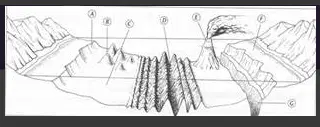
43. What is letter C?
a)
mid-ocean ridge
b)
continental slope
c)
continental shelf
d)
abyssal plain
44.
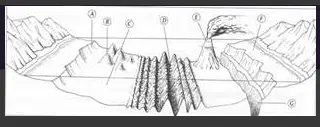
44. What is letter D?
a)
continental shelf
b)
mid-ocean ridge
c)
volcanic island
d)
seamount
45.
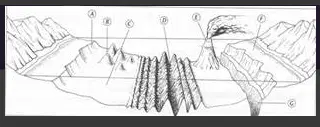
45. What is letter E?
a)
volcanic island
b)
mid-ocean ridge
c)
seamount
d)
abyssal plain
46.
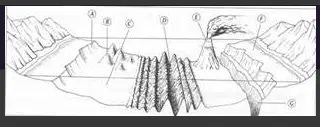
46. What is letter A?
a)
continental shelf
b)
seamount
c)
continental slope
d)
abyssal plain
47.

47. What is letter G?
a)
mid-ocean ridge
b)
trench
c)
rift
d)
continental shelf
48.
48. What is letter B?
a)
continental shelf
b)
mid-ocean ridge
c)
continental slope
d)
seamount
49.
49. The gradually sloping part of a continent that extends under the ocean is the...
a)
continental shelf
b)
seamount
c)
continental slope
d)
trench
50.
50. Seamount is similiar to...
a)
a volcanic island
b)
the Great Plains
c)
a small mountain or volcano
d)
the Grand Canyon
51.
51. The shallowest(least deep) part of the ocean is the ____________________
a)
trench
b)
continental shelf
c)
abyssal plain
d)
continental slope
52.
52. The deepest part of the ocean
a)
trenches
b)
ocean basin
c)
abyssal plain
d)
rift
53.
53. What is the difference between a volcanic island & a seamount?
a)
A volcanic island rises above the water & a seamount does not
b)
Both the seamount & volcanic island are underwater
c)
A seamount rises above the water & a volcanic island does not
d)
Both the seamount & the volcanic island rise above the water
54.
54. Which best represents the order of seafloor features as you move from the shoreline to the deep ocean?
a)
Continental slope – continental shelf- continental rise – mid-ocean ridge
b)
Continental shelf – continental slope – continental rise – mid-ocean ridge
c)
Continental rise – continental shelf – mid-ocean ridge - continental slope
d)
Mid-ocean ridge – continental rise – continental shelf- continental slope
55.
55. Flat or very gently sloping areas of the ocean floor.
a)
continental shelf
b)
continental floor
c)
trench
d)
abyssal plain
100 %

