Wayground logo

Free Printable Worksheets

Font size

S
M
L
XL
Worksheets

NYS Geologic History

Total questions: 27

Worksheet time: 28mins

Name
Class
Date
1.
On top of Mt. Everest, there are fossilized remains of sea life; this tells us that the rocks at the top of world's highest mountain 
a)
used to be above sea level
b)
used to be below sea level
c)
used to be on Mars
d)
came from an asteroid
2.
Which best describes a fossil that helps determine the relative age of a rock layer?
a)
trace fossil
b)
index fossil
c)
radioactive fossil
d)
unconformity fossil
3.

How long ago did the Earth form, according to geologists?

a)

3.6 million years ago

b)

3600 million years ago

c)

4600 million years ago

d)

4.6 million years ago

4.
Most fossils are found in __________ rock layers
a)
metamorphic
b)
sedimentary
c)
igneous
d)
igneous and sedimentary
5.
Certain fossils existed all over the world, but only for a short period of geologic time.  If a geologist finds this fossil in a layer of rock, he/she will be able to tell how old that rock layer is.  These are called
a)
intrusion fossils
casts
b)
imprint fossils
c)
index fossils
d)
intrest fossils
6.
How do MOST fossils form? 
a)
living things die and their remains are quickly buried by sediments 
b)
the hard parts of an organism dry out in the air 
c)
the soft parts of an organism change to stone 
d)
freezing preserves the remains of an organism 
7.
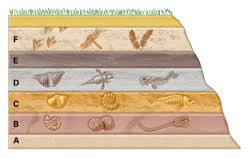
Which rock layer in the diagram seems to be the oldest?
a)
F
b)
E
c)
B
d)
C
8.
Paleozoic, Mesozoic & Cenozoic are all
a)
Epochs
b)
Eras
c)
Periods
d)
Eons
9.
The diagram represents the placoderm fish Bothriolepis, an index fossil found in New York State. What time period is this fossil from?
a)
Ordovician
b)
Silurian
c)
Devonian
d)
Cambrian
10.
Valcouroceras is a New York State index fossil. Which mountain-building event occurred in New York State during the time when Valcouroceras was living in oceans covering parts of New York State? 
a)
Alleghenian orogeny  
b)
Taconian orogeny 
c)
Acadian orogeny
d)
Grenville orogeny
11.
Which fossil could be classified as an index fossil? 
a)
Fossil 1
b)
Fossil 2
c)
Fossil 3
d)
Fossil 4
12.
The index fossil shown at the top has been found in New York State sedimentary bedrock.

Which other index fossil could also be found in New York State bedrock of the same age? 
a)
LIchenaria
b)
Manticoceras
c)
Elliptocephala
d)
Eospirifer
13.

When these rocks were deposited as sediments, this area was most likely

a)

under the ocean

b)

a desert between high mountains

c)

repeatedly covered by lava flows

d)

glaciated several times

14.
Trilobites are good index fossils because.... (pick the best answer).
a)
abundant, large
b)
abundant, widespread geographically, and only lived a short time
c)
only lived for a short time period
d)
were large
carbonized
15.

geologic time intervals that eras are divided into.

a)

geologic time scale

b)

era

c)

period

d)

epoch

16.

Which meets the requirements of an index fossil?

a)
b)
c)
d)
17.
Which rock layer contains the newest fossils?
a)
F
b)
E
c)
B
d)
C
18.
What era came first?
a)
Palezoic
b)
Mesozoic
c)
Cenozoic
d)
Precambrian
19.
What periods are in the Palezoic era?
a)
Cambrian, Ordovician  Silurian,  Devoian,  Carboniferes, Permain, 
b)
Triassic, Cambrian, Silurian
c)
Tertiary, Ordovician,  Silurian, Devoian,
20.
What Era are we currently in?
a)
Mesozoic
b)
Palezoic
c)
Cenozoic
21.
What periods are in the Mesozoic era?
a)
Tertiary, Quatenary
b)
Precambrian
c)
Triassic, Jurassic, Cretaceous
22.
What are index fossils?
a)
A fossil found in the index of your science book.
b)
A fossil of an organism that only lived for a short period of time, so scientists use this fossil to find the absolute age of rock layers.
c)
A regular fossil
d)
An index fossil doesn't exist.
23.

At the end of what period did the dinosaurs become extinct?

a)

Mesozoic

b)

Palezoic

c)

Precambrian

d)

Cretaceous

24.

What period did humans first appear on Earth?

a)

Tertiary

b)

Quaternary

c)

Paleogene

d)

Pleistocene

25.

Salt and gypsum were deposited in evaporite basins during this time period.

a)

Silurian

b)

Permian

c)

Paleogene

d)

Cambrian

26.

The index fossil, Phacops, could be found in which geologic time period?

a)

Devonian

b)

Ordovician

c)

Cambrian

d)

Silurian

27.

The index fossil, Cooksonia, could be found in this time period.

a)

Devonian

b)

Silurian

c)

Ordovician

d)

Cambrian