wayground logo

Free Printable Worksheets

NEW

Font size

S
M
L
XL
Worksheets

Biology Chapter 7 Exam

Total questions: 40

Worksheet time: 48mins
Name
Class
Date
1.
Which of the following statements is not part of the cell theory?
a)
Cells are the basic unit of structure and function in all living things.
b)
All cells are produced from other cells.
c)
Only animal cells are composed of cells.
d)
All living things are composed of cells.
2.
Cells are often called "the ____ of life."
a)
bread
b)
road map
c)
building blocks
d)
meaning
3.
Which is true of prokaryotic and eukaryotic cells?
a)
Prokaryotic cells are larger than eukaryotic cells.
b)
Eukaryotic cells do not have nuclei, and prokaryotic cells do have nuclei.
c)
Prokaryotic cells lack membrane-bound organelles, and eukaryotic cells contain membrane-bound organelles.
d)
Eukaryotic cells are simpler than prokaryotic cells.
4.

What are the smallest units that make up your body?

a)

tissue

b)

cell

c)

organ

d)

organ system

5.

What invention made the discovery of cells possible?

a)

The lightbulb

b)

The phonograph

c)

The kinetoscope

d)

The microscope

6.

What type of organic molecule are enzymes?

a)

carbohydrates

b)

lipids

c)

nucleic acids

d)

proteins

7.

What do both prokaryotic and eukaryotic cells contain?

a)

membrane bound organelles

b)

linear chromosomes

c)

cytoplasm

d)

a nucleus

8.
If a cell contains a nucleus, it must be a(n) ____
a)
plant cell
b)
eukaryotic cell
c)
animal cell
d)
prokaryotic cell
9.
A plasma membrane is made up of a(n) ____.
a)
cholesterol layer
b)
enzyme bilayer
c)
lipid bilayer
d)
protein bilayer
10.
The movement of materials into and out of cells is controlled by the _____.
a)
nucleus
b)
cytoplasm
c)
cell membrane
d)
ribosomes
11.
Which of the following scientists concluded that all animals are made of cells?
a)
Rudolf Virchow
b)
Matthais Schleiden
c)
Robert Hooke
d)
Theodor Schwann
12.
Which of the following scientists was the first to observe bacteria under a microscope?
a)
Anton van Leuwenhoek
b)
Matthais Schleiden
c)
Robert Hooke
d)
Theodor Schwann
13.

The cell membrane is _______________ permeable.

a)

selectively

b)

somewhat

c)

physically

d)

ionically

14.

The cell membrane is mostly made of what?

a)

Membrane-spanning Proteins

b)

Surface Proteins

c)

Phospholipids

d)

Carbohydrates

15.

Located on the cell membrane surface, nucleus membrane or other cellular organelle membrane - they can bind to corresponding proteins to initiate cellular signaling pathways (reactions).

a)

carrier protein

b)

channel protein

c)

receptor protein

16.

Identify cholesterol molecule

a)

structure a

b)

structure b

c)

structure h

d)

structure i

17.

Identify microfilament of the cytoskeleton

a)

structure i

b)

structure b

c)

structure g

d)

structure c

18.

Plasma membranes are selectively permeable. This means

a)

anything can pass in and out

b)

the membrane regulates the passage of the material in and out of the cell

c)

glucose cannot enter the cell

d)

cholesterol cannot enter

19.

Which is NOT a function of the membrane?

a)

it forms a selective barrier

b)

it has receptors for chemical messages

c)

it is the control center of the cell

d)

it is involved in self recognition

20.

Which structure is the hydrophobic tail of the phospholipid molecule?

a)

E

b)

B

c)

G

d)

A2

21.

The _______________ of the phospholipids in a cell membrane face inward towards each other.

a)

heads

b)

tails

c)

stems

d)

sticks

22.

The suffix -phobic means

a)

fear

b)

loving

c)

pho

d)

phone

23.
What does the cell membrane do?
a)
controls activities of cell
b)
releases energy
c)
stores food, water, and waste
d)
controls movement in and out of cell
24.
What is the function of the nucleus?
a)
store food, water, and waste
b)
control cell activities
c)
take in energy from the sun
d)
give the cell shape
25.
In what kind of cell can you find a cell wall?
a)
plant 
b)
animal 
c)
both
d)
neither
26.
What does cytoplasm do?
a)
protects & supports organelles, and helps transport material
b)
controls cell activities
c)
releases energy from food
d)
contains chlorophyll
27.
Why is the mitochondria called the powerhouse of the cell?
a)
because it releases energy from food 
b)
because it creates food
c)
because it stores food
d)
because it makes proteins
28.
What is the function of vacuoles?
a)
store food, waste, and water
b)
make proteins
c)
create food from sun's energy and CO2
d)
control cell activities
29.
What is the function of chloroplasts?
a)
make proteins
b)
collect sun's energy
c)
create food (sugar) from sun's energy
d)
control cell activities
30.
Which structure is not in a bacteria cell?
a)
nucleus
b)
cytoplasm
c)
cell membrane
d)
DNA
31.
Movement of particles through the cell membrane from high to low concentrations
a)
diffusion
b)
photosynthesis
c)
mitochondria
d)
active transport
32.
Against the concentration gradient
low to high uses energy/ATP
a)
facilitated diffusion
b)
osmosis
c)
active transport
d)
diffusion
33.
Allows certain molecules or ions to pass through it by diffusion and doesn't allow others.
a)
protein
b)
semi-permeable membrane
c)
isotonic
d)
homeostasis
34.
Equal percentage of solutes inside and out. 
Concentration of substances is the same. 
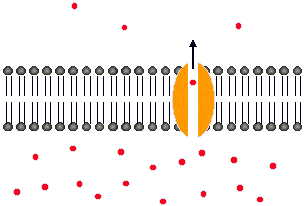
a)
hypotonic
b)
isotonic
c)
nucleus
d)
hypertonic
35.
Particles are too large to enter the membrane.
Need help from channel proteins. No energy required.
a)
active transport
b)
passive transport
c)
facilitated diffusion
d)
osmosis
36.
Diffusion of water across a cell membrane
from high to low.
a)
osmosis
b)
active transport
c)
protein channel
d)
pinocytosis
37.
Engulfs large molecules and moves them inside the membrane.
Uses energy.
a)
exocytosis
b)
endocytosis
c)
protein channel 
d)
diffusion
38.
Engulfing a large substance from the inside of the cell to move it outside of the cell. 
Uses energy. 
a)
exocytosis
b)
endocytosis
c)
photosynthesis
d)
diffusion
39.
Particles move from high concentrations to low concentrations.
Doesn't need energy
a)
passive transport
b)
facilitated transport
c)
active transport
d)
exocytosis
40.
Osmosis is the movement of 
a)
water from low to high concentration
b)
particles from low to high concentration
c)
water from high to low concentration
d)
particles from high to low concentration