
 Worksheets
Review for T5 Lessons 2 and 3 Quiz (and Test Review)
Total questions: 59
Worksheet time: 2hrs 22mins
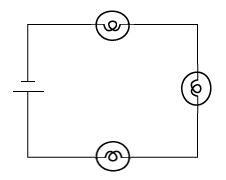



A student builds a circuit made up of a battery, two light bulbs, and a switch. What will the student most likely observe in this circuit?
Light bulb 1 and light bulb 2 will both be on
Light bulb 1 will be off, but light bulb 2 will be on
Light bulb 1 and light bulb 2 will both be off
Light bulb 1 will be on, but light bulb 2 will be off

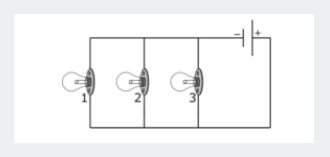
The diagram shows a series circuit with three lit bulbs. How many of the bulbs will remain lit if the wire is cut a the point shown by the arrow?
0
1
2
3

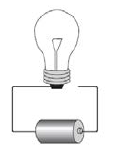
A group of students built the circuit shown above. The lightbulb does not glow. Which statement explains this observation?
The battery is not charged
The lightbulb is not part of a complete circuit
The circuit does not have a switch
The bell uses most of the energy from the battery

Students constructed a circuit using different-colored lightbulbs. What will happen if Switch 3 is closed and the other switches are left open?
Only the white bulb will operate
None of the bulbs will operate
Only the white and yellow bulbs will operate
Only the red and blue bulbs will operate

The diagram shows an electric circuit with four bells that a student plans to build. When the student connects the wire as shown, which of the bells will ring?
Bell 1 only
Bells 1 and 4 only
Bells 3 and 4 only
Bells 1, 2, 3, and 4



All of the bells will ring, and all of the bulbs will be on.
Bells X and Z will ring, and bulb V will be on.
None of the bells will ring, and none of the bulbs will be on.
Bells Y and Z will ring, and bulb W will be on.

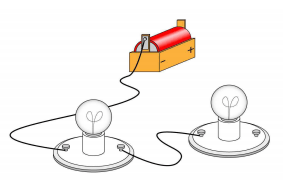
A wire needs to be added between the light bulb and the battery to open the circuit.
A load needs to be added next to the battery to produce less energy.
A wire needs to be added between the light bulb and the battery to close the circuit.
A load needs to be added next to the battery to produce more energy.
What's one example of a powerful electrical charge?
lightening
fire
tornado
flashlight
Protons have a ______ charge.
Positive
Negative
Neutral
When you get shocked by touching a doorknob, that's an example of ___________________.
current electricity
static electricity
Turning on a light in your house is an example of
static electricity
current electricity
Static electricity is when_________________
electrons jump from one thing to another
magic happens
electrons flow through a wire
What would cause two balloons to repel?
one is positive and one is negative
both balloons are positive
both balloons are negative
one balloon is positive and one is neutral

If the balloon has a negative charge, the hair must have what charge?
negative
positive
neutral
_______ is when there is a buildup of charges (more of one type of charge) on an object.
static electric discharge
static electricity
current electricity
What can cause electrons to jump across a gap and cause a spark?
rubbing two coins together
charging a battery
an imbalance of charges between surfaces
True/False: static electricity powers your appliances
True
False
True/False: Static and current are two ways in which electrical charges can behave. Current is produced by the apparent motion of electrons along a conductor
True
False
What happens when you touch a metal doorknob after rubbing your shoes on the carpet?
The doorknob sends a burst of electric current into your body
Millions of electrons go from your finger into the doorknob
The doorknob sends millions of electrons into your finger
Your finger becomes negatively charged
An object that is neutral contains the same number of electrons and protons.
True
False
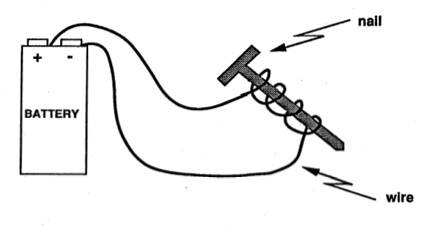
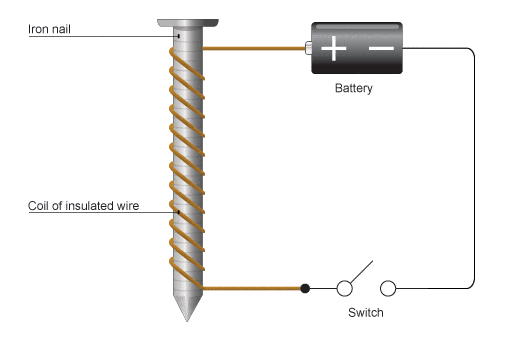
How do you increase the strength of an electromagnet?
add more magnets
larger core
increase the number of coils around the core
salt water
True or False: When energy is flowing through a wire a magnetic field is created.
True
False
Like regular magnets, electromagnets have a...
north and south pole
a charge
power
consistent magnetic field
Min tapes a piece of string to each of two ping-pong balls. He hangs the balls so that they are close to one another but do not touch. Later, he finds that they have pulled together. They are now touching. What could explain why the two balls are now touching?
They have both lost their charges.
They have gained opposite charges.
They have both gained a positive charge.
They have both gained a negative charge.
Curtis uses a wool cloth to give a balloon a negative charge. What will happen when he holds the balloon near the wall, and why?
The balloon will stick to the wall because a negatively charged object is attracted to an uncharged object.
The balloon will stick to the wall because a negatively charged object is attracted to another negatively charged object.
The balloon will not stick to the wall because a negatively charged object is repelled by an uncharged object.
The balloon will not stick to the wall because a negatively charged object is repelled by another negatively charged object.
A material that allows an electric current to flow through it is an electrical conductor. A material through which an electric current cannot flow easily is called an insulator. Which statement best describes the difference between an insulator and a conductor?
An insulator has a static charge, and a conductor does not.
A conductor contains more electrons than an insulator.
A conductor is a metal, and an insulator is any material that is not a metal.
An insulator does not have electrons that are free to move, and a conductor does.
You use energy transformations every day. Which of these is a way that you would use the transformation of electrical energy into motion energy?
watching your favorite show on television
taking an elevator to the top of a tall building
listening to your MP3 player while you walk to school
turning on the lamp on your desk so you can see to do your homework
Suppose you built an electric circuit that included a light bulb. Which would be empirical evidence to support the analysis that the circuit was complete?
The bulb would produce light and heat.
The bulb would not produce light or heat.
The bulb would produce light but not heat.
The bulb would produce heat but not light.

A student makes a model of a circuit, as shown.
The student observes that when the switch is closed, the bulb lights up, and when a piece of paper is held against the bulb for 10 minutes, burn marks form. Based on the observations, which conclusion can the student draw?
Heat energy produces electrical energy.
Chemical energy in batteries is stored as heat.
Chemical energy is released as heat and light energy in circuits.
Heat energy is released as chemical and light energy in circuits.

