
Font size
 Worksheets
Ashley Australia cambridge global 4 part 2
Total questions: 27
Worksheet time: 19mins
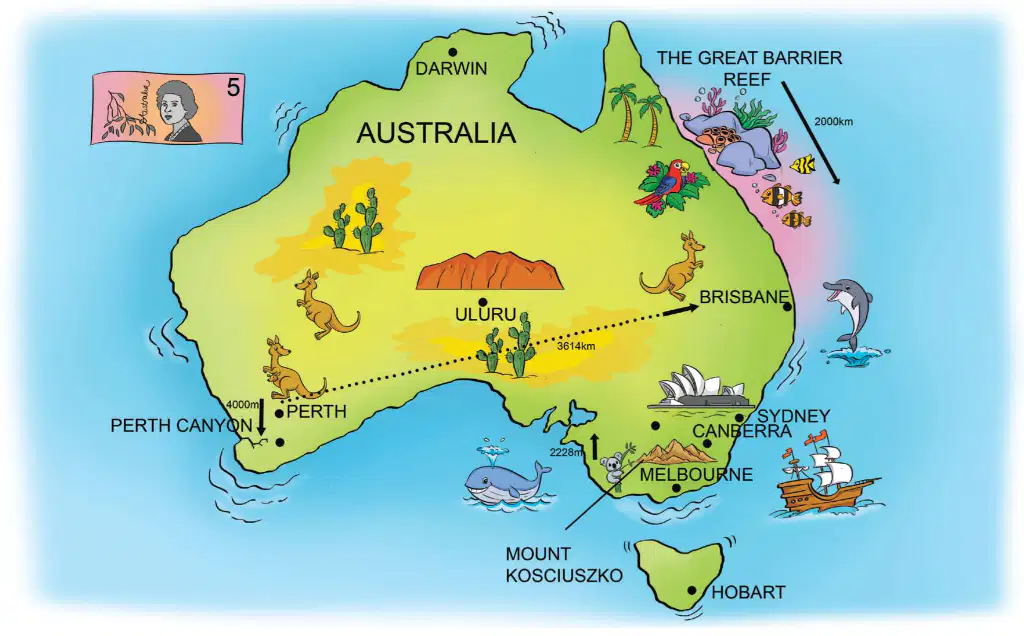
Which geographical feature is represented by the Great Barrier Reef?
a) Mountain range
b) Coral reef
c) Desert
d) Coast
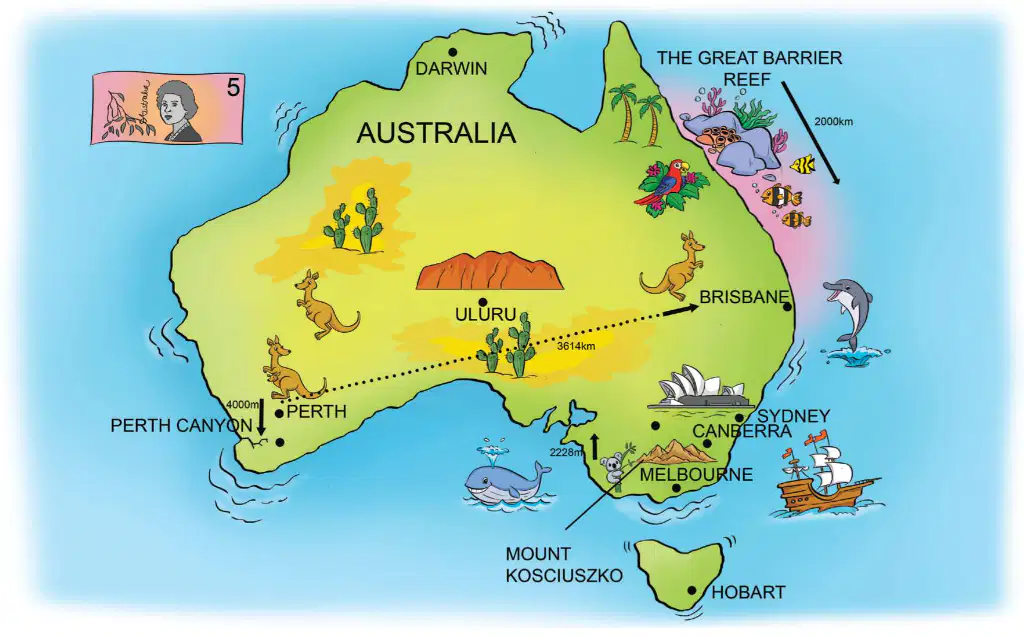
Which of these is a famous rock formation in Australia?
a) Mount Kosciuszko
b) Perth Canyon
c) Uluru
d) Great Barrier Reef

Which geographical feature is located in the center of Australia?
a) Mount Kosciuszko
b) The Great Barrier Reef
c) Uluru (Ayer's Rock)
d) Perth Canyon

What is the highest peak in Australia?
a) Mount Kosciuszko
b) Uluru
c) The Great Barrier Reef
d) Perth Canyon
Match the following
The world's largest coral reef located in the northeast
The Great Barrier Reef
A famous rock formation in the center of Australia
Uluru (Ayer’s Rock)
The highest peak in New South Wales
Mount Kosciuszko
A deep underwater valley on the east coast
Perth Canyon
A dry, hot area that covers 20% of Australia
The Desert

What is the population of Australia?
a) 10 million
b) 25 million
c) 50 million
d) 100 million
Which of the following is TRUE about the Great Barrier Reef?
a) It is a rock formation in the center of Australia.
b) It is the largest coral reef in the world.
c) It is a mountain range in New South Wales.
d) It is a deep underwater canyon.
Match the following
The measurement of something from end to end
Length
The distance across something from one side to the other
Width
The distance from the top to the bottom of something
Height
The distance down from the top of something to the bottom
Depth

Match the following
The population of Australia
25,000,000
Australia's rank as the largest country in the world
6th
The total land mass of Australia
7,700,000 square metres
People in Australia were born in other countries
1/5
How many people live in Australia?
🔘 2.5 million
🔘 25 million
🔘 205 million
How many people live in Indonesia?
100 million
277 million
350 million
What is Australia’s landscape like?
🔘 Mountainous
🔘 Mostly desert
🔘 It changes across the country.
What is Indonesia’s landscape like?
🔘 Mostly desert
🔘 Tropical islands with mountains, rainforests, and beaches.
🔘 Completely flat with no mountains
What is Uluru?
🔘 It’s a rock formation.
🔘 It’s a mountain.
🔘 It’s a building.
Is there a famous rock formation in Indonesia?
🔘 Yes, like Mount Kelimutu and Belitung’s granite rock formations.
🔘 No, Indonesia only has mountains.
🔘 Indonesia has only deserts.
_______________ grow very slowly. Large reefs grow at the rate of 1 to 2 cm per year. Some of the largest reefs took as long as 30 million years to form!
🔘 Deserts
🔘 Mountain range
🔘 Coastline
🔘 Coral reefs
Giant’s Causeway in Northern Island is a _______________ of 40,000 columns made from a volcanic eruption. Some columns are 25 metres high!
🔘 Mountain range
🔘 Rainforest
🔘 Coastline
🔘 Rock formation
About 50% of the world’s plants and animals live in _______________. The Amazon Rainforest has over 2.5 million different types of insects! It has lots of amazing animals too, including jaguars, monkeys, snakes, frogs, lizards, turtles, and some very dangerous fish!
🔘 Rock formations
🔘 Rainforests
🔘 Mountain ranges
🔘 Deserts
The world’s largest _______________ is about 65,000 km long. It is called the Mid-Ocean Ridge and 90% of its mountains are under the sea!
🔘 Desert
🔘 Coral reef
🔘 Mountain range
🔘 Coastline
Some _______________ are so dry that they only get 2 mm of rain a year! Some plants don’t have fresh water for several years, so they grow very long roots to find water from deep underground.
🔘 Rainforests
🔘 Coral reefs
🔘 Deserts
🔘 Coastlines
The shortest _______________ in the world is in Monaco, a small nation in Europe. It is only about 4 km long! Monaco is not very wide at all – if you walk fast, you could walk it in less than 1 hour!
🔘 Coral reef
🔘 Coastline
🔘 Rainforest
🔘 Desert
Match the Noun with Its Adjective
Height
High
Width
Wide
Length
Long
Depth
Deep
Match the Numbers with Their Facts
30 million
The number of years it took for some cor
65,000 km
The length of the Mid-Ocean Ridge
50%
The percentage of the world’s plants and
2 mm
The amount of rain some deserts receive

Why is the year 50,000 BCE important in Australian history?
It was the year the British formed New South Wales.
It was when the ancestors of Aboriginal people first lived in Australia.
It was the year the Commonwealth of Australia was formed.
It was when Canberra became the capital city of Australia.

What happened in the 17th century (1600–1700) in Australia?
The Australian flag was designed.
Spanish, Dutch, Portuguese, and British explorers first saw Australia from their ships.
The Commonwealth of Australia was formed.
People started farming sheep and crops.

What significant event happened in 1901 in Australia?
The Commonwealth of Australia was formed, and there was a competition to design the Australian flag.
The ancestors of the Aboriginal people arrived in Australia.
The first European explorers saw Australia.
Gold was discovered, leading to economic growth.

Why is the year 1927 important in Australian history?
Australia became an independent country.
The first European settlers arrived.
Canberra became the capital city of Australia.
The Aboriginal people established their first settlements.

