
 Worksheets
Exploring Earth's Layers and Spheres
Total questions: 38
Worksheet time: 25mins
What is the outermost layer of the Earth called?
Mantle
Core
Crust
Inner Core
Which type of rock is formed from the cooling and solidification of magma or lava?
Sedimentary
Metamorphic
Igneous
Fossil
What process describes the transformation of rocks from one type to another over time?
Erosion
Rock Cycle
Weathering
Sedimentation
Which layer of the Earth is composed mostly of liquid iron and nickel?
Crust
Outer Core
Mantle
Inner Core
Which sphere of the Earth includes all living organisms?
Atmosphere
Hydrosphere
Biosphere
Geosphere
What is the main component of the Earth's atmosphere?
Oxygen
Nitrogen
Carbon Dioxide
Argon
How does sedimentary rock typically form?
By cooling of magma
By heat and pressure
By compaction and cementation of sediments
By melting
Which process is responsible for the breakdown of rocks into smaller pieces?
Melting
Weathering
Erosion
Deposition
How does the hydrosphere interact with the atmosphere?
By forming mountains
Through the water cycle
By creating earthquakes
Through volcanic eruptions
Which type of rock can be transformed into metamorphic rock?
Only igneous rock
Only sedimentary rock
Only other metamorphic rock
Any type of rock
Explain how the rock cycle contributes to the formation of different types of rocks.
It involves only the cooling of magma.
It includes processes like melting, cooling, erosion, and compaction.
It only involves the weathering of rocks.
It is a one-step process.
Why is the geosphere important for life on Earth?
It provides oxygen for breathing.
It contains water for drinking.
It provides minerals and nutrients for plants.
It reflects sunlight.
Describe how human activities can impact the biosphere.
By increasing the amount of sunlight.
By altering habitats and polluting environments.
By changing the Earth's orbit.
By creating new species.
How do tectonic plate movements affect the Earth's surface?
They cause the Earth to shrink.
They create mountains, earthquakes, and volcanoes.
They make the Earth spin faster.
They have no effect on the Earth's surface.
What role does the atmosphere play in protecting life on Earth?
It provides a solid surface to walk on.
It blocks harmful solar radiation and regulates temperature.
It creates new landforms.
It stores all the Earth's water.

Which layer of the Earth is liquid Iron and Nickle?
Crust
Mantle
Outer Core
Inner Core

What is the thickest layer of the Earth?
Crust
Mantle
Outer Core
Inner Core
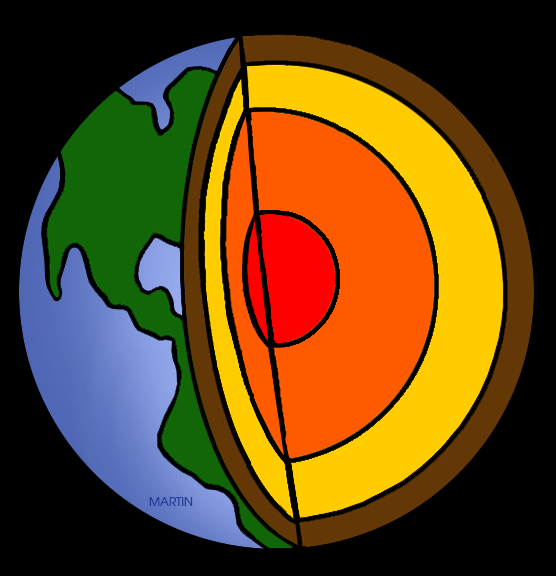
Which layer is shown in yellow?
crust
mantle
outer core
inner core
Igneous rocks form from weathered rock particles.
true
false
The melted form of rocks underground it called?
Lava
Igneous rocks
Magma
Metamorphic rocks
Which of the following statements is true about the rock cycle?
Sedimentary rock can be changed only to metamorphic rock
Any rock can be changed into any other type of rock
Igneous rock can be changed to only sedimentary rock


Which type of rock are fossils found in?
Igenous
Sedimentary
Metamorphic


the layer of gas surrounding planet Earth, containing gases such as nitrogen and oxygen
hydrosphere
biosphere
atmosphere
geosphere
all the water in the air, oceans, rivers, lakes, ice caps, soil, rocks, and organisms of Earth
geosphere
biosphere
hydrosphere
atmosphere
the sum of all living matter
biosphere
atmosphere
hydrosphere
geosphere
sand or small pieces of rock broken down by weathering and deposited on land or in water
landforms
molten rock
magma
sediments
If a deer was drinking from a pond, what two spheres would be interacting?
Hydrosphere and Atmosphere
Geosphere and Biosphere
Biosphere and Hydrosphere
Atmosphere and Geosphere
What does Geo mean?
Water
Air
Ground
Gas
Bio means:
Happy
Water
Ground
Life
A hurricane destroys a forest. What two spheres are interacting?
Hydrosphere and Biosphere
Hydrosphere and Atmosphere
Atmosphere and Geosphere
Biosphere and Geosphere


This rock was formed by smaller pieces of rock that settled at the bottom of a lake millions of years ago. What type of rock is this?
Sedimentary
Igneous
Metamorphic

According to the diagram, what process is shown by letter B?
compaction & cementation
weather & erosion
heat & pressure
melting
According to the diagram, what process is shown by letter B?
compaction & cementation
weather & erosion
heat & pressure
melting
If a lot of heat is applied to a rock, it will turn into
magma
rocks
sediment
metamorphic rocks

