
 Worksheets
Chapter 4 Solids, Liquids, gases
Total questions: 58
Worksheet time: 1hrs 4mins
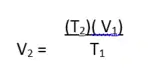
(Charles Law) There are 40 liters of helium in a balloon at 100 K. If the temperature of the balloon is increased to 200 K, what will the new volume of the balloon be?
Formula to use is to the left
80 L
45 L
54 L
45.33 L
What is the formula for Boyle's Law?
P1V1=P2V2
P1V1/P2V2
P1V2=P2V1
P1/V1=P2/V2
In Boyle's Law, when the pressure increases then the volume must...
not change
In Boyle's Law, what type of relationship exists between pressure and volume?
directly proportional
inversely proportional
There is no relationship
This type of soilds have ordered internal structures.
Crystalline solids
Amorphous solids
Pseudo solids
Supercooled liquids
What is an amorphous solid?
Solid that does not has ordered internal structure
Solid that has a crystal lattice
Solid that cannot change its state
Halite is a crystalline solid. Which means
Its structure is not symmetrical
It exhibits isotropy
It can be compressed
It has a sharp melting point
What does it mean when a solid has a sharp melting point?
It will turn into a gaseous state at a defined value of temperature
It will melt over a range of temperature
It will completely melt at a fixed value of temperature
It will have sharp edges before it turns to liquid
Cotton candy is a/an..
amorphous solid that has an unsymmetrical lattice pattern
amorphous solid that has a symmetrical lattice pattern
crystalline solid that has an unsymmetrical lattice pattern
crystalline solid that has a symmetrical lattice pattern

Butter on a hot pancake is an example of?
Freezing
Melting
Condensation
Freezing
During sublimation, particles of a solid....
do not pass through the liquid state as they form a gas.
do not pass go and collect $200.
do pass through the liquid state as they form a gas.
change from a warm liquid to a cold liquid or similar to snowcones.
The phase when the reverse of vaporization or the change in state from a gas to a liquid is called...
evaporation
precipitation
condensation
sublimation


If a hairspray can is heated, what can be expected of the pressure of the gas inside the can?
The pressure will increase
The pressure will decrease
The pressure will remain constant
The pressure will equalize
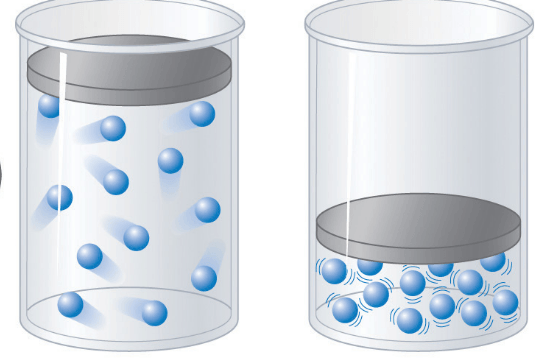
The burner of a hot air balloon start heating the air inside the envelope. This continues heating the air, until the balloon inflates all the way & starts to lift off the ground. What happens to the pressure of the balloon as it is being inflated?
Increases
Decreases
You shake a can of soda & then open it, decreasing its pressure. What happens to the volume of the carbon dioxide in the soda?
Increase
Decrease

Which law is represented by the image of the ping pong ball?

Which law is represented by the expanding marshmallows?
Boyle
Charles
Landis
Boykin
in an orderly fashion
constantly and in random straight lines
in straight lines in one direction only
in a circular motion
Define crystalline solid
A solid in which the atoms CANNOT be changed.
A regular repeating, three-dimensional structure of atoms that form a crystal lattice.
A pure solid that can conduct electricity.
A pure solid that has a defined melting and boiling point.
One major difference between crystalline and amorphous solids is that
crystalline solids have a true melting point, while amorphous solids do not.
amorphous solids have a lattice structure.
amorphous solids always behave consistently and uniformly.
crystalline solids break unpredictably and can produce curved fragments.
Solids whose particles are not arranged in any particular pattern
Amorphous
Crystalline
Concentrated
Dilute
What are the 2 things that determine whether something is a solid, liquid, or a gas?
the color of the matter
the motion of the particles in the matter
the forces between the particles of matter
the matter's ability to react with other matter
When particles in matter move faster, they move farther apart. What happens to the attractive forces holding the particles together?
the attractive forces get stronger
the attractive forces get weaker
the attractive forces do not change
there is not enough information to answer this question
Which of the following are properties of a solid? There is more than one correct answer.
definite shape
definite volume
particles are packed tightly together
attractive forces between particles are strong
What are the 2 types of solids?
crystalline solids
metalloid solids
noble solids
amorphous solids
What are 2 examples of crystalline solids?
diamonds
glass
table salt
rubber
Which has higher viscosity: a liquid that flows very quickly, or a liquid that flows very slowly?
a liquid that flows very slowly
a liquid that flows very quickly
In which state of matter are particles moving the fastest?
solid
liquid
gas
If the temperature of matter increases, what will happen to the attractive forces between particles?
the attractive forces will get weaker because the particles will start moving faster
the attractive forces will get stronger because the particles will start moving slower
If it takes the same amount of one liquid longer to pour than the same amount of another liquid, is its viscosity higher or lower?
higher
lower
What is the property of a liquid that allows certain bugs to literally walk on water?
viscosity
surface tension
evaporation
flammability
The motion of gas particles is described as
constant
rapid
random
all of these
When gas particle collide
both particles lose some energy
no energy is lost or gained
both particles gain some energy
An example of an amorphous solid is
table salt
diamond
glass
ice
The phase change solid--> gas is
vaporization
crystallization
sublimation
condensation

