
 Worksheets
HOMS Review: Waves
Total questions: 67
Worksheet time: 1hrs 6mins
_____ is a repeated disturbance caused by vibrations that carry energy from place to place.
Matter
Energy
Wave
Medium
What does a wave carry from place to place?
energy
matter
people
These are solids, liquids, or gases that waves are able to travel through.
Energy
Medium
Vacuum
______ is empty space and only light waves are able to travel through.
Medium
Air
Vacuum
A wave that can travel through matter and empty space is a:
electromagnetic (light) wave
longitudinal wave
transverse wave
The highest point on a wave is:
crest
trough


What is frequency?
Highest point of a wave
Lowest point of a wave
the number of complete wavelengths that pass a point in a given time
Anything that has mass and takes up space
When a wave hits a smooth surface, and it cannot pass through it. The wave bounces back. This is known as...
Reflection
Pulse rate
Trough
Mechanical Wave
What is a wave?
Material through which a wave travels
a disturbance that transfers energy from place to place
the number of beats per minute; speed
Anything that has mass and takes up space
The distance from any point on a wave to an identical point on the next wave is called?
crest
node
wavelength
trough
The maximum distance that the particles of a wave's medium vibrate from their rest position is called?
altitude
longitude
amplitude
frequency
Frequency is
the medium in a direction perpendicular to the direction in which the wave travels
the vibration of the medium is parallel to the direction the wave travels
the distance from any point on a wave to an identical point on the next wave
the number of complete wavelengths that pass a point in a given time


Which wave has the shortest wavelength?
1
2
3
4

Which wave has highest frequency?
A
B
C
D

Which wave is carrying more energy?
The blue wave because it has a larger amplitude.
The blue wave because it has higher frequency.
The red wave because it has higher amplitude.
The red wave because it has higher frequency.
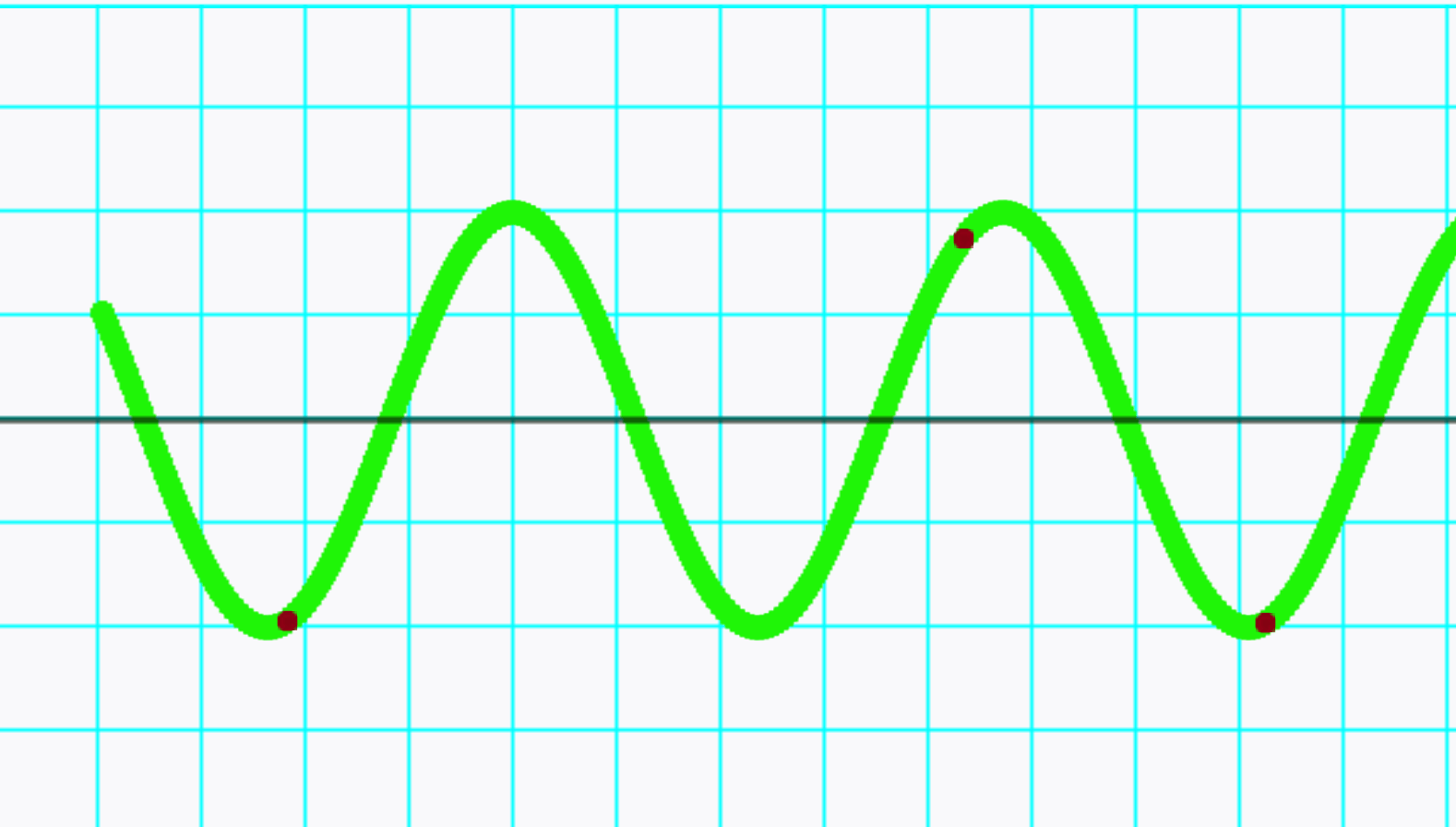
If each square represents one cm, what is the approximate wavelength of this wave? (To the nearest cm)
1 cm
2 cm
4 cm
8 cm
Sound waves must travel through ___________________.
air
a medium
an outward area
a short
Sound waves can NOT travel through
Air
Water
Earth
space
What is the source of a sound wave?
Electricity
Vibration
Light waves
Tiny nuclear explosions


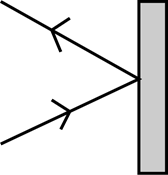
In the illustration, the light ray striking the object is-


Reflection is to bouncing as refraction is to:
bending.
breaking.
dissipating.
halting.
When a light ray strikes a smooth, flat surface, what is the relationship between the angle of incidence and the angle of reflection?
They are equal.
The angle of incidence is twice that of the angle of reflection.
The angle of reflection is twice that of the angle of incidence.
They combine to add up to 180o.

In this diagram, which is the angle of incidence?
Angle A
Angle B
Angle C
Angle D
What is it called when light waves enter a substance?
refraction
reflection
energy
absorption
The wave of energy we can see is ___________
visible light
radio waves
microwaves
x-rays
When light bounces off something it is known as _____________
reflection
refraction
light energy
mechanical energy
The definition of the word refract is __________
to make warm
to go through
to bend
to create energy
What color of the rainbow has the longest wavelength?
red
blue
green
violet

What is the relationship between frequency and wavelength?
high frequency --> short wavelength
high frequency --> long wavelength
low frequency --> short wavelength
there is no relationship

Which type of light has the highest frequency of this group (be careful of the order!)?
red
yellow
green
blue


How does a concave lens differ from a convex lens?
A convex lens is another way to describe a plane mirror; a concave lens is curved
A concave lens is curved inward on both sides; a convex lens is on only one side
A convex lens has a thick center and thin edges, a concave lens has a thin center and thicker edges
A convex lens has a thin center and thick edges. a concave lens has a thick center and thinner edges
Light travels
in a straight line until it strikes an object
in a wavy line and continues when it hits an object
in a straight line and through every object
How do humans see different wavelengths?
as different colors
as ultraviolet light
as infrared rays


How does light behave when hitting this shirt?
Yellow is absorbed; all other colors are reflected.
Yellow is reflected; all other colors are absorbed.
All colors are absorbed, but yellow is refracted.
Yellow is scattered and all other colors are absorbed.
Which colors make up white light?
Red, Orange, and Yellow
All colors
Reds and Violets

Which part of the wave is shown at letter A?
amplitude
crest
trough
wavelength

Which part of the wave is shown in letter D?
amplitude
crest
trough
wavelength

What kind of wave behavior is shown?
diffraction
reflection
refraction
total internal reflection
When refraction occurs, light waves __.
change color
change direction
change wavelength
Which type of lens can magnify an object and is used in magnifying hand lenses?
concave
plane
convex
Which diagram shows light rays being reflected by the mirror?


A lens uses ____ to change the image.
Reflection
Absorption
Refraction
Reflection

