
 Worksheets
5th Year Maths Resource
Total questions: 100
Worksheet time: 1hrs 5mins
Emma is building a small wooden box in the shape of a cube for her art project. What is the formula to measure the volume of the cube?
V = side^2
V = 6 * side
V = 4/3 * π * radius^3
V = side^3
Ethan is building a small box with a side length of 3 centimetres. What is the volume of the box?
12 cubic centimetres
27 cubic centimetres
36 cubic centimetres
9 cubic centimetres
Benjamin is designing a cylindrical water tank for his garden. How do you calculate the volume of the tank?
V = 2πrh
V = πr²h
V = 4/3πr³
V = πr² + h
Charlotte is making a cylindrical vase with a radius of 2 centimetres and a height of 5 centimetres. What is the volume of the vase?
30π cubic centimetres
20π cubic centimetres
10π cubic centimetres
15π cubic centimetres
Emma is making a recipe that requires 2 litres of milk. How many millilitres of milk does she need?
2500 millilitres
1500 millilitres
2000 millilitres
1000 millilitres
Oliver is making a recipe that requires 1 litre of milk. How many millilitres of milk does he need to use?
250 millilitres
1500 millilitres
1000 millilitres
500 millilitres
Nora has a bottle that contains 500 ml of water. How many litres of water does she have?
250 ml
0.5 litres
1 litre
0.25 litres
Aiden is building a small box-shaped planter for his garden. If each side of the planter is 4 centimetres long, what is the volume of the planter?
64 cubic centimetres
32 cubic centimetres
48 cubic centimetres
80 cubic centimetres
Henry is designing a cylindrical container that needs to hold a volume of 30 cm³. If the height of the container is 5 cm, what is the radius of the base?
2.50 cm
3.14 cm
1.00 cm
1.24 cm
Harper has a water bottle that holds 2 litres of water. How many millilitres of water can the bottle hold?
Multiply the number of litres by 100.
Add 1000 to the number of litres.
Divide the number of litres by 10.
Multiply the number of litres by 1000.
Mia is making a fruit punch for a party. She pours 1.5 litres of juice into a large bowl. How many millilitres of juice did she pour?
1000 millilitres
2000 millilitres
750 millilitres
1500 millilitres
Lily is packing a gift box that measures 10 cm by 5 cm by 2 cm. What is the volume of the box?
200 cm³
50 cm³
100 cm³
80 cm³
Priya is designing a cylindrical water tank for her garden. The tank has a diameter of 10 centimetres and a height of 10 centimetres. What is the volume of the tank?
250π cm³
300π cm³
200π cm³
100π cm³
David has a 1 litre bottle. If he pours 250 ml of water into it, how much space is left in the bottle?
250 ml
1 litre
750 ml
500 ml
Ava is filling up her new aquarium, which has a volume of 60 litres. How many millilitres of water does she need to fill it completely?
60 millilitres
6000 millilitres
60000 millilitres
600000 millilitres
Michael is designing a spherical fish tank with a radius of 3 centimetres. What is the volume of the tank?
36π cubic centimetres
27π cubic centimetres
4/3π cubic centimetres
9π cubic centimetres
Evelyn is building a rectangular sandbox for her backyard. If the sandbox has dimensions 4 cm by 3 cm by 2 cm, what is its volume?
18 cm³
12 cm³
20 cm³
24 cm³
Anika has a water bottle that can hold 0.75 litres of water. How many millilitres of water can the bottle hold?
500 millilitres
1000 millilitres
750 millilitres
250 millilitres
Lucas is creating a cylindrical candle with a radius of 3 cm and a height of 10 cm. What is the volume of the candle?
120π cubic centimetres
60π cubic centimetres
30π cubic centimetres
90π cubic centimetres
Sophia is filling a rectangular swimming pool that measures 8 m by 4 m by 2 m. What is the volume of the pool?
16 cubic metres
80 cubic metres
32 cubic metres
64 cubic metres
James has a spherical balloon with a radius of 5 cm. What is the volume of the balloon?
250/3π cubic centimetres
125π cubic centimetres
100π cubic centimetres
500/3π cubic centimetres
What is the formula for calculating the volume of a cube?
V = s^2
V = 6s
V = 4s
V = s^3
How do you find the volume of a cylinder?
V = πr²h
V = 2πrh
V = πd²h/4
V = 4/3πr³
What unit is commonly used to measure volume?
meters
grams
seconds
liters
What is the volume of a sphere formula?
V = 2πr²
V = πr²h
V = (1/3)πr²h
V = (4/3)πr³
How does the volume of a rectangular prism differ from that of a cube?
The volume of a rectangular prism can vary based on its dimensions, while a cube has a fixed volume based on the length of its equal sides.
A cube can have varying volumes depending on its dimensions.
The volume of a rectangular prism is always larger than that of a cube.
Both shapes have the same volume regardless of their dimensions.
What is the relationship between area and volume?
Area measures the volume of a shape.
Area is a measure of two dimensions, while volume is a measure of three dimensions.
Volume is always larger than area.
Area and volume are the same concept.
How do you convert cubic centimeters to liters?
Add 1000 to the cubic centimeters.
Divide the cubic centimeters by 1000.
Convert cubic centimeters to milliliters first.
Multiply the cubic centimeters by 1000.
What is the volume of a cone formula?
V = π * r² * h
V = (1/3) * π * r² * h
V = π * r² * (h + 1)
V = (1/2) * π * r² * h
How can you calculate the volume of an irregular shape?
Measure the weight and divide by density.
Estimate based on the shape's appearance.
Use the water displacement method to measure the volume.
Use a ruler to measure each side and multiply.
What is the significance of volume in real-world applications?
Volume is significant for capacity measurement, material requirements, and space utilization in various fields.
Volume has no impact on construction projects.
Volume is irrelevant in scientific research.
Volume is only important in cooking recipes.
What is the formula for calculating the volume of a cube?
V = s^2
V = 6s
V = 4s
V = s^3
How do you find the volume of a cylinder?
V = πr²h
V = 2πrh
V = πd²h/4
V = 4/3πr³
What unit is commonly used to measure volume?
meters
grams
seconds
liters
What is the volume of a sphere formula?
V = 2πr²
V = πr²h
V = (1/3)πr²h
V = (4/3)πr³
How does the volume of a rectangular prism differ from that of a cube?
The volume of a rectangular prism can vary based on its dimensions, while a cube has a fixed volume based on the length of its equal sides.
A cube can have varying volumes depending on its dimensions.
The volume of a rectangular prism is always larger than that of a cube.
Both shapes have the same volume regardless of their dimensions.
What is the relationship between area and volume?
Area measures the volume of a shape.
Area is a measure of two dimensions, while volume is a measure of three dimensions.
Volume is always larger than area.
Area and volume are the same concept.
How do you convert cubic centimeters to liters?
Add 1000 to the cubic centimeters.
Divide the cubic centimeters by 1000.
Convert cubic centimeters to milliliters first.
Multiply the cubic centimeters by 1000.
What is the volume of a cone formula?
V = π * r² * h
V = (1/3) * π * r² * h
V = π * r² * (h + 1)
V = (1/2) * π * r² * h
How can you calculate the volume of an irregular shape?
Measure the weight and divide by density.
Estimate based on the shape's appearance.
Use the water displacement method to measure the volume.
Use a ruler to measure each side and multiply.
What is the significance of volume in real-world applications?
Volume is significant for capacity measurement, material requirements, and space utilization in various fields.
Volume has no impact on construction projects.
Volume is irrelevant in scientific research.
Volume is only important in cooking recipes.
V represents...
Volume
Variable
Vertical
Vegetable

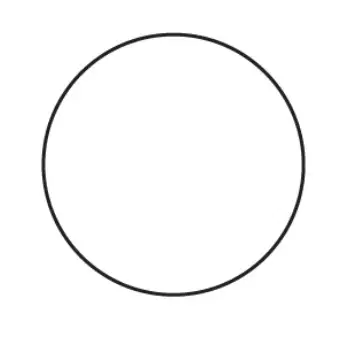
Name the pictured part of the circle.
Diameter
Sector
Radius
Central Angle
Arc

This is a triangular prism. What would the big B be for this shape?
bh
Bh
1/2bh
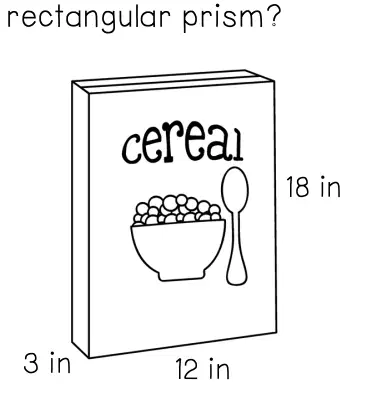
What would big B represent for this rectangular prism?
bh
Bh
1/2bh
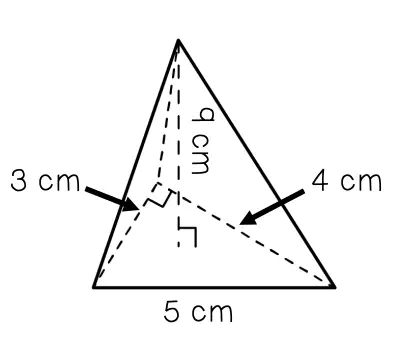
This is a triangular pyramid. What would be the big B for this shape?
bh
Bh
1/2bh
πrr
Match the following
Complementary Angles
90 degrees
Supplementary Angles
180 degrees
Area of a Circle Formula
πrr
Circumference of a Circle Formula
2πr
Big B
area of the base
πr² really means πrr
πr² really means πr times 2
Match each to the correct formula.
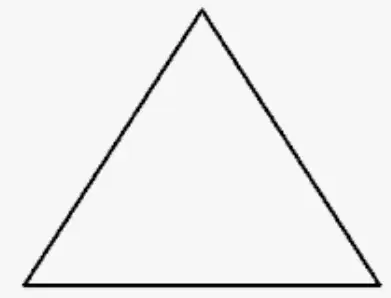
B=1/2bh
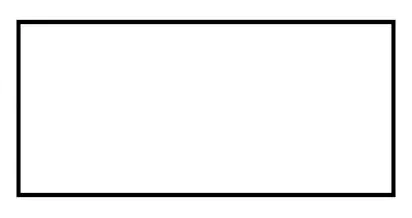
B=bh
A=πrr
Pyramid
V=1/3Bh
Prism
V=Bh
Complementary angles add up to 180 degrees.
Supplementary angles (a) up to (b)

B for the following shape is
B=1/3bh
B=1/2bh
B=bh
B=1/2(b+b)h

B for the following shape is
B=1/3bh
B=1/2bh
B=bh
B=1/2(b+b)h
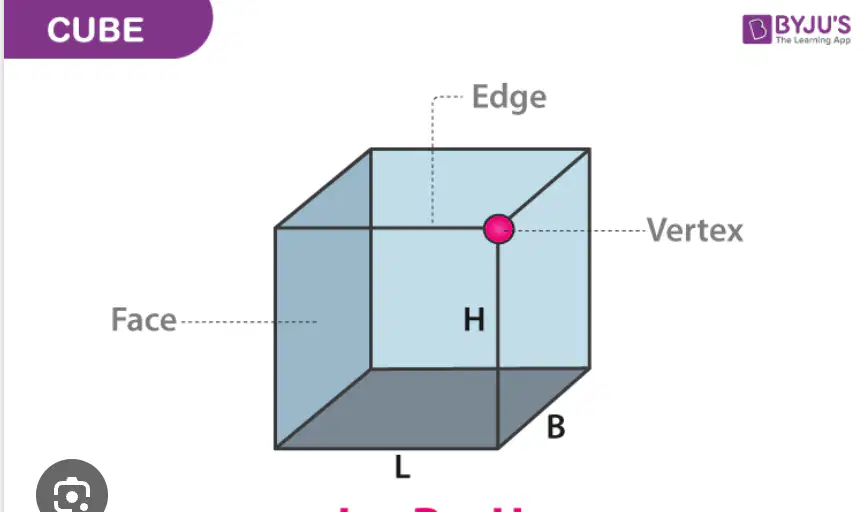
B for the shape is
B=1/3bh
B=1/2bh
B=bh
B=1/2(b=b)h

Which of the following formulas would be used to find the area of the base?
A=bh
A=21bh
V=Bh
V=31Bh

Volume of Rectangular prisms are calculated...
Base Area of a rectangle x Height of the prism
Base Area of a triangle x Height of the prism
Volume of Triangular prisms are calculated...
Base Area of a rectangle x Height of the prism
Area of a triangle x Height of the prism

Triangular prism and Triangular pyramid; both have bases as Triangles
True
False

For calculating the VOLUME of Pyramids...
Base Area x height, then divide it with 3
Base Area x height
Length x width
base x height divide it with 2
Both prisms and pyramids are named for their
vertices
edges
base(s)
faces
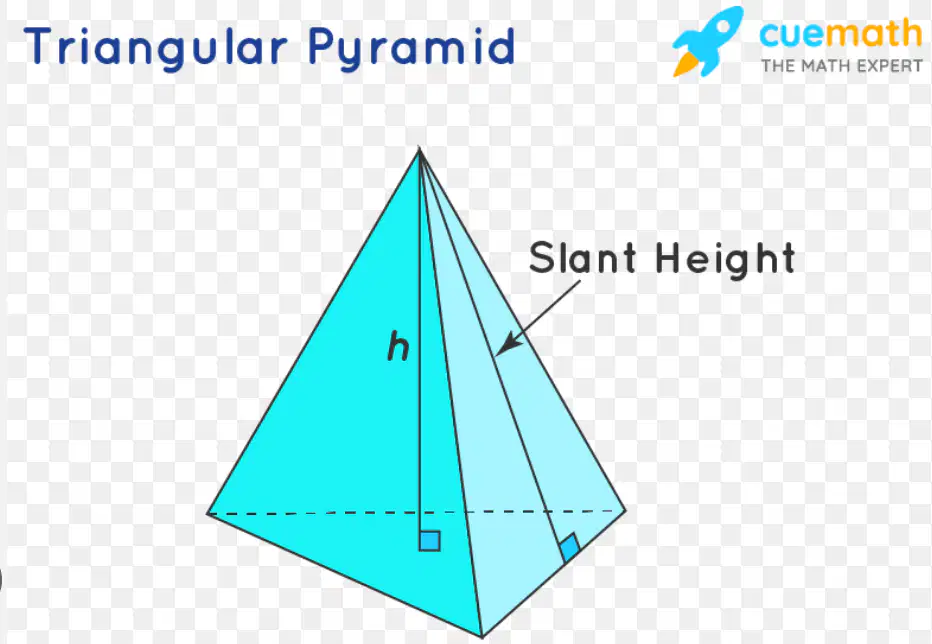
V= 1/3 (a) h

What formula do you need for a triangular prism?
V=1/2bhh
V=1/3bhh
V=1/2bh
V=bhh
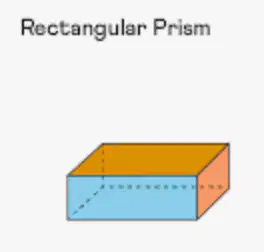
What formula do you need for a rectangular prism?
V=1/2bhh
V=bhh
V=1/3bhh
V=1/3(1/2)bhh

What formula do you need for a triangular pyramid?
V=1/2bhh
V=1/3bhh
V= 31 21 bhh
V=bhh
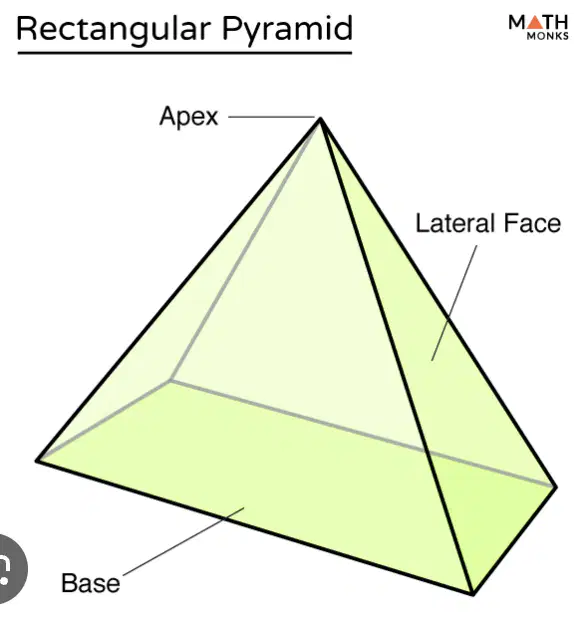
What formula would you use for a rectangular pyramid?
V=1/2bhh
V=1/3bhh
V= 31 21 bhh
V=bhh

What formula would you use for a cube?
V=1/2bhh
V= 31 21 bhh
V=bhh
V=1/3bhh

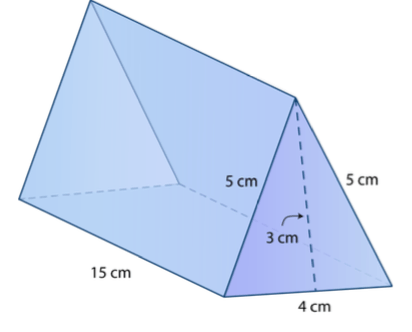


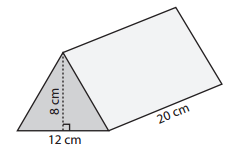
What is the formula for calculating density?
Density = Mass × Volume
Density = Mass ÷ Volume
Density = Volume ÷ Mass
Density = Mass + Volume
Which of the following units is commonly used to express density?
Kilograms (kg)
Meters (m)
Kilograms per cubic meter (kg/m³)
Liters (L)
If a substance has a mass of 200 grams and a volume of 50 cm³, what is its density?
2 g/cm³
4 g/cm³
5 g/cm³
6 g/cm³
Which of the following statements is true about the density of water?
The density of water is 1 g/cm³ at 4°C.
The density of water is 1 kg/m³ at 4°C.
The density of water is 10 g/cm³ at 4°C.
The density of water is 0.1 g/cm³ at 4°C.
A block of wood has a density of 0.6 g/cm³. Will it float or sink in water, and why?
Sink, because its density is greater than water.
Float, because its density is less than water.
Sink, because its density is less than water.
Float, because its density is greater than water.
How does temperature generally affect the density of a substance?
Density increases as temperature increases.
Density decreases as temperature increases.
Density remains constant as temperature increases.
Density fluctuates randomly as temperature increases.
A metal cube has a side length of 3 cm and a mass of 81 grams. What is its density?
3 g/cm³
9 g/cm³
27 g/cm³
1 g/cm³
Explain why ice floats on water.
Ice is heavier than water.
Ice has a higher density than water.
Ice has a lower density than water.
Ice and water have the same density.
If two objects have the same volume but different masses, which one will have a higher density?
The one with the higher mass.
The one with the lower mass.
Both will have the same density.
Density cannot be determined from mass and volume.
A liquid has a density of 0.8 g/cm³. If you pour it into water, what will happen?
It will sink to the bottom.
It will float on top.
It will mix evenly with water.
It will evaporate immediately.
Which of the following materials is likely to have the highest density?
Air
Water
Iron
Wood
A piece of metal has a mass of 300 grams and displaces 100 cm³ of water when submerged. What is the density of the metal?
1 g/cm³
2 g/cm³
3 g/cm³
4 g/cm³
Why is density an important property in identifying substances?
It determines the color of the substance.
It helps to identify the substance by comparing it to known densities.
It changes the chemical composition of the substance.
It affects the taste of the substance.
If the density of a substance is 5 g/cm³, what is the mass of 10 cm³ of this substance?
50 grams
5 grams
2 grams
15 grams
How can the concept of density be used to separate mixtures?
By heating the mixture until it evaporates.
By using a magnet to attract denser materials.
By allowing denser materials to settle at the bottom.
By dissolving the mixture in water.
What is the formula for calculating the volume of a rectangular prism?
V = l * w
V = 2(lw + lh + wh)
V = l * w * h
V = l + w + h
Olivia has a cylindrical container with a height of 15 cm and a radius of 4 cm. What is the volume of the container?
180π cubic centimetres
240 cubic centimetres
240π cubic centimetres
120π cubic centimetres
How many litres are there in 2500 millilitres?
250 litres
0.25 litres
2.5 litres
25 litres

