
 Worksheets
The Origin of Species: The Making of a Theory
Total questions: 11
Worksheet time: 6mins
Name
Class
Date
1.
One of Alfred Russel Wallace's motivations to travel to South America and the Malay Archipelago collecting plants and animals was to sell his specimens to museums and collectors. What was Wallace's other major motivation?
a)
To be a companion to the ship's captain.
b)
To add more evidence to Charles Darwin's natural selection theory.
c)
To understand the origin of species.
d)
To save enough money to buy his own ship.
2.
When Charles Darwin set sail on his five year journey on the HMS Beagle, both he and most of his contemporary scientists thought that
a)
each species was specially created by God in its present form and did not change over time.
b)
each species was a product of natural laws and changeable over time.
c)
each species had been selectively bred by humans after the invention of agriculture.
d)
each species had evolved into its present form by way of genetic mutation.
3.
Which pair of characteristics (similarity and difference) are both correct comparisons of Darwin and Wallace?
a)
Both Darwin and Wallace were naturalists. Darwin published his natural selection theory in an 1839 book, whereas Wallace published his natural selection theory in a scientific paper in 1859.
b)
Both Darwin's and Wallace's ideas about natural selection were revealed to the scientific community at the same time. Darwin's ideas about natural selection were inspired by what he observed on the Galapagos Islands, while Wallace's ideas about natural selection were inspired by what he observed on the Malay Archipelago.
c)
Both Darwin and Wallace collected specimens on the Galapagos Islands. Before each began collecting specimens around the Southern Hemisphere, Darwin though species arose by way of natural causes, while Wallace thought species were specially created by God.
d)
Both Darwin and Wallace formulated that natural selection theory at the same time. Wallace came from a wealthy, upper-class family, whereas Darwin grew up in a family that did not have much money.
4.
Darwin and Wallace both gathered a large number of observations and facts on which they based their theories. Which of the following types of evidence was NOT part of the evidence they gathered?
a)
fossil evidence
b)
anatomical evidence
c)
geographical distribution
d)
genetic evidence
5.
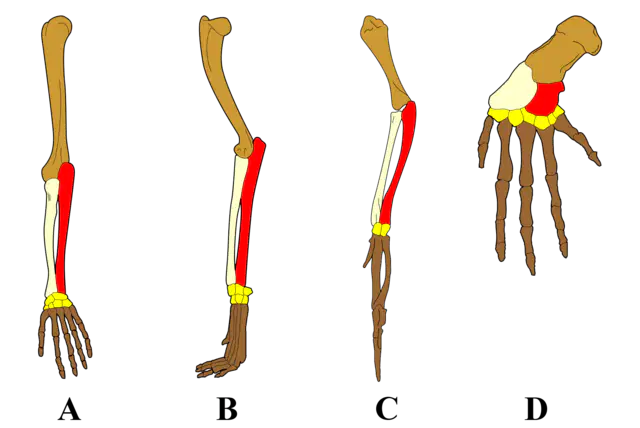
The diagrams to the right illustrate the bones in the forelimbs of four different organisms. Although these limbs all look different, they share some common patterns. These common patterns suggest that
a)
These organisms are members of the same species.
b)
The organisms existed at about the same point in time.
c)
These organisms share a common ancestor.
d)
These organisms have exactly the same genes.
6.
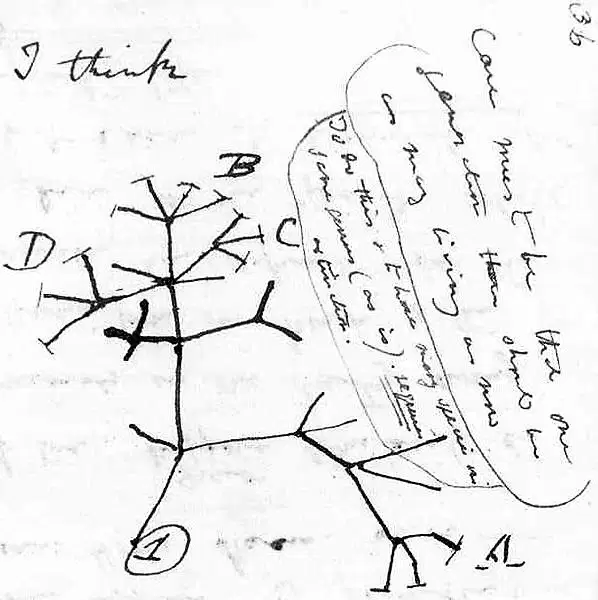
The image below is the famous "I think" sketch that appears in one of Darwin's notebooks.
In one or two sentences, explain what this sketch represents.
4 lines
7.
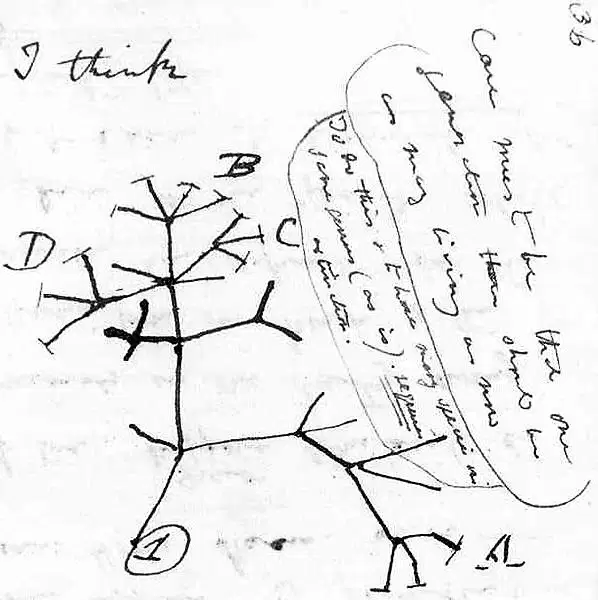
The image below is the famous "I think" sketch that appears in one of Darwin's notebooks.
Which observations from the list below support the ideas presented in Darwin's sketch? Click all the statements that apply.
a)
i. Tortoises from different islands of the Galapagos have different shells.
b)
ii. Fossils of extinct animals resemble animals living today.
c)
iii. Animals that are extinct were much larger than animals living today.
d)
iv. The Galapagos Islands have only a few species of animals living on them.
e)
v. Mockingbirds on different islands of the Galapagos have different markings.
8.
Which observation led Wallace to conclude that all species are connected in a tree of life?
a)
Around the globe, the more similiar two species are, the closer to each other they tend to live.
b)
Different species migrated from Australia to the islands of the Malay Archipelago.
c)
Both the butterflies and the birds he studied had wings.
d)
Darwin had published the same ideas in On the Origin of Species.
9.
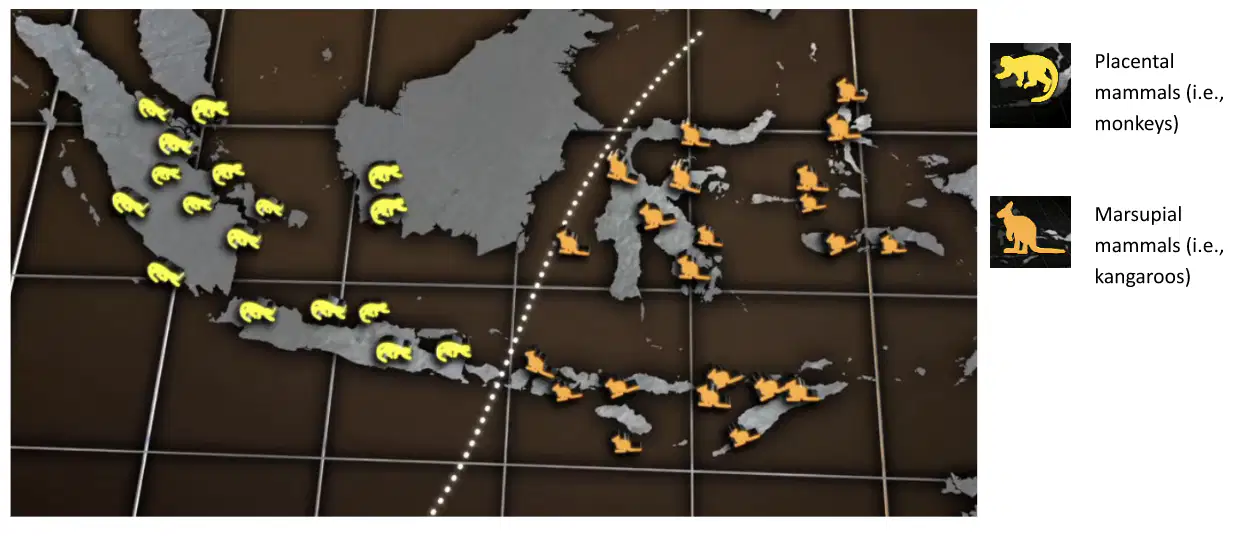
Study the figure below showing the distribution of animals in the Malay Archipelago.
Explain show the distribution of animals supported Wallace's evolution theory.
4 lines
10.
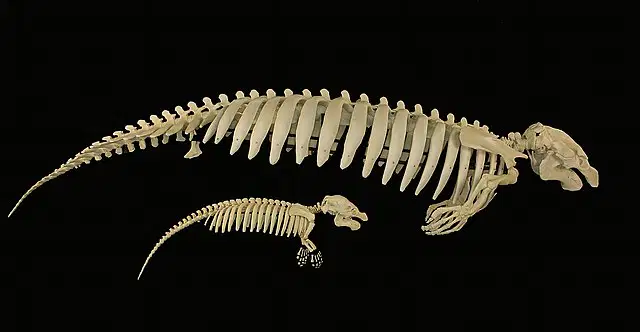
This image shows the bones found within the flippers of manatees. Similar bones are found in the flippers of whales. What did Wallace conclude from observing these seemingly useless structures and others like them?
4 lines
11.
Which observations led Wallace to understand how species change over time? Click all the statements that apply.
a)
i. The same species are found in different parts of the world.
b)
ii. The traits in a population vary from one individual to the next.
c)
iii. The characteristics of individuals change when their environment changes.
d)
iv. Populations tend to produce more offspring in each generation will survive.
100 %

