
Font size
 Worksheets
Stage 9 Science - Unit 8 Revision Quiz
Total questions: 31
Worksheet time: 24mins
What does the rate of reaction measure?
The color change that occurs during a reaction
The total amount of product formed at the end of a reaction
How quickly reactants are used up or products are formed
The size of the reactants before a reaction
How does increasing the surface area of a solid reactant affect the rate of reaction?
It decreases the reaction rate because there is less contact between reactants
It has no effect on the reaction rate
It increases the reaction rate by allowing more collisions to occur
It stops the reaction from happening
Which of the following best explains why a higher temperature increases the rate of reaction?
It provides more reactant particles
It makes the reactants heavier
It increases the energy and movement of the particles, leading to more collisions
It removes excess energy from the system
What happens to the rate of reaction when the concentration of a reactant is increased?
It decreases because there are fewer particles available to react
It stays the same since concentration has no effect
It increases because there are more particles to collide and react
It stops the reaction completely
When a solid is broken into smaller pieces, its (a) increases, leading to a faster reaction.
The rate of reaction can be measured by how quickly ____________ are formed or how fast ____________ are used up.
(a)
Before a chemical reaction, we have _____________.
reactants
products
After a chemical reaction, we have _____________.
reactants
products
Increasing temperature makes particles move (a) and collide more often with enough energy to react
Increasing temperature makes particles move (a) and collide more often with enough energy to react
A more concentrated solution has more (a) per unit volume, leading to more collisions between reactants.
Which makes the rate of reaction faster?
less surface area
less concentrated solution
higher temperature
Which makes the rate of reaction faster?
more surface area
less concentrated solution
lower temperature
Which makes the rate of reaction faster?
less surface area
more concentrated solution
lower temperature
Chemical reactions happen faster when there are more particle (a) .
sự va chạm là...
(a)
nhiệt độ là...
(a)
Tốc độ phản ứng là...
(a)
hạt là...
(a)
Phản ứng hóa học là...
(a)
Diện tích bề mặt là...
(a)
Nồng độ là...
(a)
Chất phản ứng là...
(a)
Sản phẩm là...
(a)
Increasing the temperature...
______________________
...Therefore, the rate of reaction increases.
TWO CORRECT ANSWERS
makes particles move faster
so there are more particle collisions
means there are more particles
so there are less particle collisions
Increasing the concentration...
______________________
...Therefore, the rate of reaction increases.
TWO CORRECT ANSWERS
makes particles move faster
so there are more particle collisions
means there are more particles
so there are less particle collisions
Increasing the surface area...
______________________
...Therefore, the rate of reaction increases.
TWO CORRECT ANSWERS
makes particles move faster
so there are more particle collisions
means there are more particles at the surface
so there are less particle collisions
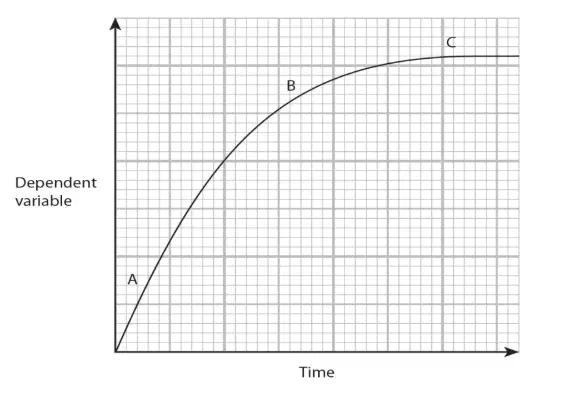
Which letter shows where the reaction has stopped?
A
B
C
Which letter shows where the reaction has slowed down?
A
B
C
Which letter shows where the reaction is fastest?
A
B
C

What should we measure and how often?
The amount of acid
The amount of gas produced
Every hour
Every minute

