
 Worksheets
U8 Transformation Review
Total questions: 89
Worksheet time: 6hrs 21mins
When you translate, (x-4 ,y) will move _____.
4 units right
4 units left
4 units up
4 units down


Find the image of the Δ with vertices P(−1,5), Q(−4,3), R(−2,1) after the similarity transformation:
Rotation 180 degrees about the origin AND Dilation: (x,y)→(2x,2y)
P′′(−10,1), Q′′(−6, 8), R′′(−2, 4)
P′′(5,−1), Q′′(3,−4), R′′(1,−2)
P′′(1,−5), Q′′(4,−3), R′′(2,−1)
P′′(2,−10), Q′′(8,−6), R′′(4,−2)

Which similarity transformation maps ABCD to A'B'C'D'?
A 180° rotation followed by a dilation with scale factor 3
A reflection in the x-axis followed by a dilation with scale factor 3.
A 31 rotation followed by a dilation with scale factor
A reflection in the x-axis followed by a dilation with scale factor 31

Which similarity transformation maps WXYZ to W'X'Y'Z'?
Reflection over the x-axis, followed by a dilation with a scale factor of 2
Reflection over the y-axis, followed by a dilation with a scale factor of 2
Reflection over the y-axis, followed by a dilation with a scale factor of 21
Reflection over the x-axis, followed by a dilation with a scale factor of 21

Choose the statement that accurately describes the relationship between ABCD and EFGH.
ABCD and EFGH are congruent, but not similar.
ABCD and EFGH are similar, but not congruent.
ABCD and EFGH are both congruent and similar.
ABCD and EFGH are neither congruent, nor similar.

Triangle ABC with Vertices A(-1, 2), B(-1, -2), and C(-4, -2) is dilated by a scale factor of 2 to form triangle A’B’C’.
What is the length in units, of side A’B’?
4
2
8
7
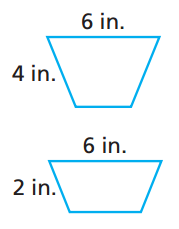
Are the following similar? Why or why not?
Yes, they are both trapezoids
No, they have different sizes
No, the ratios of the corresponding sides are not equal.
Yes, they have the same base and 4 angles

What is the scale factor from MNOP to ABCD?
2/3
1/2
3/2
2

(x, y) ----> (-x, y)

90 degrees counterclockwise
180 degrees
90 degrees clockwise
270 degrees counterclockwise
Which picture shows a TRANSLATION?


Identify the transformation from A to D. (All are rotated about the origin)
90o Clockwise Rotation
180o Rotation
270o Clockwise Rotation
90o Counterclockwise Rotation
Reflect the point (2, -4) over y = x.
Reflect the point D (-9, -12) over the line y = -x.
(12, 9)
(-12, -9)
(-12, 9)
(12, -9)

Triangle A is rotated 90° clockwise with the origin as the center of rotation to create a new figure. Which triangle shows the new location?
A
B
C
D
Which is a complete and accurate description of the transformation pictured?
Rotation 90 degrees counterclockwise about the origin
Rotation 180 degrees about the origin
Rotation 90 degrees clockwise about the origin
None of these

How many degrees was the figure rotated around the origin?
90 degrees counterclockwise
180 degrees
270 counterclockwise
90 degrees clockwise
Which rule describes a 180° clockwise rotation about the origin?
( x, y ) → ( y, -x )
( x, y ) → ( -x, -y )
( x, y) → ( x, y )
( x, y ) → ( -y, x )
You can describe a rotation two ways. (choose one)
clockwise and counterclockwise
right and left
up and down
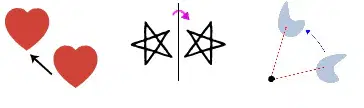
When a transformation does not change an image's shape or size, the two images are:
Circumference
Congruent
Constant
Similar


What is another word for rotation?
Turn
Flip
Slide
Shrink
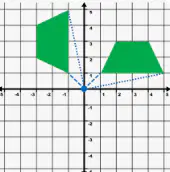
A rotation turns a figure around a fixed point called the (a) of rotation.
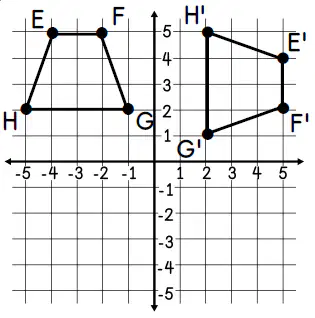
The figure EFGH was rotated to E'F'G'H
either ____ .
90° clockwise or 270° counterclockwise
270° clockwise or 90° counterclockwise
180° clockwise or 180° counterclockwise
180° clockwise or 90° counterclockwise
Ivy will rotate ABC using the rule (x, y) --> (-x, -y). Point C is (-5,-2). What is the location of C'?
(5, 2)
(2, 5)
(-5, 2)
(-5, -2)

How many degrees does this shape rotate counterclockwise about the origin?
90°
180°
270°
360°
A(3,3) B(6,6) C(9,3)

A dilation produces a congruent figure
True
False


1.) Is the dilation from A to B an enlargement or a reduction?
enlargement
reduction

2.) Is the dilation from A to B an enlargement or a reduction?
enlargement
reduction

3.) Is the dilation from A to B an enlargement or a reduction?
enlargement
reduction

4.) Is the dilation from A to B an enlargement or a reduction?
enlargement
reduction

5.) What is the scale factor of the dilation from A to B ?
1/4
1/2
1
2

6.) What is the scale factor of the dilation from A to B ?
8
2
1/6
1/3

7.) What is the scale factor of the dilation from A to B ?
2
1
1/2
1/3

What does congruent mean?
corresponding sides and angles are congruent
corresponding sides are proportional and corresponding angles are congruent
sames shape
neither sides or angles are congruent

Which series of transformations were performed in the figure?
Translation 5 units down, reflection over the y-axis
Reflection over the x-axis, translation 6 units right
Rotation 90o clockwise, reflection over the x-axis
Rotation 180o clockwise, reflection over the y-axis

Which transformations keep figures congruent?
translation, reflection, and dilation
reflection, rotation, and dilation
dilation, translation, reflection, and rotation
translation, reflection, and rotation
Which scale factor shrinks a figure?
k = 0
k =2
k= 1/3
k = 1

What is the rule for the dilation pictured below?
(x, y) → (½x, ½y)
(x, y) → (x + 2, y + 2)
(x, y) → (2x, 2y)
(x, y) → (2x, 3y)
Which of the following are similarity transformations? Choose all that apply.
Translation
Dilation
Rotation
Stretch
Reflection


Which series of transformations was used? Select ALL that apply.
Rotation
Reflection
Dilation
translation

Which transformations can be used to confirm that the figures are similar?Select all that apply.
Reflection
Rotation
Translation
Dilation

Which sequence of transformations can be used to prove that these shapes are similar? Select all that apply.
reflection
rotation
translation
dilation

Which sequence of transformations can map ABCD to EFGH? Select all that apply.
Rotation
Reflection
Dilation
Translation

Which transformations can be used to map ABCD to JKLM?
reflection
rotation
translation
dilation
Which of the following transformations are rigid motions?
Translations
Reflections
Rotations
Dilations
Which of the following transformations are not rigid motions?
Translations
Reflections
Rotations
Dilations
Identify the single rigid motion that performs the same mapping as the given composition. T(1,1)(T(0,1)(T(1,0)))
T(1,1)
T(0,1)
T(1,0)
T(2,2)
Identify the single rigid motion that performs the same mapping as the given composition. R(2,0),90°(R(2,0),90°)
R(2,0),90°
R(4,0),90°
R(2,0),180°
R(4,0),180°
When writing the notation for rotations, the negative degree indicates which direction?
counterclockwise
clockwise
When writing the notation for rotations, the positive degree indicates which direction?
counterclockwise
clockwise
Identify the inverse of the following transformation:
T(1,3)
T(1,3)
T(−1,−3)
T(3,1)
T(−3,−1)
Identify the inverse of the following transformation:
R(−2,2),−90°
R(−2,2),−90°
R(−2,2),90°
R(2,−2),−90°
R(2,−2),90°

Find the coordinates of the vertices of each figure after the given transformation.
V'(5, -1), W'(3, -3), X'(4, -1)
V'(2, -3), W'(4, -1), X'(3, -3)
W'(-3, -3), X'(-4, -1), V'(-5, -1)
W'(-3, -1), X'(-4, 1), V'(-5, 1)

Find the coordinates of the vertices of each figure after the given transformation.
Q'(-3, 1), R'(2, 1), S'(-1, 5), P'(-3, 3)
P'(-2, 0), Q'(-2, 2), R'(3, 2), S'(0, -2)
Q'(5, 5), R'(0, 5), S'(3, 1), P'(5, 3)
Q'(3, 5), R'(-2, 5), S'(1, 1), P'(3, 3)

Write a rule to describe each transformation.
translation (x, y) → (x + 7, y)
translation (x, y) → (x + 1, y + 3)
rotation 180° about the origin
translation (x, y) → (x + 6, y + 4)

Write a rule to describe each transformation.
rotation 90° clockwise about the origin
reflection across y = x
reflection across x = 2
translation: (x, y) → (x - 3, y - 1)


