
 Worksheets
[5.0] Storage
Total questions: 68
Worksheet time: 39mins
Which of the following is the component of a storage device that physically holds data?
Read/Write Mechanism
Device Controller
Storage Medium
Bus Interface
Which of the following is the component of a storage device that reads or writes data to and from the storage medium?
Read/Write Mechanism
Device Controller
Storage Medium
Bus Interface
Which of the following is the component of a storage device that provides the interface between the storage device and the system bus?
Read/Write Mechanism
Device Controller
Storage Medium
Bus Interface
Which of the following are components of a storage device?
Read/Write Mechanism
Device Controller
Storage Medium
Bus Interface
Memory Buffer
Why is no single storage technology considered optimal for all characteristics?
Because different applications require different trade-offs in speed, cost, and capacity
Because storage devices are all identical in function
Because storage mediums do not affect performance
Because faster storage is always better regardless of cost
Which of the following are the key characteristics of storage devices?
1. speed
2. volatility
3. access method
4. portability
5. cost
6. capacity
d
d
d
What does the speed of a storage device refer to?
The time required to read and write data
The amount of data a storage device can transfer per unit of time
The time required to transfer a file to another device
The time required to access the storage physically
Which characteristic differentiates primary and secondary storage?
Capacity
Speed
Portability
Cost
What does access time refer to in a storage device?
The time required to transfer a file to another device
The time required to perform a complete read/write operation
The time needed to delete a file permanently
The time required to access the storage physically
What is assumed about access time unless otherwise stated?
It is different for reading and writing
It is the same for both reading and writing
It is longer for reading than writing
It is longer for writing than reading
What is the data transfer unit in a storage device?
The time required to transfer data
The amount of power used per data transfer
The size of data accessed for each read and write operation
The type of storage medium used
What does the data transfer rate measure?
The amount of data a storage device can transfer per unit of time
The cost of data storage per gigabyte
The time required to transfer data
The lifespan of a storage medium
What does volatility in a storage device refer to?
The speed at which data can be accessed
The ability of the storage device to reliably hold data over time
The amount of power the device consumes
The physical durability of the storage device
A device is _______ if it holds data without loss over long periods.
Volatile
Nonvolatile
A device is _______ if it can't reliably hold data for long periods.
Volatile
Nonvolatile
Which of the following is true about magnetic storage devices like hard disks and tapes?
They are completely immune to data loss over time
They are volatile like RAM
They are non-volatile but may lose data over several years due to magnetic decay
They require constant power to retain data
Under what condition can RAM be considered non-volatile, even though it is generally classified as volatile?
When it is used in a system with an advanced cooling mechanism
When it continuously receives external power
When data is frequently refreshed by the CPU
When stored in a magnetic field to preserve charge
TRUE OR FALSE:
The access method of a storage device is dependent on the drive's physical structure.
TRUE
FALSE
Which access method retrieves data in the same order it was written (linear order)?
Random access
Serial access
Parallel access
Indexed access
Which of the following storage methods allows data to be accessed in any storage location directly and in order, without following a sequence?
Sequential access
Random/direct access
Serial access
Indexed sequential access
Which storage method is used in RAID configurations, allowing a device to simultaneously access multiple storage locations and improve performance by distributing data across multiple devices?
Serial access
Indexed access
Parallel access
Direct access
In which access method does access time depend on the physical location of the read/write mechanism and the position of the target data item in the storage medium?
Serial access
Parallel access
Direct access
Random access
How is storage device portability typically implemented?
The storage medium is permanently attached to the computer and cannot be moved.
The entire storage device can be transported, or the storage medium can be removed and used on another compatible device.
Data is only transferred through a network, eliminating the need for physical transport.
Why do portable storage devices typically have slower access speeds compared to non-portable ones?
Portability requires additional security layers that slow down data access.
Portable devices use outdated technology that is inherently slower.
High-speed access requires controlled environments and interfaces, which are harder to maintain in portable devices.
Only wired connections allow fast storage access, and portable devices are always wireless.
TRUE OR FALSE:
Speed, volatility, and portability directly affect the cost per unit of storage.
TRUE
FALSE
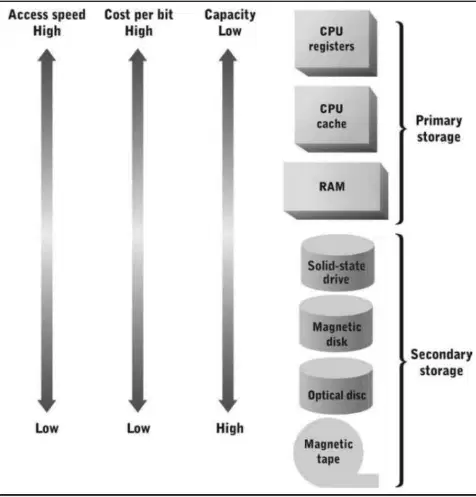
If a storage device needs to be both highly portable and have fast access speed while maintaining low cost, what is the tradeoff?
It will have reduced storage capacity
It will have increased storage capacity
It will require constant external power
It will have slower data transfer rates than traditional hard drives
If storage device capacity is increased while maintaining the same cost, what must happen?
Access speed must be increased
Access speed must be decreased
The device must become more portable
Data retention must improve
What are the two critical performance characteristics of primary storage devices?
access speed
data transfer unit size
physical size
volatility
portability
This is a small electronic component that can be used to store energy, but discharge quickly unless supplied with electrical current at regular intervals. It it the basic building block of primary storage.
(a)
Which of the following are characteristics of primary storage in RAM?
Microchip implementation with semiconductors
Capaibility to read and write with equal speed
Random access to stored bytes, words, or larger data units
Sequential access to stored bytes, words, or larger data units
It uses capacitors to store data.
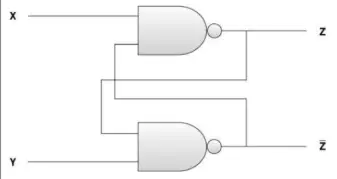
This is a RAM implemented entirely using transistors that form flip-flops (switch circuits that remembers its last position).
Static RAM
Dynamic RAM
Double Rate Dynamic RAM
Synchronous Dynamic Ram (SDRAM)
This is a RAM that stores each bit by using a circuitry (w/ a single transistor and capacitor) that performs a refresh thousands of times per second to perform data.
Static RAM
Dynamic RAM
Double Rate Dynamic RAM
Synchronous Dynamic Ram (SDRAM)
Which technique in speeding up RAM involves preactivating read/write circuitry of the memory location next to the one currently in use? (ASSUMING CPU ACCESSES MEMORY SEQUENTIALLY)
Pipelining
Synchronous read operation
Read ahead memory access
Sequential memory access
Which technique in speeding up RAM breaks down read/write operations into smaller substeps to improve speed and parallelism?
Pipelining
Synchronous read operation
Read ahead memory access
Sequential memory access
The mainstream memory technology used by modern computers is ____________
Static Random Access Memory (SRAM)
Magnetoresistive Random Access Memory (MRAM)
Synchronous Dynamic Random Access Memory (SDRAM)
Synchronous Double Rate Random Access Memory (SDRAM)
Generic terms for memory devices that are capable of storing data for the long-term are ________ and ________.
Nonvolatile memory (NVM)
Read-only memory (ROM)
Random access memory (RAM)
Flash Memory
There are three NVM technologies.
This is the most common, but has limited lifetime in terms of number of writes.
Flash memory
Magnetoresistive RAM (MRAM)
Phase-Change Memory (PCAM or PCRAM)
There are three NVM technologies.
This stores bit values by using two magnetic elements that change polarity; SRAM speed with comparable density to DRAM.
Flash memory
Magnetoresistive RAM (MRAM)
Phase-Change Memory (PCAM or PCRAM)
There are three NVM technologies.
This uses glasslike compound that changes reflectivity when heated; slower read and less dense than flash RAM but faster write.
Flash memory
Magnetoresistive RAM (MRAM)
Phase-Change Memory (PCAM or PCRAM)
____________ convert electrical signals into magnetic charges and captures them on a storage medium.
Magnetic storage devices
Optical storage devices
Solid-state drives (SSDs)
Capacitive storage devices
Semiconductor memory devices
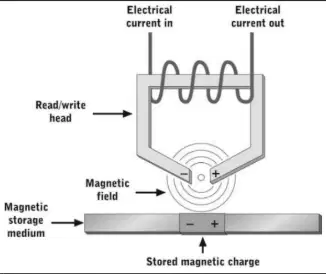
Given the two statements, which of the ff. are true:
I. The polarity of a magnetic charge represents the speed of data transfer in magnetic storage devices.
II. The direction of current flow on the read/write head creates a magnetic charge with a specific polarity.
Only I is true
Only II is true
Both are true
None are true
This refers to the minimum strength of the magnetic charge needed to produce a current flow across the head in order to do a successful read.
Read Threshold
Magnetic Saturation
Signal Amplitude
Areal Density
Write Threshold
This refers to the minimum surface area required to record a bit to reach the read threshold.
Read Threshold
Magnetic Saturation
Signal Amplitude
Areal Density
Write Threshold
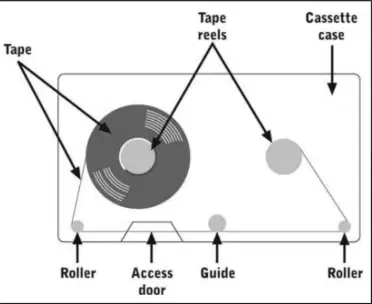
This is a serial access device that uses a ribbon of plastic with coercible coating as the storage medium. A motor winds and unwinds the tape. It is used primarily to make backup copies of data.
(a)
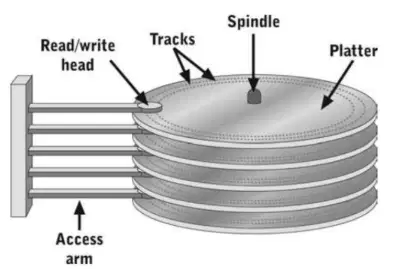
This device consists of rigid platters with data recorded on both sides, multiple platters mounted on a common spindle, and read/write heads on access arms for each side.
(a)
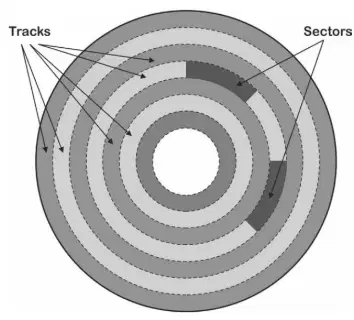
The platters of a magnetic disk can be further split into three parts/sections:
This refers to the one concentric circle of a platter.
Track
Cylinder
Sector
The platters of a magnetic disk can be further split into three parts/sections:
This consists of all tracks at an equivalent distance from the spindle on all platter surfaces (vertical stack).
Track
Cylinder
Sector
The platters of a magnetic disk can be further split into three parts/sections:
This is a fractional portion of a track which is also the normal data transfer unit to or from the drive. It can range from 512 to 4096 bytes in size.
Track
Cylinder
Sector
Why are there delays in the magnetic disk?
[3 answers]
HTH Switching Time (Head-to-Head Switching Time)
TTT Seek Time (Track-to-Track Seek Time)
Rotational Delay
Magnetic Recharging Delay
Optical Disk Spinning Delay
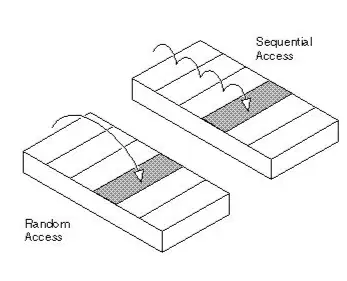
Why does storing related data in sequential sectors (one after the other) improve disk performance?
It allows the CPU to access data faster by reducing seek time.
It prevents data from being corrupted by external magnetic fields.
It increases the storage capacity of the disk by optimizing space.
It reduces the need for disk defragmentation by compressing files.
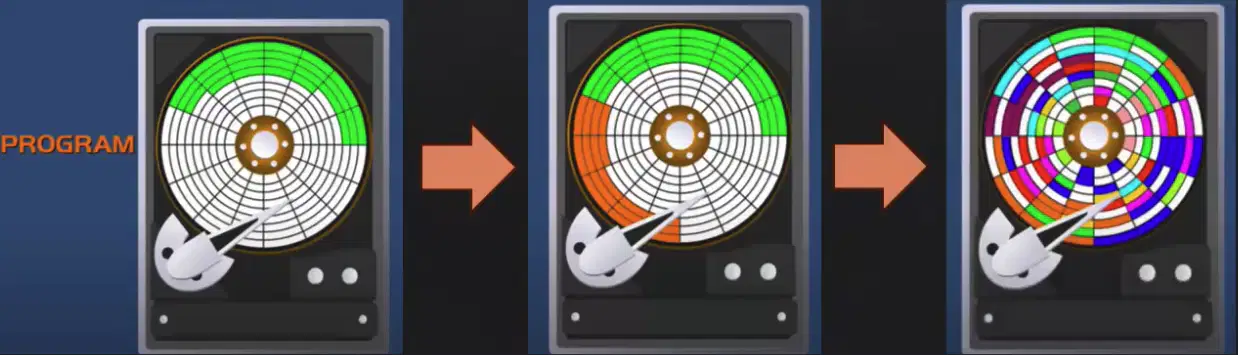
What happens when fragmentation occurs on a hard disk?
Data is stored in sequential sectors, improving read speeds
The operating system automatically optimizes file placement
Portions of a file are scattered across different disk locations, slowing performance
The hard drive reduces storage capacity to make room for new files
What is the role of disk defragmentation?
It rearranges data on the disk to place file contents in sequential sectors.
It increases storage capacity by compressing fragmented files.
It clears all unnecessary data from the hard drive to free space.
It prevents the disk from overheating by reducing mechanical movement.
What is sequential access time?
The time required to read the second of two adjacent sectors on the same track and platter
The time taken for the read/write head to move from one track to another on the disk.
The delay caused by the rotation of the disk before the correct sector is positioned under the read/write head.
The total time taken to access a randomly located file on the disk, including seek time, rotational delay, and transfer time.
What does the data transfer rate (bytes per second) represent in a disk drive?
The speed at which data is moved through the disk controller to and from memory or the CPU
The time it takes for the read/write head to move from one track to another on a disk.
The delay before the correct sector rotates under the read/write head.
The total time taken for a system to boot from the hard drive
What is the maximum data transfer rate?
The fastest rate the drive can support, assuming sequential access
The total amount of data a hard drive can store.
The average speed of data transfer under mixed workload conditions.
What is the sustained data transfer rate of a storage device?
The consistent speed at which data is transferred over time under normal conditions
The fastest possible data transfer speed the drive can achieve under ideal conditions
The time it takes for the disk to spin up to full speed before reading data
The speed at which the CPU processes data from RAM
Why do outer tracks have a higher data density than inner tracks?
Because outer tracks have a larger circumference, allowing more data to be read per revolution
Because outer tracks rotate faster than inner tracks
Because inner tracks are reserved for system files only
Because the inner tracks have lower read/write speeds
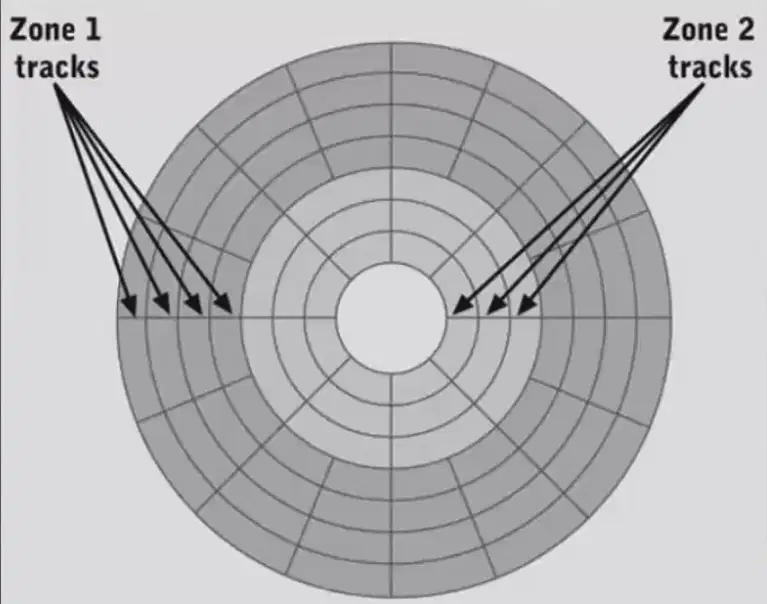
TRUE or FALSE:
Manufacturers divide tracks into two or more zones to optimize storage capacity by varying the number of sectors per track.
TRUE
FALSE
CASE-BY-CASE BASIS
What is the primary difference between an SSD and a magnetic disk drive?
SSDs use flash RAM or non-volatile memory, while magnetic drives use spinning platters
SSDs have a mechanical read/write head, while magnetic drives do not
Magnetic drives are always faster than SSDs
SSDs require external power to retain data, while magnetic drives do not
Why are SSDs faster than traditional hard drives?
They have no spinning platters or access arms, reducing latency
They use compressed data storage to speed up access times
They operate at a higher rotational speed than HDDs
They use laser technology to read and write data
SSDs need to erase a memory cell before writing new data to it (no overwrites). In relation to this, what is "overprovisioning" in SSDs?
Reserving extra space to allow immediate writes without waiting for erasure
Increasing the SSD’s total storage capacity by compressing data
Allocating more RAM to the SSD for temporary storage
SSDs use wear levelling to track the write frequency to each memory region and distribute write operations evenly throughout the device to prolong the lifetime of memory cells. What are the other characteristics of the Solid State Drives?
They are more tolerant to shock because they have no moving parts.
They consume less power compared to magnetic drives.
They have a limited lifespan as flash memory cells degrade after a finite number of write operations.
Some memory regions are reserved to replace worn out regions.
SSDs require periodic defragmentation, just like HDDs
A hybrid drive combines flash memory and magnetic disk storage in a single device. It has a dedicated processor and firmware to determine which data to store in flash or magnetic. Which of the ff. are true about the data that the flash memory and magnetic disk store?
[SELECT TWO]
Flash memory holds frequently-accessed data but has smaller capacity.
Magnetic disk holds less frequently-accessed data but has larger capacity.
Magnetic disk holds frequently-accessed data but has smaller capacity.
Flash memory holds less frequently-accessed data but has larger capacity.
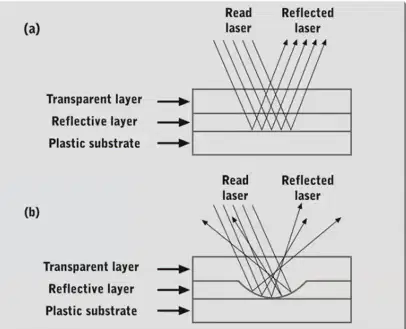
These drives store data using light reflection, where its read mechanism (laser and photoelectric cell) detect bit values: 1 for highly reflective spots and 0 for less reflective areas.
(a)
Select all the characteristics that apply to optical drives.
Higher density compared to magnetic disks (more storage for same size)
Low volatility
Slower than magnetic disks
Favored for read-only storage
Favored for write-only storage
What is are two key characteristics of recordable disks like CD-R and DVD-R?
They use magnetic fields to store data permanently.
They rely on a laser-sensitive dye that changes reflectivity when written.
They allow unlimited rewriting of data without degradation.
They store data using phase-change material that changes state when heated.
They are write once discs, but not erasable.
Unlike recordable disks, you can rewrite the data on phase-change optical disks (with limitations). How do phase-change optical disks like CD-RW, DVD-RW, enable rewriting?
They use a laser to melt and reform microscopic pits in the disk.
They change the electrical resistance of embedded metal layers.
They rely on phase-change material that alters reflectivity when heated.
They use high-frequency sound waves to rearrange data bits.
What is a key advantage of cloud storage?
It eliminates the need for internet connectivity.
It ensures data is stored locally only for faster access.
It allows data to be stored in multiple remote locations and synchronized for availability.
It requires specialized hardware for each user to access their data.

