
 Worksheets
7.4 PA STEELS Assessment: Matter Cycling & Photosynthesis
Total questions: 53
Worksheet time: 39mins
What are the main inputs required for photosynthesis?
Oxygen and glucose
Carbon dioxide, water, and light energy
Nitrogen, oxygen, and sunlight
Water, nitrogen, and glucose
How does energy flow through an ecosystem?
The sun provides energy to plants, which is transferred to consumers and decomposers.
Energy is created by plants and stored in the soil.
Animals produce their own energy, which they pass to plants.
Decomposers create energy that flows back to producers.
Which statement best explains why plants are considered producers in an ecosystem?
They break down dead organisms to release nutrients.
They take in food molecules from the soil.
They use sunlight to produce food molecules through photosynthesis.
They consume other organisms for energy.
What happens to the carbon atoms in a plant when the plant dies?
They disappear into the air.
They are broken down by decomposers and returned to the soil and atmosphere.
They turn into oxygen and are released into the air.
They remain in the dead plant forever.
Matter cycles between plants, animals, and decomposers in an ecosystem. Which of the following best describes this process?
Plants produce oxygen and glucose, animals consume them, and decomposers break down waste into nutrients.
Animals produce oxygen and glucose, plants consume them, and decomposers break down waste into nutrients.
Decomposers produce oxygen and glucose, plants consume them, and animals break down waste into nutrients.
Plants and animals both produce oxygen and glucose, and decomposers consume them.

What trend do you observe in the data?
The data shows an increase in the light and a decrease in the dark
The data shows a decrease in the dark and and increase in the light
The data shows no significant trend.
The data shows an increase in the dark and a decrease in the light

The data supports the role of photosynthesis in cycling carbon in an ecosystem by showing:
the increase in carbon dioxide levels during photosynthesis
the decrease in carbon dioxide levels during photosynthesis
the increase in oxygen levels during photosynthesis
the decrease in oxygen levels during photosynthesis
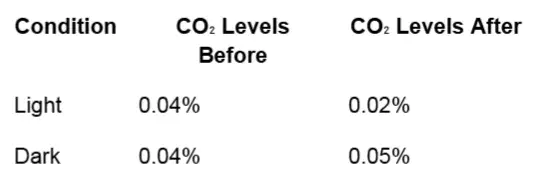
A student claims that “Plants only take in carbon dioxide; they do not release it.” Based on what you learned in this unit, explain why this statement is incorrect. Use evidence from your investigations or the data table above to support your answer.
Plants only take in carbon dioxide during photosynthesis and release oxygen.
Plants take in carbon dioxide and release it during respiration.
Plants only release carbon dioxide at night.
Plants neither take in nor release carbon dioxide.
What is the main purpose of photosynthesis?
To produce oxygen for animals to breathe
To convert sunlight into chemical energy stored in glucose
To remove carbon dioxide from the atmosphere permanently
To provide water for plant growth
What is the primary function of photosynthesis?
It provides energy to convert carbon dioxide and water into glucose
It directly becomes glucose in the plant
It reacts with oxygen to form carbohydrates
Where in a plant cell does photosynthesis occur?
Nucleus
Mitochondria
Chloroplasts
Cytoplasm
Why do plants need water for photosynthesis?
Water molecules provide hydrogen and oxygen for glucose production
Water cools down the plant to prevent overheating
Water carries nutrients from the soil to the leaves
Water helps break down carbon dioxide
What would most likely happen if plants stopped performing photosynthesis?
The amount of oxygen in the atmosphere would increase
Decomposers would no longer have a role in the ecosystem
The energy supply for most ecosystems would disappear
Carbon dioxide levels would decrease drastically
What role do decomposers play in the cycling of matter?
They produce glucose for plants to use
They break down dead organisms and return nutrients to the environment
They convert sunlight into energy for consumers
They store excess carbon in plant roots
How does carbon return to the atmosphere in an ecosystem?
Through the respiration of plants and animals
Through photosynthesis
By absorbing oxygen from the air
By being stored in plant roots permanently
What happens to the glucose produced by photosynthesis?
It is immediately used up by the plant and disappears
It is stored as starch or used for energy through cellular respiration
It is only used to produce oxygen
It is directly absorbed by animals for energy
Which of the following is an example of a producer?
A) A rabbit eating grass
B) A hawk hunting a mouse
C) A tree absorbing sunlight
D) A mushroom on a log
What would happen to an ecosystem if decomposers were removed?
A) Plants would stop producing food
B) Nutrients would stop being recycled, and waste would accumulate
C) Carbon dioxide levels would drop to zero
D) The sun’s energy would no longer reach plants
Which of the following is NOT an output of photosynthesis?
Glucose
Carbon dioxide
Oxygen
Water (in small amounts)
What happens to the oxygen produced during photosynthesis?
It is used by the plant to produce glucose
It is stored in the plant’s roots for later use
It is released into the air as a waste product
It is converted into carbon dioxide inside the plant
How does carbon dioxide enter a plant for photosynthesis?
Through its roots
Through openings in the leaves called stomata
By absorbing it from the soil
By converting water molecules into carbon dioxide
Which of the following factors would NOT directly affect the rate of photosynthesis?
Amount of sunlight
Amount of carbon dioxide
Amount of oxygen in the air
Availability of water
What happens to the sugar produced during photosynthesis?
It is immediately broken down by sunlight
It is used by the plant for energy or stored for later use
It is only used to make the plant green
It is released into the soil to help other plants grow
Why do plants need to carry out cellular respiration in addition to photosynthesis?
To break down glucose and release energy for growth and survival
To get rid of excess water in their cells
To convert oxygen into carbon dioxide
To produce more sunlight for photosynthesis
In what type of cells does cellular respiration occur?
Only plant cells
Only animal cells
Both plant and animal cells
Only bacterial cells
What would happen if there were no decomposers in an ecosystem?
A) Dead organisms and waste would pile up, and nutrients wouldn’t be recycled
B) Plants would no longer need carbon dioxide
C) Animals would become producers
D) The Sun would stop providing energy for the ecosystem
Which of the following BEST describes the role of producers in an ecosystem?
They decompose dead organisms to recycle nutrients
They provide energy by making food through photosynthesis
They eat plants and other organisms for energy
They produce carbon dioxide by absorbing it from animals
How do synthetic materials relate to natural resources?
Synthetic materials are made directly from plant and animal parts without any changes
Synthetic materials are created by rearranging natural molecules through chemical reactions
Synthetic materials occur naturally without human intervention
Synthetic materials are the same as decomposed materials in the environment
Which of the following is an example of a synthetic material made using natural resources?
Plastic made from petroleum (a fossil fuel)
Oxygen released by plants during photosynthesis
A tree producing sap that humans collect
Water evaporating into the atmosphere
What is the primary source of energy for plants?
Water
Sunlight
Wind
Soil
What is maple sap primarily composed of?
Sugar and Water
Protein and Minerals
Fats and Oils
Vitamins and Fiber
What is a hydroponic system used to demonstrate?
That plants need soil to grow
That plants can grow without soil
That plants get food molecules from the air
That plants require sunlight for growth
Which molecule found in air is essential for plant growth?
Argon
Nitrogen
Carbon dioxide
Helium
Which of the following is NOT considered a direct source of food molecules for plants?
Water
Air
Light
Soil
What is the role of chloroplasts in plant cells?
To transport nutrients
To capture light energy
To absorb water
To protect against pests
What are the outputs of photosynthesis?
Oxygen and Glucose
Carbon Dioxide and Glucose
Oxygen and Carbon Dioxide
Light and Glucose
What are the inputs of Cellular Respiration?
Oxygen and Glucose
Carbon Dioxide, Energy, and Water
Oxygen and Carbon Dioxide
Oxygen, Water and Glucose
What are the outputs of Cellular Respiration?
Oxygen and Glucose
Carbon Dioxide, Energy, and Water
Oxygen and Carbon Dioxide
Oxygen, Water and Glucose
What is the primary source of food molecules for most animals?
Other animals
Plants
Water
Air
What role do decomposers play in the ecosystem?
They produce food
They consume sunlight
They break down dead material
They prevent plant growth
What role do consumers play in an ecosystem?
They create energy from the sun
The obtain energy by eating other orgainisms
They break down dead organisms
The recycle nutrients into the soil
All life on Earth gets its energy from _________?
The Sun
The Earth
The Moon
The food we eat
How are atoms recycled in ecosystems?
They are destroyed after use.
They are continuously cycled between organisms and the environment.
They are stored permanently in one organism.
They are converted into energy.
What type of food molecules do we get from plants?
Carbohydrates
Proteins
Fats
All of these
If a plant is moved from direct sunlight to a shady area, what will likely happen?
The plant will continue photosynthesis at the same rate.
The rate of photosynthesis will decrease.
The plant will stop absorbing water.
The plant will release more oxygen.
The main source of energy for all life on Earth comes from_____.
The Earth
The Sun
The Moon
The food we eat
How do plants store excess food produced during photosynthesis?
As oxygen gas in leaves
As sugar and starches in various parts of the plant
As carbon dioxide in the roots
As proteins in the stems
Draw a diagram to model the process of photosynthesis.
Label the following:
-Inputs (reactants)
-Outputs (products)
-Where the process occurs in a plant cell

Explain how matter cycles between plants, animals, and decomposers in an ecosystem. Use specific examples to describe the process.

Investigation Results:
Students conducted an experiment measuring the amount of carbon dioxide around a plant in the light and in the dark.Their data is shown below:
Analysis Questions:
What trend do you observe in the data?
Investigation Results:
Students conducted an experiment measuring the amount of carbon dioxide around a plant in the light and in the dark.Their data is shown below:
Analysis Questions:
How does this data support the role of photosynthesis in cycling carbon in an ecosystem?
Investigation Results:
Students conducted an experiment measuring the amount of carbon dioxide around a plant in the light and in the dark.Their data is shown below:
Argurment from evidence:
A student claims that “Plants only take in carbon dioxide; they do not release it.” Based on what you learned in this unit, explain why this statement is incorrect. Use evidence from your investigations or the data table above to support your answer.

