
 Worksheets
Atomic Structure Worksheet
Total questions: 36
Worksheet time: 1hrs 2mins
Which of the following is NOT an element?
Oxygen
Gold
Water
Carbon
What characteristic do all elements share?
They can be broken down by chemical means
They have distinct chemical and physical properties
They are mixtures of different substances
They are always gases
What is an atom?
The largest particle of an element
A molecule of a compound
The smallest particle of an element that still has the properties of that element
A mixture of different elements
What is the part of the atom that is located in the middle?
Electron Cloud
Proton
Nucleus
Neutron
What is the nucleus of an atom described as?
The large part on the outside
The really tiny part in the middle
The visible part of the atom
The part that contains electrons
Which of the following is NOT a part of an atom?
Electron Cloud
Nucleus
Molecule
Proton
Where are electrons located in an atom?
In the nucleus
In the electron cloud
In the proton field
In the neutron zone
What charge do electrons carry?
Positive
Negative
Neutral
Double positive
Where are protons found in an atom?
In the electron cloud
In the nucleus
In the outer shell
In the atomic orbitals
What does the number of protons in an atom determine?
Atomic mass
Atomic number
Electron configuration
Neutron number
What role do neutrons play in an atom?
Determine the chemical properties
Determine the atomic mass
Determine the charge
Determine the color
What charge do electrons have?
Positively charged
Negatively charged
Neutrally charged
No charge
Where do electrons typically move around in an atom?
Inside the nucleus
In a "cloud" around the nucleus
On the surface of the atom
In a straight line
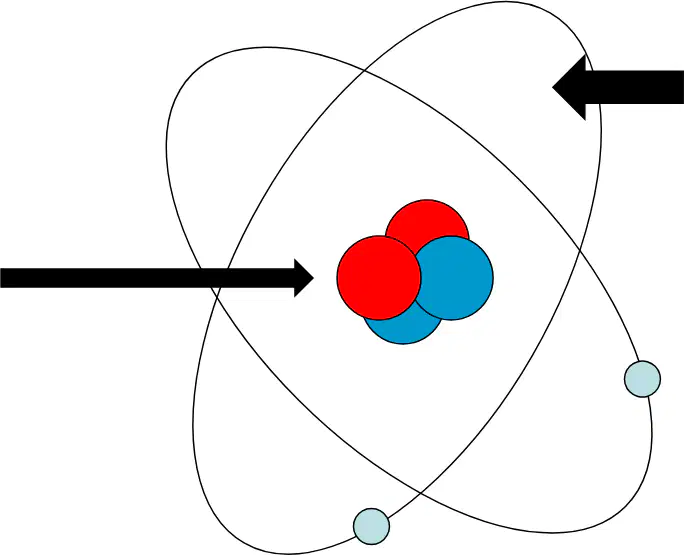
What is found at the center of an atom?
Electron cloud
Nucleus
Proton cloud
Neutron field
What is the distance between the nucleus and the electron clouds described as?
Small
Moderate
Huge
Tiny
Where is almost all of an atom's mass located?
In the electron cloud
In the empty space
In the nucleus
In the proton
If an atom has 1 proton, which element is it?
Helium
Oxygen
Hydrogen
Carbon
What is the atomic number for oxygen?
6
22
8
53
How many protons does iodine have?
6
22
8
53
What is the atomic mass number?
The number of electrons in an atom
The number of protons plus neutrons in the nucleus of an atom
The number of protons in an atom
The number of neutrons in an atom
If a carbon atom has 6 protons and 6 neutrons, what is its atomic mass number?
6
12
18
24
An atom of chlorine has 17 protons and 18 neutrons, what is its atomic mass number?
35
34
36
33
What are atoms with the same number of protons but different numbers of neutrons called?
Ions
Isotopes
Molecules
Compounds
How many neutrons do some carbon atoms have according to the text?
4
6
8
10
What is the mass number of a carbon atom with 6 protons and 6 neutrons?
10
12
14
16
What is the difference between atomic mass and atomic mass number?
Atomic mass is the same as atomic mass number.
Atomic mass is the average of protons and neutrons for all isotopes, while atomic mass number is the sum of protons and neutrons for one atom.
Atomic mass is only the number of protons, while atomic mass number is the number of neutrons.
Atomic mass is the number of electrons, while atomic mass number is the number of protons.
How is the atomic mass number calculated?
By adding the number of electrons and protons.
By adding the number of protons and neutrons for one atom.
By averaging the number of protons and neutrons for all isotopes.
By subtracting the number of neutrons from protons.
What does atomic mass represent?
The number of protons in an atom.
The number of neutrons in an atom.
The average of protons plus neutrons for all isotopes of an element.
The sum of electrons and protons in an atom.
Why are masses on the periodic table often shown as decimals?
Because they are rounded to the nearest whole number
Because they represent the average mass of all isotopes
Because they are measured in grams
Because they are estimates
What is the atomic number of carbon?
12
6
14
8

A substance that is made up of only one kind of atom is a(n)
compound
homogeneous mixtures
element
solution


Which of these samples shown best represents an element?
A
B
C
D

Is ammonia (NH3) an element, compound or mixture?
Mixture

Gold is an element because it only contains gold atoms.
True or False?

This picture represents which of the following?
element
compound

