
 Worksheets
2025 Benchmark Review
Total questions: 159
Worksheet time: 4hrs 53mins
Match the molecules with the correct state of matter.

solid

liquid

gas
Match the appropriate states of matter.
definite shape & volume
solid
definite volume,
NOT shape
liquid
NO definite
shape or volume
gas

Liquid matter takes the shape of _______.
a gas
water
a pet
Its container
What do you call a description of objects that can be measured and observed?
physical traits
physical characteristics
physical properties
chemical properties

Adding HEAT to matter causes its particles (atoms) to-
move faster and farther apart.
move slower and farther apart.
move faster and closer together.
move slower and closer together.

A (a) balance or (b) can measure (c) with (d) .

What does the word melting mean?
To change a state of matter from a solid to a liquid
To change a state of matter from a liquid to gas
Match the changing states of matter.

condensation

evaporation

melting

freezing

A _____ is a tool is used for separating solids from other solids.
filter
sieve / strainer
hot plate
tweezer

__________ is the ability of an object to float or sink in water.
Solubility
Density
Magnetism
Mass
(a) is anything that has (b) and takes up (c) .
What does the property of texture tell us about an object?


What does the property of texture tell us about an object?
Tells what the object feels like
Tells what the object sounds like
Tells what the object looks like
Tells what the object smells like

What are properties of matter?
Describes what matter looks like, feels like, and acts like
Properties are solids, liquids, and gases
Molecules are tightly packed

The graduated cylinder has a volume of 40 mL. You drop a tennis ball in the cylinder. The volume rises to 65 ml. What is the volume of the tennis ball?
25 cm3
40 cm3
65 cm3
105 cm3

Look at the thermometers. What is the difference in temperatures?
60 degress
19 degrees
59 degrees
There is no difference.
A student wants to collect 20 milliliters (mL) of water from a forest stream so she can observe the tiny organisms that live in the water. Which would be the best tool for measuring exactly 20 mL of water?


If the mass of a rock is greater than the mass of a cotton ball, the rock has –
less matter
more matter
less volume
more volume
To _____ is to break down and spread out evenly in a liquid.
mix
dissolve

_____ is the ability to float in a liquid.
Surviving
Treading water
Swimming
Buoyancy

A ___ is material that allows liquids to pass through it, while very small solids remain behind.
filter
sieve / strainer
funnel
spoon

You could use a (a) to separate a solution.
Select all the items that are buoyant (float).


Name the following science tool.
beaker
triple beam balance
graduated cylinder
hot plate

When a substance begins to melt its molecules will (a)
speed up and spread out.
slow down and come together.
speed up and come together.
remain the same.

If I added 27 grams of salt to water and separated the solution with a hot plate, what amount of salt would be left behind?
20 grams
0 grams
27 grams
10 grams
Match the following scientific instruments.

filter

sieve

hot plate

funnel

container
Match the following scientific tools with the physical property of matter it will be based on.

temperature
(evaporation)

size
(big particles stay on top)

density

mass
Select the two liquids with the lighter density.
Identify the solute, solvent, and solution.
solute
solvent
solution
Identify the solute & solvent.
solute
solvent
Organize these options into the right categories

chocolate milk

sugar water

trail mix

chicken noodle

taco

lemonade

_____ is the force between the players' shoes and the ground that helps them pull.
Friction
Push
Tension
Gravity
Pull
(a) is the force between the players' shoes and the ground that helps them pull.
Identify the different forces taking place in this tug-of-war.

If the boys used an applied force of 100 Newtons (N), while the girls used an applied force of 50 Newtons (N), what is difference in net force?
Team 1 pulls with 700 Newtons (N), and Team 2 pulls with 700 Newtons (N). The difference in net force is _____.
Draw a picture of the tug-of-war teams. Label where each team is pulling. Use arrows to represent the direction of the force each team applies.


What causes paper airplanes to fall down?
(a)
Match the following.

most friction

least friction

some friction
Select the various types of forces.
gravity
magnetism
push
pull

Why do trucks want big tires that provide lots of friction?
They look very cool.
They help the truck go fast.
They prevent the vehicle from flipping over.
They cost less.

(a) energy is the energy of movement.

Electrical energy is the movement of (a) .
Identify the electrons.

A girl turned the light off and went to bed. She remembered she had accidentally left her glass of ice water on the counter. When she got up the next morning, the ice had melted. What form of energy caused the ice to melt?
sound energy
light energy
thermal energy
mechanical energy

Select all the electrical insulators.
iron nail
glass window
wooden pan
metal fork

conductors

insulators

switch

open circuit

closed circuit

What is a conductor?
A material that both allows and slows the flow of electricity.
A material that let's electricity flow through it
A material that does not let electricity flow through it.
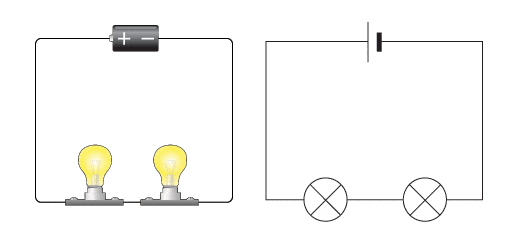


What type of circuit does the picture represents?
Series Circuit
Parallel Circuit

What type of circuit does the picture represents?
Series Circuit
Parallel Circuit

Select all the examples of refraction.
rainbow
glass of water
prism
bird in mirror

(a) materials allow (b) (c) to pass (d) , but scatter some of the other rays.
Orbit is the (a) one (b) takes as it (c) around another object.
Match the following.

equator

axis

rotation

orbit

hemisphere
Label the Earth.

Earth's orbit lasts (a) days.
The sun appears to rise in the (a) and set in the (b) .

9. Does your shadow appear longer at sunrise noon, or sunset?
sunrise
noon
sunset

Earth's (a) is responsible for making the stars appear to move across the sky at night.

The moon appears lit because...
it glows from inside.
it is on fire.
it reflects the sun's light.
it is hot.

Design an experiment to observe and record the phases of the Moon over a month. What materials would you need and what steps would you follow?
Materials: Telescope, notebook, pen. Steps: Observe the Moon every night, record the date and phase, and compare the observations over a month.
Materials: Microscope, notebook, pen. Steps: Observe the Moon every night, record the date and phase, and compare the observations over a month.
Materials: Camera, notebook, pen. Steps: Observe the Moon every night, record the date and phase, and compare the observations over a month.
Materials: Binoculars, notebook, pen. Steps: Observe the Moon every night, record the date and phase, and compare the observations over a month.

By using a (a) you can (b) the next (c) of the (d) .

Which phase of the Moon occurs when the Moon is between the Earth and the Sun?
Full Moon
New Moon
First Quarter
Last Quarter

What is the phase of the Moon when it is completely illuminated as seen from Earth?
New Moon
Full Moon
First Quarter
Last Quarter

Sun

Earth

Moon
Reorder the following moon phases INCREASING in size...

new moon (0%)

waxing crescent (25%)

first quarter (50%)

waxing crescent (75%)

full moon (100%)
Reorder the following moon phases DECREASING in size...
full moon (100%)
waxing crescent (75%)

last quarter (50%)
waxing crescent (25%)
new moon (0%)
What is the largest planet?
Which planet is known as the Red Planet?
Earth
Venus
Mars
Mercury
What are the 4 inner planets?
What are the four outer planets?
what are the rocky objects between Mars and Jupiter?

Arrange the four INNER planets starting with the one closest to the Sun.

Mercury

Venus

Earth

Mars

Arrange the four OUTER planets starting with the one closest to the asteroid belt (after Mars).

Jupiter

Saturn

Uranus

Neptune
Draw the water cycle starting with (1) the sun.
Be sure to include the
following processes and label them:
(2) evaporation
(3) transpiration
(4) condensation
(5) precipitation
(6) runoff

Select all the types of precipitation.

rain

snow

fog

hail
What role does the Sun play in the water cycle?
It cools down the water
It provides energy for evaporation
It causes condensation
It collects water in oceans
The process of (a) in the (b) is when (c) (d) and changes into (e) droplets.
Identify condensation.
Identify evaporation.
Explain how the Sun's energy drives the water cycle.
The Sun's energy causes water to freeze.
The Sun's energy causes water to evaporate, which then condenses and precipitates.
The Sun's energy causes water to sink into the ground.
The Sun's energy causes water to stay in one place.
What is the main difference between weather and climate?
Weather is the average atmospheric conditions over a long period, while climate is the atmospheric conditions at a specific time.
Weather refers to short-term atmospheric conditions, while climate refers to long-term patterns.
Weather is always predictable, while climate is not.
Weather and climate are the same.
Why is it important to understand weather and climate? Select all that apply.
To predict daily activities
To prepare for natural disasters
To understand long-term environmental changes
To assist farmers & ranchers

Evaluate the importance of weather forecasting in agriculture.
Weather forecasting is not important for agriculture.
Weather forecasting helps farmers plan planting and harvesting times.
Weather forecasting only helps in predicting natural disasters.
Weather forecasting is only useful for city planning.

Design a project to study the long-term effects of climate change in your local area.
Record daily weather conditions for a week.
Collect data on temperature and precipitation over several years.
Study the weather forecast for the next month.
Measure the humidity levels in your home.

Ava is a part of different research teams. Each team recorded temperatures for five days. Which team reported the temperatures correctly?
Team A (Ava's team): 13°, 74°, 61°, 76°, 69°.
Team B (Zoe's team): 13, 74, 61, 76, 69.
Team C (Sophia's team): 13°C, 74°C, 61°C, 76°C, 69°C.
Team D: 13°F, 74°F, 61°F, 76°F, 69°F.

Which city experienced the biggest change in temperature from Monday to Friday?
A) Madrid
B) Moscow
C) Lima
D) Caracas

Stephanie, Leslie, and Sophia recorded the highest temperature for each month in Washington, D.C. and New York City. Based on their graph, which statement is true?
A) They used a barometer to take these measurements.
B) The daytime temperature in New York was higher than in Washington, DC.
C) They used an anemometer to take these measurements.
D) The temperatures in both cities changed in a similar pattern.

What would be a reasonable prediction for the precipitation in Virginia Beach in November 2022?
A) 90 mm
B) 70 mm
C) 70 in
D) 90 in
Match the following

thermometer

rain gauge

anemometer

weather map
(a) is when pieces of the Earth are deposited
somewhere else.

What type of change is this?
erosion
weathering
deposition
hurricane
Most weathering is a (a) process that happens over thousands or millions of years.
Identify where erosion and deposition take place.

A (a) is an enormous mass of ice moving over land, causing weathering of rock and soil.
Match the following landforms to the changes that created them.

wind erosion

glacial movement (weathering & erosion)

water erosion

water erosion & deposition

weathering & erosion
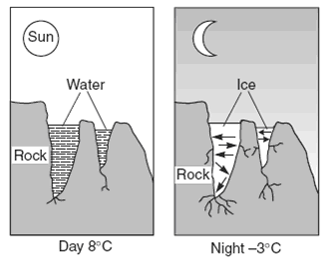
Which statement best explains why this process results in weathering?
Identify the area where erosion has occurred the most by clicking on the correct part of the image.

A (a) is a deep valley with steep sides.

An (a) is land that has water all around it.

(a) are the largest bodies of saltwater on earth.

A (a) is the area where the ocean touches the land.

A (a) is a low area between higher lands such as mountains.
Where are deltas located?
At the mouth of a river
At the start of a river
On a beach
At the top of a mountain

When the students created the small pile of sand at the end of the flow of water, they modeled the formation of which of the following?
Dunes
Canyon
Plain
Delta

Which forces create landforms such as deltas?
Volcanic eruptions
Earthquakes and landslides
Planetary movements
Moving wind and water
What shape does a delta form?
a rectangle
a square
a triangular fan
Not Here
Select the fossils that can help a scientist determine that this land used to be covered in water.
Select the oldest layer of soil that contains fossils.
Select the fossils of carnivores.
Match the following

imprint
fossil

trace
fossil

fossil
fuel

sedimentary
rock

mineral

What's your favorite dinosaur?
Reorder the following in the correct sequence.

organism
dies

erosion covers it with sediment

time & pressure push bones down

What process is responsible for moving the soil and small rocks downstream?
weathering
erosion
deposition
compaction
(a) is responsible for moving the soil and small rocks downstream.

What happens to the soil and small rocks when they settle and build up at the mouth of the river?
HINT-The mouth of the river is at the bottom.
They are eroded into smaller pieces.
They are deposited to form a delta.
They are compacted to form sedimentary rock.
They are melted by the river's heat.
Identify the mouth of the river where soil and small rocks are deposited.
The river (a) soil and small rocks at the mouth of the river.
123-124.
Answer the questions below after watching the video
The formation of (a) began with (b) dying in (c) .

Pressure from the top layers of soil is known as _____.
compaction
deposition
cementation

Fossil B is an ancient marine (ocean) mollusk that has been found in tall mountains. This tells us that-
Fossils can be carried up a mountain.
The rocks at the top of the mountain used to be underwater.
The rocks at the top of the mountain used to be in the desert.
It is impossible that marine mollusks existed in the past.

_____ is a scientist who studies fossils.
Paleontologist
Marine Biologist
Astronaut
Zoologist
(a) is a scientist who studies fossils.

_____ rocks form from cementation and compaction.
Sedimentary
Igneous
Metamorphic

(a) are the remains, imprints or traces of once-living organisms.
Identify the three different types of rocks.
HINT-Look at your anchor charts.

A highway being built through a (a) may lead to a (b) in the animal (c) in the area.
A (a) is an area where an organism lives and gets its resources for survival.

You are on a field trip to the zoo. Which observation would describe elephants interacting with the biotic elements of their ecosystem?
Elephants walking across their habitat.
Elephants drinking water using their trunks.
Elephants eating leaves off of a tree.
Elephants tend to live in warm areas.

As you visit the hippo area at the zoo, which of your observations would describe how hippos interact with the biotic parts of their environment?
The hippos sliding into their pond and climbing onto a flat rock.
The hippos eating a watermelon that is being fed to them by a zoo worker.
The hippose using the water as their restroom.
The hippos splashing water against the window.
Identify the abiotic (non-living) factors in this ecosystem.
Identify the biotic (living) factors in this ecosystem.

An (a) are the (b) among (c) and (d) things in an (e) .
Identify the biotic and abiotic factors in this artic ecosystem.
Categorize these organisms as producers, consumers, or decomposers.
mushroom
human
giraffe
flowers
tree
grass
monkey

fungi
worm

bacteria

jaguar

moss
Match human activities to their environmental impact.

loss of habitat for organisms

poor air quality

decline in fish populations

protecting ecosystems
Label this food chain.

What is this an example of?
ecosystem
population
community
niche
What are the nonliving factors of an ecosystem?


What is the difference in population decline between terrestrial (land) species and freshwater species?

This chart shows countries elephants' habitat. In which country has the elephant population acutally increased the land for its habitat?
(a)

Based on this pie chart, what is combined forest area of Africa, Asia, & Europe?
Select all the forms of pollution that can disrupt a plant's life cycle.


Pollution in the soil can (a) a plant's roots.
Plants release (a) , but need (b) .
Humans (c) carbon dioxide, but (d) oxygen.
(a) is the process by which plants take in water, sunlight, and carbon dioxide to make food for itself.
Identify the part of the plant that gathers the sunlight needed for photosynthesis.
Reorder the plant life cycle.


A seedling does not have flowers or fruit.
A seedling does not have a root.
A seedling does not have a stem.
A seedling does not need sunlight to grow.

Bees are the only way plants get pollinated.
True
False

Identify the similarities between
these two life cycles.
Both organisms become a larva.
Both organisms begin as an egg.
Both organisms grow inside a pupa.
Both organisms begin life as a seed.
Drag the correct stage to the tomato life cycle.
Which picture shows a life cycle?


Order the stages of the Frog Life Cycle.


Compare the life cycle of a reptile to the life cycle of an amphibian. How are the life cycles of reptiles and amphibians different?
Amphibians lay eggs and reptiles do not.
Amphibians go through a stage that looks different from the adult and reptiles do not.
Reptiles always have a shell and amphibians do not.
Reptiles have legs and amphibians do not.

