wayground logo

Free Printable Worksheets

Font size

S
M
L
XL
Worksheets

6th Grade Final Exam Review

Total questions: 159

Worksheet time: 2hrs 24mins

Name
Class
Date
1.
A constellation is a group of visible ____ that form a pattern when viewed from Earth.  
a)
planets
b)
stars
c)
patterns
d)
creatures
2.
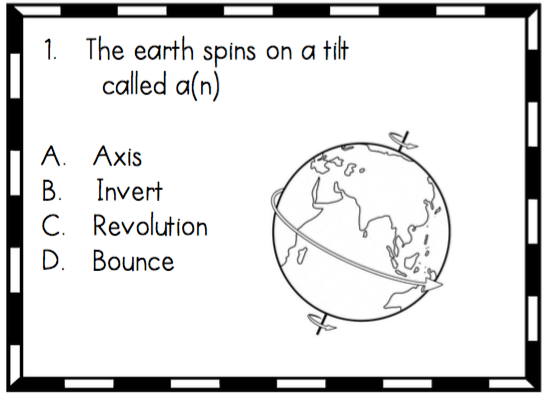
The Earth spins on a tilted angle called a (an) 
a)
Axis
b)
Invert
c)
Revolution
d)
Bounce
3.
Rotation of the earth is what causes
a)
The seasons
b)
Day and night
c)
The tides
d)
A full moon
4.
Rotation of the earth takes
a)
One day
b)
One year
c)
One summer
d)
One winter
5.
Revolution of the earth takes
a)
One day
b)
One year
c)
One summer
d)
One winter
6.
The earth's revolution is called an orbit, and we orbit around
a)
The moon
b)
The sun
c)
Earth
d)
Venus
7.
Which happens in one year’s time?
a)
The moon makes one complete revolution around Earth.
b)
Earth makes one complete revolution around the sun.
c)
Earth makes one complete spin on its axis.
d)
The sun makes one complete spin on its axis.
8.
What motion of the Earth takes 365 days?
a)
Rotation
b)
Tilting 
c)
Revolution
d)
Spinning
9.
Which of the following best describes why the Earth has the four seasons?
a)
The sun is closer to the Earth during summer and farther away during winter
b)
The sun shines directly onto the equator all year long
c)
The tilt of the Earth is the primary reason for the seasons
10.
a)

A

b)

B

c)

C

d)

D

11.
a)

A

b)

B

c)

C

d)

D

12.
During an equinox, the Sun is directly over the?
a)
Tropic of Capricorn
b)
Tropic of Cancer
c)
Equator
d)
Santa's Workshop
13.
Fall and Spring occur during ___.
a)
solstices
b)
equinoxes
c)
New Moons
d)
Full Moons
14.
Winter and Summer occur during ___.
a)
solstices
b)
equinoxes
c)
Full Moons
d)
New Moons
15.
A person would weigh less on on the Moon than on the Earth because . . .
a)
Moon has more mass, and therefore more gravity
b)
Moon has less mass, and therefore more gravity
c)
Moon has more mass, and therefore less gravity
d)
Moon has less mass and therefore less gravity
16.
What moon phase would be seen from Earth when the moon is at position 1? 
a)
new moon
b)
first quarter
c)
third quarter 
d)
full moon
17.
What moon phase is this? 
a)
waxing crescent
b)
waxing gibbous
c)
waning crescent
d)
waning gibbous
18.
What moon phase would be seen from Earth when the moon is at position 5? 
a)
new moon
b)
first quarter
c)
full moon
d)
third quarter
19.
What moon phase is this? 
a)
waxing crescent
b)
waxing gibbous
c)
waning crescent
d)
waning gibbous
20.
What phase of the moon would be visible when the moon is at position 3? 
a)
new moon
b)
first quarter
c)
full moon
d)
third quarter
21.
What moon phase is this? 
a)
new moon 
b)
full moon
c)
waxing crescent
d)
waning crescent
22.
What moon phase would be visible from Earth when the moon is at position 5? 
a)
first quarter
b)
third quarter
c)
new moon
d)
full moon
23.
What moon phase is this? 
a)
first quarter
b)
third quarter
c)
waxing crescent
d)
waning crescent
24.
What moon phase is this? 
a)
new moon
b)
full moon
c)
waxing crescent
d)
waning crescent
25.
What does "waning" mean? 
a)
growing
b)
shrinking
c)
lighted
d)
dark
26.
What does "waxing" mean?
a)
growing
b)
shrinking
c)
lighted
d)
dark
27.
What side of the moon is the light on when the moon is waning? 
a)
left
b)
right
c)
front
d)
back
28.
What side of the moon is the light on when the moon is waxing? 
a)
left
b)
right
c)
front 
d)
back
29.
When the Earth is between the Moon and the Sun, it is most likeky a:
a)
Full Moon
b)
Half Moon
c)
3rd Quarter Moon
30.
The Moon gets its light from the
a)
Earth
b)
Stars
c)
Sun
31.
About how long does it take the Moon to complete it's cycle?
a)
1 week
b)
1 month
c)
1 year
32.
Why does the Moon have different phases?
a)
It follows the Sun around the Earth.
b)
It moves around the Earth.
c)
It moves around the Sun.
33.
When the Moon is between the Earth and the Sun, it is most likely in what phase?
a)
New
b)
3rd Quarter
c)
Full
34.
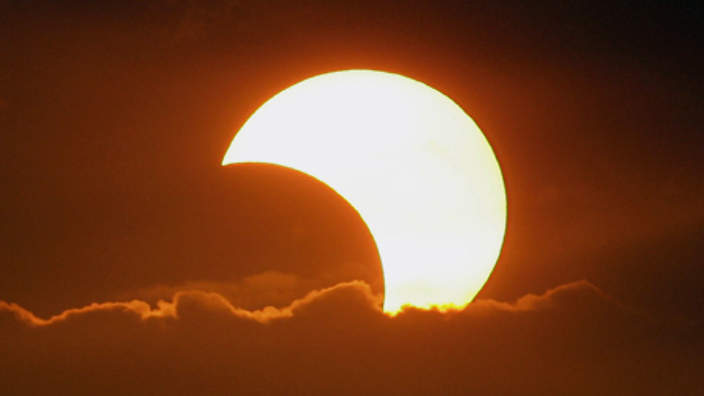
This image is an example of
a)
Lunar Eclipse
b)
Full Moon
c)
New Moon
d)
Solar Eclipse
35.
Why isn't there an eclipse every month?
a)
Because the moon orbits the sun differently than Earth does.
b)
Because the Earth's orbit and the moon's orbit are at the same angle, flat plane.
c)
Because the moon's orbit is offset from Earth's orbit by 1.5°, not in a flat plane.
d)
Because the lunar cycle is longer than a month.
36.

What happens during a solar eclipse?

a)

The sun blocks the moon from Earth.

b)

The moon blocks the light from the sun from Earth.

c)

The Earth blocks the moon from the sun.

d)

The Earth blocks the light from the sun on the moon.
37.
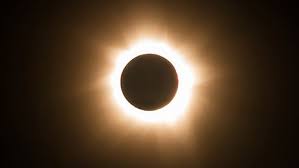
During a solar eclipse...
a)
The sun is blocked by the moon
b)
The Earth is blocked moon
c)
The moon is blocked by the sun
d)
You are blocked
38.
What is the darkest inner part of the shadow cone called, where a total eclipse can be viewed.
a)
Total
b)
Umbra
c)
Penumbra
39.
Which of the following is NOT true about a total solar eclipse?
a)
It can be viewed from every spot on earth
b)
It is dangerous to look at without the proper device
c)
When it happens, the moon blocks all of the sun except the corona
d)
You must be within the moon's umbra to see it
40.
There are two sections of a shadow. Which one is the lighter, outer shadow?
a)
umbra
b)
lumbar
c)
penumbra
d)
annular
41.
What must occur for an solar eclipse to occur?
a)
Sun-Earth-Moon in line
b)
Sun-Moon-Earth in line
42.
What causes tides?
a)
Earth's tilt
b)
Moon's Tilt
c)
Sun's tilt
d)
Earth's Rotation
43.
During which moon phase do the highest high tides and the lowest low tides occur?
a)
New/Full
b)
Full/Quarter
c)
New/Quarter
d)
Crescent/Gibbous
44.
When high tides are higher and low tides are lower these are called ________ tides.
a)
Spring
b)
Neap
c)
Quarter
d)
Crescent
45.
During which moon phases do the high tides not rise as high and the low tide not drop as low?
a)
Neap
b)
Spring
c)
Quarter
d)
Crescent
46.
A[n] ______________ tide occurs when the sun is at right angles to the line between Earth and the moon. 
a)
high
b)
neap
c)
low
d)
spring
47.
Differences in the moon's and sun's pull on different sides of the Earth cause _________.
a)
gravity
b)
lunar phases
c)
tides
d)
dabbing
48.
A[n] ___________ tide occurs when the sun, Earth, and the moon are nearly in a line. 
a)
spring
b)
high
c)
low
d)
neap
49.
The bulge of water on the side of the Earth closest to the moon produces ___________.
a)
high tide
b)
low tide
c)
neap tide
d)
spring tide
50.
Tides are caused mainly by the differences in how much gravity from the moon and the sun pulls on different parts of the Earth. 
a)
True
b)
False
51.
Changes in the positions of Earth, the moon, and the sun affect the height of high tides during a month. 
a)
True
b)
False
52.

What are dark, flat areas on the moon made from lava flows?

a)

craters

b)

maria

c)

highlands

d)

mountains

53.

What are large round pits on the Moon created by objects crashing into the Moon?

a)

craters

b)

highlands

c)

rays

d)

maria

54.

What are light-colored parts of the Moon that were too high for lava to reach?

a)

craters

b)

highlands

c)

rays

d)

maria

55.

Why are craters still on the Moon when there aren't as many left on Earth?

a)

Earth never had any craters.

b)

It is illegal to remove them.

c)

There is no wind or water on the Moon to erase them away.

56.

The Moon rotates in the same amount of time as it revolves around Earth. What does this cause?

a)

the phases of moon

b)

the changing seasons on earth

c)

the rise and fall of tides

d)

the same side of the Moon to always be visible on Earth

57.
  What does "geo-" mean?
a)
Earth
b)
sun
c)
Center
58.
This image shows the:
a)
Geocentric Solar System
b)
Heliocentric Solar System
59.

Which person popularized the heliocentric model?

a)

Ptolemy

b)

Aristotle

c)

Copernicus

60.

Kepler's first law states that the orbits of the planets are in the shape of a/an...

a)

perfect circle

b)

ellipse

c)

spiral

61.
What Model is where the sun is the center of the universe?
a)
Geocentric
b)
Heliocentric
c)
Earth's rotations
d)
Earth's planets
62.
Vernal equinox is what season?
a)
Winter
b)
Spring
c)
Summer
d)
Fall
63.
Autumonial equinox is what season?
a)
Spring
b)
Fall
c)
Winter
d)
Summer
64.
a dark spot on the photosphere of the sun
a)
corona
b)
solar flare
c)
sunspot
d)
magnitude
65.
a brief burst of energy from the sun’s photosphere
a)
corona
b)
solar flare
c)
solar wind
d)
photosphere
66.
the sun’s atmosphere
a)
corona
b)
universe
c)
photosphere
d)
solar flare
67.
the visible surface of the sun
a)
galaxy
b)
universe
c)
corona
d)
photosphere
68.
a group of stars, gas, and dust
a)
galaxy
b)
universe
c)
light-year
d)
corona
69.
everything that exists- planets, stars, dust, gases, and energy
a)
galaxy
b)
universe
c)
photophere
d)
corona
70.
a band of stars that includes most stars of average color, size, magnitude, and temperature
a)
main sequence
b)
galaxy
c)
magnitude
d)
corona
71.
brightness of stars
a)
galaxy
b)
magnitude
c)
photosphere
d)
corona
72.
fast-moving stream of particles thrown into space by solar flares
a)
magnitude
b)
corona
c)
solar flare
d)
solar wind
73.
Identify part 1.
a)
corona
b)
photosphere
c)
core
d)
radiation zone
74.
Identify part 2.
a)
corona
b)
convection zone
c)
core
d)
radiation zone
75.
Identify part 3.
a)
corona
b)
convection zone
c)
core
d)
radiation zone
76.
Identify part 4.
a)
photosphere
b)
convection zone
c)
core
d)
radiation zone
77.
Identify part 5.
a)
photosphere
b)
chromosphere
c)
core
d)
radiation zone
78.
Identify part 6.
a)
photosphere
b)
chromosphere
c)
corona
d)
radiation zone
79.
Identify part 7.
a)
sunspot
b)
solar flare
c)
corona
d)
radiation zone
80.
Identify part 9.
a)
sunspot
b)
solar flare
c)
granules
d)
prominence
81.
What is the closest planet to the Sun?
a)
Mercury
b)
Mars
c)
Venus
d)
Earth 
82.
What are the inner planets composed of?
a)
gases and ice
b)
rock and ice
c)
gases and rock
d)
rock
83.
What do all the items in this list have in common?
1)has a day longer than its year
2)is the hottest planet
3)rotates counter clockwise (east to west)
a)
This list describes Earth.
b)
This list describes Mercury.
c)
This list describes Mars.
d)
This list describes Venus.
84.
Which list places the inner planets in order from largest in size to smallest in size?
a)
Venus, Earth, Mercury, Mars
b)
Mercury, Mars, Venus, Earth
c)
Earth, Venus, Mars, Mercury
d)
Venus, Mars, Earth, Mercury
85.
What are the three qualifications of an inner planet?
a)
has an elliptical orbit, has a rocky surface, and no atmospere
b)
has an elliptical orbit, has rings, and a rocky surface
c)
has an elliptical orbit, has a rocky surface, and is position between the Sun and the Asteroid Belt.
d)
has an elliptical orbit, a rocky surface, and is positioned between the Asteroid Belt and Pluto
86.
Which inner planets have a moon?
a)
Earth and Mars
b)
Mercury and Mars
c)
Earth and Jupiter
d)
Mars and Venus
87.
Which of the following pairs have a ROTATION that is the approximately the same amount of time?
a)
Venus and Mars
b)
Earth and Venus
c)
Mars and Mercury
d)
Earth and Mars
88.
What do Mercury and Venus have in common?
a)
They both thick atmospheres.
b)
They both rotate counter clockwise.
c)
They have a similar diameter.
d)
They both have no moons.
89.
The right combination of temperature, water, and oxygen
a)
affects Neptune’s orbit.
b)
supports life on Earth.
c)
causes gas giants to form.
d)
results in storms on Jupiter.
90.
If we needed to move to another planet right now, which planet could we move to?
a)
Mars
b)
Venus
c)
Mercury
d)
There is no other planet that we know of that we could survive on.
91.
Which planet has a longer day than its year? 
a)
Saturn
b)
Neptune
c)
Mercury
d)
Mars
92.
What do all the items in the list below have in common?
1) has a rotation of 59 days 
2) is furthest to left of the Asteroid Belt
3) has no atmosphere and no wind
a)
The items in the list describe Earth.
b)
The items in the list describe Mars.
c)
The items in the list describe Mercury.
d)
The items in the list describe 
93.
The absence of a dense atmosphere and Mercury’s slow rotation contribute to 
a)
long days & short nights   
b)
short days & long nights   
c)
steady temperatures   
d)
a large daily temperature range   
94.
____________is a planet similar to Earth in size, mass, and density.
a)
Mercury
b)
Venus
c)
Mars
d)
Neptune
95.
____________ is the closest planet to the sun; and has a hot heavily cratered surface.
a)
Mercury
b)
Venus
c)
Earth 
d)
Mars
96.
The sun and all the planets and other bodies that revolve around it make up the
a)
universe
b)
galaxy
c)
solar system
d)
neighborhood
97.
Compared to Earth, the Outer planets are HUGE.  True or False
a)
True
b)
False
c)
Neither
d)
Both
98.
The first four outer planets from the sun out are:
a)
Jupiter, Saturn, Pluto, Neptune
b)
Pluto, Neptune, Uranus, Saturn, Jupiter
c)
Jupiter, Saturn, Uranus, Neptune
d)
Neptune, Uranus, Saturn, Jupiter
99.
The first four outer planets are:
a)
Much smaller and have rocky surfaces.
b)
Much larger and have rocky surfaces.
c)
Much larger and do not have solid surfaces.
d)
Much smaller and do not have solid surfaces.
100.
The gas giants have so much mass, they exert a much stronger gravitational force.True or False
a)
True
b)
False
c)
Neither
d)
Both
101.
The composition of the outer planets atmospheres is similar to the gases in the __________.
a)
Mercury
b)
Venus
c)
Sun
d)
Earth
102.
All of the giant planets have a solid surface.  True or False
a)
True
b)
False
c)
Niether
d)
Both
103.
Giant planets have cores that are:
a)
Partly solid core made of rock, ice, frozen carbon dioxide.
b)
Partly solid core made of rock, no ice, frozen carbon dioxide.
c)
Partly solid core made of rock, ice, liquid carbon dioxide.
d)
Soggy core made of rock, ice, liquid carbon dioxide.
104.
Jupiter has a thick atmosphere made up mainly of _______ and ________.
a)
Hydrogen and Nitrogen
b)
Hydrogen and Helium
c)
Nitrogen and Argon
d)
Nitrogen and Helium
105.
One of the interesting features of Jupiter is the hurricane storm called the:
a)
The Great Orange Spot
b)
The Great Red Spot
c)
The Great Pink Dot
d)
The Big Dark Spot
106.
Saturn's rings are made up of
a)
Chunks of Ice and snow
b)
Chunks of Ice and rock
c)
Chunks of asteroids and Ice
d)
Chunks of Corn and Broccoli
107.
Saturn's largest moon, is 
a)
Luna
b)
Titan
c)
Triton
d)
Charon
108.
Uranus looks  __________ because of traces of methane in its atmosphere.
a)
Green
b)
Orange
c)
Blue
d)
Red
109.
Uranus is rotating on its axis from  ________ to _________.
a)
East to West
b)
South to North
c)
West to East
d)
North to South
110.
How was Neptune discovered by
a)
NASA probe sent into outer space
b)
Mathematical prediction of another planet whose gravity was affecting Uranus's orbit
c)
Astronomers found it by accident one day while using a high level microscope.
d)
Mrs. Dickson and Mrs. Sarra
111.
True or False.   Pluto is smaller than the Earth's Moon.
a)
True
b)
False
c)
Neither
d)
Both
112.
Pluto has been demoted to a 
a)
Mini moon planet
b)
Midget Planet
c)
Small Planet
d)
Dwarf Planet
113.
The belt between Mars and Jupiter
a)
Comets
b)
Asteroids
c)
Meteors
d)
Stars
114.
They are sometimes called shooting stars
a)
interplanetary dust
b)
asteroids
c)
comets
d)
meteors
115.
A meteorite is DIFFERENT from a comet mainly because
a)
has a tail of ice and gas
b)
is found in orbit between Jupiter and Mars
c)
enters the Earth's atmoshere
d)
has a nucleus mad of rock and snow.
116.
Sometimes I am called a "dirty snowball". I have a hydrogen cloud, coma, and a nucleus. I am invisible except when near the sun. What am I?
a)
Asteroid
b)
Star
c)
Meteor
d)
Comet
117.
We are composed mainly of rock and metal.
a)
comets and stars
b)
stars and meteors
c)
asteroid and meteors
d)
comets and asteroid
118.
I am a rock entering a planet's atmosphere.
a)
meteor
b)
meteorite
c)
asteroid
d)
comet
119.
When a meteor hits Earth, what is it called?
a)
meteorite
b)
meteroid
c)
meteor
120.
Objects made of ice, gas and dust and orbit our sun are called:
a)
Asteroids
b)
Comets
c)
Meteroids
d)
Meteors
121.
Asteroids "hang out" in our solar system in a place called:
a)
The Kupier Belt
b)
The Oort Cloud
c)
The Planetary Rings
d)
The Asteroid Belt
122.
One similarity between asteroids, comets and meteoroids is that they all:
a)
are made of rock
b)
come from the Asteroid Belt
c)
come from the Oort Cloud
d)
orbit the sun
123.
When objects strike the surface of a planet or moon, they leave a deep impression on the surface called a:
a)
Pothole 
b)
Crater
c)
Canyon
d)
Plateau
124.
What is a meteor called when it's in space?
a)
meteroid
b)
meteor
c)
meteorite
125.
What causes meteors to burn up in our atmosphere?
a)
Heat from the Sun
b)
Heat from Earth's atmosphere
c)
They are already so hot that our atmosphere can't handle it
d)
Friction from the Earth's atmosphere
126.
All modern telescopes are 
a)
reflectors
b)
refractors
c)
long
d)
thin
127.
Why are many large optical telescopes located on mountains?
a)
to be closer to the stars
b)
to be above part of the atmosphere
c)
because it is easier to build telescopes on mountains
d)
to be closer to city lights
128.
A ______ telescope uses a mirror to focus light onto a small area.
a)
reflecting
b)
refracting
c)
radio
d)
spectrum
129.
What does Reflecting Telescope have?
a)
Lens
b)
Mirrors
c)
Bat ears
130.
Characteristics used to classify stars include
a)
distance, size, and color.
b)
size, distance, and brightness.
c)
color, brightness, and distance.
d)
size, brightness, and temperature.
131.
What color are the coolest stars?
a)
blue-white
b)
yellow
c)
red
d)
orange
132.
The absolute brightness of a star depends on its
a)
distance and temperature.
b)
size and temperature.
c)
color and temperature.
d)
distance and color.
133.
The Hertzsprung-Russell diagram shows that main-sequence stars
a)
are mostly hot and dim.
b)
are mostly cool and bright.
c)
increase in brightness as they increase in temperature.
d)
decrease in brightness as they increase in temperature.
134.
Astronomers typically measure distances to stars in units called
a)
kilometers.
b)
light-years.
c)
parallax.
d)
electromagnetic spectrum.
135.
The brightness of a star as seen from Earth is its 
a)
apparent brightness.
b)
absolute brightness.
c)
parallax.
d)
reflective brightness.
136.
What color of star is the hottest?
a)
Blue
b)
Red
c)
Yellow
d)
Orange
137.
A supernova is the explosion of a dying
a)
high-mass star.
b)
low-mass star.
c)
medium-mass star.
d)
protostar.
138.
A star is born when
a)
a nebula expands.
b)
helium and oxygen combine.
c)
nuclear fusion starts.
d)
a protostar begins to cool.
139.
The variable that determines whether a protostar becomes a star is its
a)
mass.
b)
color and brightness.
c)
age.
d)
surface temperature.
140.
Stars with less mass will last longer than stars with more mass.
a)
True
b)
False
141.
The remains of a star that has no fuel but glows faintly is a 
a)
white dwarf.
b)
black dwarf.
c)
black hole.
d)
supernova.
142.
All stars begin as part of a large cloud of gas and dust called
a)
a nebula.
b)
a black hole.
c)
a protostar.
d)
elliptical galaxy.
143.
Our solar system is located in the 
a)
Milky Way galaxy.
b)
Andromeda galaxy.
144.
A(n) _____ galaxy has a characteristic pinwheel shape.
a)
spiral
b)
elliptical
c)
open cluster
d)
globular
145.
A galaxy that does not have a regular shape is classified as a(n) _____ galaxy.
a)
spiral
b)
open cluster
c)
globular
d)
irregular
146.
Which of the following is a major difference between elliptical galaxies and spiral galaxies?
a)
Which of the following is a major difference between elliptical galaxies and spiral galaxies?
b)
Spiral galaxies contain only old stars.
c)
Elliptical galaxies have almost no gas or dust between the stars.
d)
Elliptical galaxies vary more in shape than spiral galaxies.
147.
According to Hubble's law, the farther away a galaxy is:
a)
the faster it is moving toward us
b)
the slower it is moving toward us
c)
the slower it is moving away from us
d)
the faster it is moving away from us
148.
What type of star is the Sun?
a)
Red giant
b)
White dwarf
c)
Red supergiant
d)
Main sequence
149.
Which one of these is considered evidence in support of the big bang theory?
a)
stars
b)
electromagnetic spectrum
c)
cosmic background radiation
d)
Hubble telescope
150.
When did the big bang occur?
a)
5 million years ago
b)
4.6 billion years ago
c)
13.8 billion years ago
d)
100 billion years ago
151.
What determines if a star becomes a white dwarf, neutron star, or a black hole?
a)
Its age
b)
Its mass
c)
Its brightness
d)
Its temperature
152.
Which correctly orders the items from smallest to largest?
a)
Universe, Galaxy, Star Cluster, Star
b)
Star, Star Cluster, Universe, Galaxy
c)
Star, Star Cluster, Galaxy, Universe
d)
Star, Galaxy, Star Cluster, Universe
153.
Groups of two or more stars are called
a)
Galaxies
b)
Star Clusters
c)
Eclipsing Binaries
d)
Star Systems
154.

Most scientists believe the Big Bang Theory explains which of the following questions?

a)

How our planets and moons formed

b)

How our universe began

c)

How the sun turns hydrogen into helium

d)

How fast light travels through space

155.
All satellites are...
a)
Natural satellites
b)
Man-made satellites
c)
Both natural and man-made
156.
Which is NOT a type of galaxy?
a)
Elliptical
b)
Spiral
c)
Oblong
d)
Irregular
157.
Where is our Solar System located in the Milky Way galaxy?
a)
Near the center
b)
Near the outside on one of the arms
158.
Which type of galaxy is the brightest with a lot of new stars?
a)
Irregular
b)
Spiral
c)
Elliptical
159.

How is a theory different from a guess?

a)

A theory cannot be disproven; a guess can be

b)

A theory is backed up by hard evidence; a guess is not

c)

A theory is agreed upon by scientists; a guess is only agreed on by laypeople

d)

A theory is usually very old; a guess is usually very new