
 Worksheets
March Science Benchmark Review
Total questions: 161
Worksheet time: 7hrs 5mins

Any organism that CANNOT make its own food internally...it has to eat or ingest other organisms.
scavenger
consumer
decomposer
producer
Plants and all producers need which of the following to create their own food and survive...
Sunlight
carbon dioxide
water
All of the above
Which options list all producers...
Grasses, Oak tree, fungi
Banana tree, mushrooms, cactus
seaweed, mountain lion, algae
Prickly pear cactus, grasses, coconut tree
_______ is when an organism moves from one place to another in search of food, water and different temperatures.
habitat
migrate
hibernate
ecosystem
_______ is when an organism moves from one place to another in search of food, water and different temperatures.
habitat
migrate
hibernate
ecosystem

In the food web below, the hawk is obtaining its energy from..
The grasshopper
The rabbit
The snake
The rabbit and the snake
Which are all nonliving things?
sunlight, temperature, water, air, wind, rocks, and soil
sunlight, temperature, insects, air, wind, rocks, and soil.
bacteria, temperature, water, air, wind, rocks, and soil.
sunlight, temperature, water, air, wind, rocks, and worms.

The owl will obtain its energy from ...
grasshopper and mouse
rabbit and butterfly
mouse and rabbit
butterfly and frog
Here are some fun facts about plover birds:
1.They eat Eats fly larvae, beetles, crustaceans and marine worms.
2.They pick leeches off crocodiles gums.
3.Their legs are a bright orange color.
4.Eats fly larvae, beetles, crustaceans and marine worms
Which of these facts best describes how a plover bird depend on another animal to survive?
1
2
3
4

The arrows in a food web represent...
They point to the organism that is being eaten.
It shows how sunlight flows within an ecosystem.
They show what direction the energy is flowing between organisms.
They represent each habitat by demonstrating the organisms

A rabbit will obtain its energy from a mouse and a green tree. A jackal obtains its energy from...
a green plant and a rabbit
A goat and a green plant
A lion and a rabbit
A goat and a rabbit

What does a food web represent?
All connections of energy flow throughout all organisms in a habitat.
The specific ways that mutualism is carried out.
How carnivores get their food.
A single pathway or energy flow between organisms.

Why might an organism have more than one arrow pointing to them in a food web?
They may eat more than one other organism.
More than one organism may eat them.
The organism is the highest organism of the food web
This organism gets its energy from multiple sources.

This is an example of a ________.
chain reaction
food web
Food chain
consumers

The Frog provides energy for the _______.
Butterfly
Owl
Fox
Green plants

Where does the energy begin in this food chain?
The grass
The hawk
The grasshopper
The sun

Does this food web have arrows pointing the right way?
Yes
No
An organism that eats the remains of dead or waste material.
decomposer
consumer
producer
sun

A food chain is different than a food web. A food chain...
How all living organisms within a habitat are connected.
All of the things that a particular animal eats
How plants create their own food.
A single path of energy transfer within a habitat.


Which of these adaptations most help the hawk keep other hawks out of its territory by warning them from far away?


brown eyes
Jordan loves swimming
size of your hands
the ability to understand a language


a characteristic that is passed from parents to their offspring
inherited traits
instinctive behavior
acquired trait
learned behavior
a behavior that an animal develops by observing other animals or by being taught
learned behavior
trait
adaptation
instinctive behavior

Fox squirrels live in the trees of city parks throughout Texas. Each spring they build nests of twigs and leaves in the tops of the trees. Fox squirrels are often found near park benches, waiting to be fed by visitors. For fox squirrels, which of these is a learned behavior? (5.10B)
Building a nest each spring
Taking food from people
Having a long, bushy tail
Having sharp claws

A scientist observes sea otters using rocks to break open clamshells. Which of these investigations would best help the scientist determine whether this skill is a learned or an inherited behavior? (5.10B)
Determining what sizes and kinds of rocks are used most often by sea otters
Determining whether shellfish are an important food source in the diet of sea otters
Raising young sea otters away from adult otters that use rocks and observing whether the young otters use rocks
Observing families of sea otters over time to see whether adults that use rocks have offspring that use rocks

Crayfish live in water and often hide under rocks or plants. They come out to look for food and will eat both plants and animals. Which of these is a trait that a crayfish most likely inherits from its parents? (5.10B)
The average distance it travels each day
The number of legs it has
The amount of food it eats each day
The type of plants in its habitat

The caterpillars of monarch butterflies eat milkweed leaves. Milkweed leaves contain sap that is toxic to many animals but not to monarch butterfly caterpillars. This sap makes the monarch butterfly caterpillars toxic to predators and protects them from being eaten. Which of these is an inherited trait of monarch butterfly caterpillars? (5.10B)
The size of the milkweed leaves that the caterpillars eat
The ability of the caterpillars to eat toxic leaves without being harmed
The number of milkweed leaves the caterpillars eat each day
The number of leaves on the milkweed plants the the caterpillars visit each summer
Which of these is a learned behavior of a dog? (5.10B)
Begging for food
Drinking water
Panting on a hot day
Chewing on a bone

A farmer keeps bees to pollinate crops. The farmer makes several observations about the bees. Which of these observations describes a learned behavior? (5.10B)
Bees make return trips to sugar water from a bowl placed 40 meters from their hive.
Bees have dark eyes and black-and-yellow stripes.
Bees produce honey from the nectar they collect.
Bees will sting when threatened or disturbed.

A group of students made the observations listed in the table about the size, shape, and appearance of their hands. Which of the students' observations describe inherited traits? (5.10B)
Observations 2 and 5 only
Observations 1, 3, and 4 only
Observations 2, 3, and 5 only
All the observations

For a science assignment a student was asked to observe some organisms and then make a table to classify the organisms' traits as inherited or learned. The student's table is shown. How many of these observations describe learned behaviors and how many describe inherited traits? (5.10B)
1 learned behavior, 7 inherited traits
2 learned behaviors, 6 inherited traits
3 learned behaviors, 5 inherited traits
4 learned behaviors, 4 inherited traits
Some traits of living organisms are inherited, while some behaviors must be learned. Which statement related to inherited traits or learned behaviors is not correct? (5.10B)
The ability of a figure skater to spin on ice is related to both inherited traits and learned behaviors.
The ability of lions to use camouflage to hide in grassy fields is an inherited trait only.
The number and type of legs a cricket has is an inherited trait only.
The behavior of a dog guiding a blind person on a walk through a neighborhood is an inherited trait only.
A group of students visited a park and collected leaves from many different trees in order to study them. They recorded their observations about the leaves. Which of these observations does NOT describe an inherited trait? (5.10B)
The leaves vary in shape and size.
Some leaves have holes made by insects chewing on them.
Some leaves are smooth on one side and rough on the other.
The colors of the leaves range from light green to dark green.

A teacher is setting up the terrarium shown below in a science classroom. Which of these organisms is best suited for the terrarium? (3.9A)
Blue jay
Lobster
Snail
Water lily
An African savanna is a grassland with shrubs and a few small trees. It has warm temperatures all year long, a dry winter season, and a rainy summer season. Which group of animals is most likely supported by an African savanna? (3.9A)


In parts of the East Texas Piney Woods ecosystem, there are forests with many tall pine trees. These thick forests have few other type of tall trees besides pine trees. The other plants growing in the ecosystem are usually small shrubs, grasses, and other short trees. A student wants to know what type of birds live in the Piney Woods region. The student reads the table shown about four different birds. Based on the table, which bird is most likely to lie in Texas's Piney Woods region? (3.9A)
Burrowing owl
Roseate spoonbill
Red-cockaded woodpecker
Golden-cheeked warbler

A student studying East Africa reads these facts about the Serengeti National Park in Tanzania. The student thinks that parts of Texas are probably similar to the Serengeti. Based on the following descriptions, which of these Texas animals would be least likely to live in the Serengeti's grasslands? (3.9A)


The table lists characteristics of four types of animals. What features do the ecosystems in which these animals live most likely have in common? (3.9A)
Dry, rocky mountains
Forests of pine trees
Tall, spiny cacti
Lakes and rivers
Which statement best describes the processes of weathering and erosion?
Weathering and erosion are directly responsible for the breakdown of any type of rock into smaller particles and the carrying away of the loose sediments.
Weathering and erosion are directly responsible for depositing loose sediments on the bottom of the ocean, forming layers of sediment.
Weathering and erosion are directly responsible for the amount of water in a river that transports sediments to the sea.
Weathering and erosion are directly responsible for the transportation, deposition and compaction of loose sediments on the seafloor.

Which diagram models the process of compaction leading to the formation of Sedimentary Rock?
F
G
H
J
Erosion is one of the processes involved in the formation of Sedimentary Rock. Which of these best describes the process of erosion?
Rocks are broken into smaller pieces that remain in the same location.
Pressure compacts layers of sediment and turns them into rock.
Pieces of rock or soil are carried from one place to another.
Sediment grains fall to the bottom of a lake to form Sedimentary Rock.
Some students make a model to show one of the first steps in the formation of sedimentary rock. The students pour 2 centimeters of light-colored sand into a clear plastic box. Then they add 1 centimeter of gravel. Finally they pour 2 centimeters of dark-colored sand on top of the gravel. Which characteristic of sedimentary rock does this model best show?
Sedimentary rock is made of layers.
Sedimentary rock is cemented bits of rock.
Sedimentary rock is often limestone.
Sedimentary rock is common in Texas.

The model below shows layers of sediment on the floor of an ocean. Which of the following best explains how these layers can become rock over many years?
Sand in the sediment melts and turns into rock.
The weight of the water compacts the sediment into rock.
Changing water temperatures turn sand in the sediment into rock.
Pollution caused by humans turns the sediment into rock.

The diagram below shows the sequence of the processes that turn solid rock into sandstone. Which two processes best complete this diagram?
Melting and cooling
Erosion and compaction
Compaction and cementation
Evaporation and dissolving
Sedimentary rocks form when broken bits of other rock are deposited and then –
buried and squeezed and cemented together.
melted by the heat of the Earth’s core.
completely dissolved in salt water in the ocean.
used by humans as a natural resource.
In addition to long periods of time, all of the following are necessary for the formation of sedimentary rock EXCEPT –
extreme heat.
organic matter.
various sediment.
intense pressure.

Several layers of sedimentary rock are illustrated. They are in the same order as when they first formed. Which layer formed first?
Rock Layer W
Rock Layer X
Rock Layer Y
Rock Layer Z
Which of the following is a process that creates the sediments that form sedimentary rock?
Wind, water, and ice breaking rock into smaller pieces
Heat from the earth melting rock below the surface
Volcanoes putting out lava that cools to form new rock
Continents pushing together to fold layers of rock
Which of the following locations would most likely produce sedimentary rock after much time has passed?
A beach where sand is being deposited
A mountain that receives snow year round
A volcano that erupts frequently
A rocky desert that is windy all the time
Small particles of broken down rock can be formed into sedimentary rock when they are buried and then -
melted completely because of extreme heat.
compressed and cemented together.
pushed upward and exposed to wind and water.
contaminated by underground nuclear material.
Most sedimentary rock forms in the ocean. This is because oceans -
emit much less pollution than most other habitats
receive the majority of the Sun's energy
have fewer plants and animals than on land
are where most bits of broken rock get deposited
Which of the following describes the formation of sedimentary rocks in the correct order?
Weathering, Erosion, Compaction, Deposition, Cementation
Weathering, Cementation, Erosion, Deposition, Compaction
Weathering, Erosion, Deposition, Compaction, Cementation
Weathering, Deposition, Erosion, Compaction, Cementation

Which of the following correctly completes the Sedimentary Rock Cycle?
A = Compaction, B = Erosion, C = Cementation
A = Erosion, B = Compaction, C = Cementation
A = Cementation, B = Compaction, C = Erosion
A = Erosion, B = Cementation, C = Compaction

A wide U-shaped valley is shown in photograph. This valley is most likely formed by -
Flash flooding
a glacier
a hurricane
melting snow

The photograph shows a canyon in northern Arizona. Which of these best describes how this canyon was most likely formed?
Floods eroded the sandstone away from the canyon walls
Glaciers eroded the canyon rock as they melted and moved.
Ice wedged into cracks in the rock and weathered the canyon walls
Wind blew large rocks that smashed against the canyon walls.
A wide U-shaped valley is shown in photograph. This valley is most likely formed by -
Flash flooding
a glacier
a hurricane
melting snow

What is this landform?
delta
canyon
valley
sand dune

What is this landform?
valley
delta
canyon
sand dune

This landform is formed by
water erosion
weathering
deposition of sediments
glaciers

This landform is formed by
water erosion
wind erosion and deposition
glaciers
weathering

Students constructed a model using a cardboard box, clay, and numbers on spikes, What are the students trying to demonstrate with this model?
The model represents a delta formed by erosion of sediments onto the ocean.
The model represents a delta formed by the deposition of sediments at the mouth of the ocean
The model represents a canyon formed by a moving river
The model represents sand dunes located near a beach

Below is an illustration of a river flowing through The Grand Canyon. The change in the canyon's shape is a result of EXCEPT-
The weathering of rock by moving water
The erosion of sediments by a fast moving river
The deposition of sediments by moving water and wind
The breaking and carrying of sediments by the river

Several landforms are listed in the table below. The right hand side is blank. When completed, it will list major processes that create each landform. To which landform or landforms should the process deposition belong to?
Canyon only
Delta
Canyon and Sand dune only
Delta and sand dune only

The diagram shows a river flowing onto the ocean. Which process is shown in the image above?
The creation of a delta through the erosion and deposition of sediments
The creation of a U-Shape valley by a moving glacier
The formation of a mountain by a moving river
The creation of a river by the deposition of sediments.
Which of these best demonstrates the reflection of light? (5.6C)
Looking through the glass of a large window
Looking at an image formed on a silver spoon
Looking at a lightbulb that is glowing
Looking at a star on a clear night

When light travels through air into a prism, it bends and separates into many colors. In which other situation does light bend? (5.6C)
When light moves through air into water
When light hits a wall
When light passes through outer space
When light hits a mirror

Scientists use telescopes to make distant objects appear closer. Some parts of a telescope are shown here. Which of the following best describes how the objective lens of this telescope helps a scientist observe the moon? (5.6C)
The objective lens produces light.
The objective lens blocks light.
The objective lens reflects light.
The objective lens refracts light.

The picture shows a child standing in a swimming pool. Why does the lower part of the child appear so much different in size from the upper part? (5.6C)
The light rays that travel through water and then into air are refracted.
The light rays that travel through water and then into air are enlarged.
The light rays that travel through air and then into water are reflected.
The light rays that travel through air and then into water are reduced.
Some students paint the inside of several boxes. They paint each box a different color. They observe that the inside of the box painted white looks brighter than the others. What is the most likely reason this box looks brighter? (5.6C)
More light is reflected off white paint.
More light is refracted by white paint.
More light passes through white paint.
More light is absorbed by white paint.

The model shows a special glass fiber that is thinner than some metal wires. When light enters one end of the fiber, it moves through the fiber as shown. After the light leaves the fiber, it travels---(5.6C)
in a straight line
back into the fiber
around the fiber
in a curve
A student looks into a mirror and sees an image of an object. Which diagram shows an X where the object is most likely located? (5.6C)


The diagram shows a fish being viewed from above the water. The fish appears to be closer to the surface than it really is. What causes this difference? (5.6C)
Light is reflected.
Light is refracted.
Light is focused.
Light is blocked.

In 1859, Henry Bursill published a book of hand shadows. The picture shows one of these hand shadows. Which property of light makes it possible to produce hand shadows? (5.6C)
Light can be refracted.
Light is a form of energy.
Light travels in straight lines.
Light can be separated into different colors.
Lasers produce a beam of light that can be focused on a small area. A teacher uses two mirrors to shine a beam of light from a laser onto a box. Which diagram shows how the teacher should position the two mirrors? (5.6C)


A teacher takes the top and a side off a box. She cuts a hole in another side and puts a candle outside the box, as shown below. When the teacher lights the candle in a dark room, some of the candlelight shines through the hole. Which diagram best shows how the light appears on the opposite wall of the box? (5.6C)


This photograph shows a girl using a lab instrument during an investigation on light. A teacher asks the students in the class to look carefully at the girl's eye and give reasons for its appearance. Which table correctly identifies the reasons for the appearance of the girl's eye through the lab instrument? (5.6C)


The picture shows a series circuit with three lit bulbs. How many of the bulbs will remain lit if the wire is cut at the point shown by the arrow? (5.6B)
0
1
2
3

Which of these changes to the electric circuit shown will cause the lightbulb to light up? (5.6B)
Straightening the wire so that the current can flow more easily
Adding a switch and more wire so that the current can flow more easily
Turning one battery so that its positive end connects to the other battery's negative end
Making the length of wire the same on both sides of the lightbulb
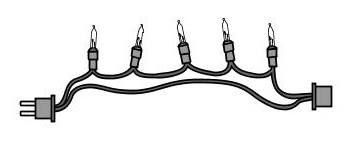
A string of light with small bubs is shown here. The bulbs are connected by wire that is covered with an insulator. When the lights are on, electricity travels in ----(5.6B)
a complete circuit
a sound wave
a light ray
an incomplete path

The diagram shows the metal posts that are usually found on a battery. The battery can be connected to a bell and a switch to produce sound. Which statement best explains why there are two metal posts on the battery? (5.6B)
The battery needs only one metal post to connect to the bell, but the other metal post is present in case the first post fails to work.
The battery needs to form a complete circuit that starts with one metal post and ends with the other metal post.
One metal post makes a complete circuit with the switch, and the other metal post makes a complete circuit with the bell.
One metal post makes the bell start to ring, and the other metal post makes the bell ring louder.

Most cars have lights, power locks, radios, and other equipment that use electricity. Electric circuits power this equipment. Each circuit has a fuse that completes it. The picture below shows one type of fuse a car may have. Which of these describes one thing that could happen if the wire in a car fuse burns out? (5.6B)
The car's lights will burn brighter.
The car's radio will not work.
The car's turn signal will blink too slowly.
The car's power windows will open faster.

A group of students built the circuit shown here. The lightbulb does not glow. Which statement explains this observation? (5.6B)
The battery is not charged.
The lightbulb is not part of a complete circuit.
The circuit does not have a switch.
The bell uses most of the energy from the battery.

A simplified diagram of a system using solar energy is shown. To recharge the battery for later use without lighting the bulb, which of the following switches should be closed? (5.6B)
Switch S only
Switches R and S only
Switches R and T only
Switches R, S, and T

All the lightbulbs in this circuit are lit. Which change would cause all the bulbs to go out? (5.6B)
Removing Wire 1
Removing Wires 2 and 4
Removing Wires 2 and 5
Removing Wires 3 and 4

Students constructed a circuit using different-colored lightbulbs. What will happen if Switch 3 is closed and the other switches are left open? (5.6B)
Only the white bulb will operate.
None of the bulbs will operate.
Only the white and yellow bulbs will operate.
Only the red and blue bulbs will operate.
Energy is
the ability to cool
what is needed to do work or cause change
what stops motion
Energy produced by a machine or moving part
thermal
electrical
mechanical


Two wires carrying electricity can create a spark if they come to close to each other. What is a good insulator for this?
Plastic can melt if it gets heated.
Plastic is a good insulator.
Plastic is a good conductor.
Plastic is softer than wire.

A students puts 4 objects in a bucket filled with water. Which 2 objects are most likely less dense than water?
Wood block and metal paper clip.
Plastic ball and glass marble.
Metal paper clip and glass marble.
Wood block and plastic ball

The diagram above shows one container with oil and water and another with oil and a cork. Which diagram below shows what most likely would happen if oil, water, and the cork were all put in the same container?


A cook uses the ingredients listed above. Which table below shows the physical properties of these ingredients when placed in hot water?


A teacher gives a student 4 clear sealed containers. Each container holds a different substance. The students record their observations about each substance. Based on these observations, which container most likely holds only gas?
Container 1
Container 2
Container 3
Container 4

Some students investigate the properties of matter of four objects using a hand lens, a magnet, and a beaker containing water. Their observations are recorded on the table. Which statement identifies a property that could be used to classify these objects into two different groups?
Density can be used to separate objects that sink in water from objects that don't.
Magnetism can be used to separate objects that are attracted to magnets from objects that are not.
Solubility can be used to separate objects that dissolve in water from objects that do not.
Physical state can be used to separate objects that are solid from objects that are not.
Some students investigate the properties of matter of four objects using a hand lens, a magnet, and a beaker containing water. Their observations are recorded on the table. Which statement identifies a property that could be used to classify these objects into two different groups?
Density can be used to separate objects that sink in water from objects that don't.
Magnetism can be used to separate objects that are attracted to magnets from objects that are not.
Solubility can be used to separate objects that dissolve in water from objects that do not.
Physical state can be used to separate objects that are solid from objects that are not.

A student classifies the above objects shown based on their physical properties. Which property cannot be used to classify these objects into more than one group?
Magnatism
Mass
Electrical Conductivity
Solubility in water

A science class tested 3 properties of different materials. The results are shown in the table above. Based on the table, which material would be best to use to insulate electrical wire?
wood
plastic
copper
steel

A student is asked to design a sleeve for a cup that will insulate thermal energy and not feel hot to the touch when the cup is filled with liquid. The students has 4 materials to choose from. Which of these materials is least useful as an insulator?
cardboard
aluminum
rubber
plastic

The student was asked to compare the masses of four blocks that were all the same size but made of different materials. Which list shows the blocks in order from least to greatest mass?
BLOCKS N, M, L, P
BLOCKS P, M, L, N
BLOCKS N, L, M, P
BLOCKS P, L, M, N

Which one of these is NOT soluble in water?
oil
salt
honey
sugar

What most likely happened to the liquids in the graduated cylinder?
The oil will remain on the bottom because there is more of it.
The oil will rise to the top because it is less dense than water.
The oil will remain on the bottom because it was poured first.
The oil will mix with the water and form a solution.

Which mixture could be separated using a magnet?
Pepper and sugar
pebbles and marbles
Sand grains and seashells
iron filings and pepper

A cook may add more salt to soup before serving it. How does salt change when added to soup?
The taste of the salt changes.
The mass of the salt changes.
The grain size of the salt changes.
The salt disappears.

Which mixture maintained its physical properties?
Pebbles and sand, sand and water, water and salt, salt and iron filings.
Sand and water, water and salt, salt and iron filings
Pebbles and sand, sand and water, salt and iron filings
Pebbles and sand, salt and iron filings

A glass of sweetened tea has a mass of 125 g. What could be the mass of the sugar?
125 grams
15 grams
225 grams
150 grams

