
 Worksheets
US CLASS 12 BAHASA DAN SASTRA INGGRIS
Total questions: 150
Worksheet time: 2hrs 1mins
What is the significance of the title 'Mr. Nobody'?
The title suggests a comedic tone throughout the story.
The title refers to a famous historical figure.
The title indicates a focus on financial success.
The title highlights themes of identity and the quest for significance.
Can you identify any symbols in the poem?
Symbols are irrelevant to the poem's meaning.
No symbols are present in the poem.
The poem only uses straightforward language.
Yes, symbols can be identified in the poem.
How does the structure of the poem contribute to its meaning?
The poem's structure amplifies its themes and emotional resonance.
The poem's structure only serves to confuse the reader.
The poem's structure has no impact on its meaning.
The poem's structure is irrelevant to its themes.
What message do you think the poet is trying to convey through 'Mr. Nobody'?
The poet emphasizes the importance of wealth and status in society.
The poet celebrates the achievements of famous individuals.
The poet is conveying the theme of invisibility and the significance of unnoticed individuals in society.
The poet critiques the role of government in people's lives.
The form of a poem is...
the pattern of rhymes at the end of lines
the pattern of rhymes at the beginning of lines
the way the words, lines, and groups of lines are arranged
the way the punctuation is arranged
The rhyme scheme is the...
units of stressed syllables at the end of the lines
measures of stressed and unstressed syllables at the end of the lines
nonrhyming stanzas at the end of the lines
pattern of rhymes at the end of the lines
In poetry, lines are grouped in...
alphabetical order
random order
segments
stanzas
Which of the following describes a free verse poem?
always talks about nature
written in iambic pentameter
do not follow a fixed pattern
a one-stanza, 14-line poem
A figure of speech that gives human-like characteristics to an abstract idea or non-human thing is called...
hyperbole
metaphor
personification
simile
A comparison of two different things using "like" or "as" is called...
hyperbole
personification
metaphor
simile
The use of words that vividly describe a sound (the word mimics the sound) so that readers can clearly "hear" them is called...
rhyme
rhythm
onomatopoeia
alliteration
Using words that have the same (or very similar) ending sound is called...
rhyme
rhythm
onomatopoeia
alliteration
The musical quality produced by the repetition of stressed and unstressed syllables is called...
rhyme
rhythm
onomatopoeia
alliteration
Which of the following uses alliteration?
It's not an optical illusion; it just looks like one.
Dyslexics of the world untie!
Help stamp out, eliminate, and abolish redundancy!
Darn dogs dancing.
Which of the following uses consonance?
First and last, adds and ends.
The furrow followed free.
I don't know what's going on!
Romeo, where art thou, Romeo?
Which of the following uses assonance?
Water, water, everywhere, not a single drop to drink.
Clap your hands and stamp your feet.
Be bold and brave!
Gaily bed light, a gallant knight!
Imagery appeals to the...
emotions
experience
memory
senses
Identify the figurative language used in the sentence below:
The days crept by slowly, sorrowfully
Imagery
Metaphor
Personification
Simile
The central or main idea of the poem is...
Structure
Mood
Imagery
Theme
Which of the following statements is correct?
Mood refers to the reader's feelings and tone refers to the author's feelings.
Mood and tone both mean the same thing
Mood refers to the author's feelings and tone refers to the reader's feelings.
Mood refers to the author's feelings and tone refers to the rhyme scheme.
Which type of poetry tells a story?
Lyrical
Haiku
Narrative
Dramatic
A poem consisting of a single speaker expressing a state of mind or process or perception, feeling, emotion, or thought.
Lyrical
Free verse
Dramatic
Narrative
The poem that is consists of 14 lines with an intricate rhyme scheme and is written in iambic pentameter.
Narrative
Sonnet
Haiku
Elegy
Type of poetry that praises or glorifies someone or something.
Haiku
Sonnet
Elegy
Ode
2. Why does the speaker say that the door will always squeak?
Because nobody will oil the door/leave it to be done by Mr. Nobody.
Mr. Nobody Visits all the houses
Both are correct
Both are wrong
4. What happened to the books on the shelves?
The books are torn
The books have disappeared
The books are chewed by the cat
None
5. Why do you think the persona chooses to stress on Mr. Nobody committing mischief?
(a)
6.Why doesn’t the kettle boil?
Because the wood on the fire is damp.
The wood is damp
Both are correct
Both are wrong
7. Why are the carpets soiled?
(a)
8. What is Mr Nobody blamed for in the last lines of the poem?
I don't know 😓
wood on the fire is damp.
feet bring in mud.
Spilling ink and leaving boots lying around.
9.Who is blamed for the cracked plates?
(a)
10. Did you like the quiz?
Yes!
Absolutely!
Urgh.No! (Lose Points)
No(Lose Points)
1. Which expression shows that the funny little man does all the mischievous things secretly?
There’s no one ever sees his face
It is done secretly and quietly in everybody’s house.
The books are torn.
The pins are scattered about.
Who is Mr. Nobody?
A funny little man
A bird
A little Rabbit
Who has seen Mr. Nobody?
A girl
A boy
No one
Mr. Nobody was as quiet as a
Crow
Rabbit
Mouse
Mr. Nobody does the mischief in
His/her house
His/her uncle's house
In everybody's house
Who cracked every plate?
Mr. Nobody
Servent
A girl
What do you mean by "quite"?
Silent (no noise)
Give up
Play
Conflict
Plot
Plot
Characterization
Conflict
Setting

Setting

Conflict
What is the definition of short story?
a brief fictional prose narrative that is shorter than a novel
a text which says what a person or a thing is like
a text that elaborates the writer's idea about the phenomenon surrounding
a fictional story, in prose or verse, that features animals, legendary creatures, plants, inanimate objects, or forces of nature
A Text that using a long story
What is the purpose of short story?
to persuade the readers that idea is important matter
to describe and reveal a particular person, place, or thing
to entertain or enlighten the readers
to describe how something is achieved through a sequence of actions or steps
to introducing the story
Which one is NOT an element of plot?
Conflict
Exposition
Rising Action
Climax
Conclusion
The beginning of a story where the conflict is introduced.
Exposition
Rising Action
Climax
Falling Action
Resolution
The height of tension in the story.
Exposition
Rising Action
Climax
Falling Action
Resolution
The part of the story where the conflict is resolved and loose ends are wrapped up.
Exposition
Rising Action
Climax
Falling Action
Resolution
The story’s conclusion.
motivation
orientation
resolution
plot
coda
conflict
setting
atmosphere
exposition
plot
re-orientation
conflict
peak
resolution
complicated
What is the orientation of a story?
Where the action is winding down after the climax.
The end of the story where everything is resolved.
The most exciting part of a story; the turning point.
The beginning of a story where we learn about setting and some of the characters.
The introduction of the conflict
The series of events in a story.
The main message or life lesson of a story.
The most exciting part of a story; the turning point.
The time and place that a story takes place.
The story of the main character
What is coda in short story?
The conclusion of the story which contains of happy ending
The conclusion of the story which contains of sad ending
The conclusion of the story which contains of moral value of the story
The summary of the story
The introduction of the story
Conflict
The standpoint from which a story is told is known as the...
Characterization
Conflict
Setting
Exposition
Point of View
What would you call the many ways an author reveals the personality of an individual?
Characterization
Conflict
Setting
Exposition
Point of View

Talking animals are an example of what type of figurative language?
Hyperbole
Personification
Simile
Alliteration
A piece of writing which are arranged in separate lines, often ending in rhyme, and are chosen for their sound and for the image and ideas they suggest.
Lyrics
Poetry
Poem
Quotes
The person who writes a poem or poetry called as ...
Poemer
Writer
Author
Poet
What is the social function of Poem?
To force someone's love through a piece of beautiful writing
To convey someone's emotion or thought in a beautiful language
To communicate with other people in beautiful way
To create a great writing in English
What is figurative language?
The literal meaning of words
Words and phrases that do not mean directly what they say
The grammar conventions of English
Words or phrases used to describe figures or pictures
A figurative language that compare two things which don't necessarily have to be alike but is linked in the readers' mind is called...
Metaphor
Simile
Personification
Hyperbole
Idiom
A figurative language which gives something non-human human like qualities, felling, or action is called...
Metaphor
Simile
Personification
Hyperbole
Idiom
A figurative language that exaggerate things to give effects of intensity or urgency is called...
Hyperbole
Idiom
Metaphor
Personification
Simile
A figurative language consisting of a phrase whose literal meaning is different from the implied meaning is called...
Metaphor
Simile
Personification
Hyperbole
Idiom
"Trees lose their leaves."
The figurative language found in the sentence above is...
Metaphor
Simile
Personification
Hyperbole
I'm happy and feel like that I'm in the top of the world.
The figurative language found in the sentence above is...
Metaphor
Simile
Personification
Hyperbole
"The night is as cold as a sharp sword."
The figurative language found in the sentence above is...
Simile
Metaphor
Personification
Hyperbole
Idiom
"Her eyes were fireflies – a brief flash of anger, quickly gone."
The figurative language found in the sentence above is...
Simile
Metpahor
Hyperbole
Personification
Idiom
What a bad day! My new car accidentally kissed that old truck.
Simile
Metaphor
Hyperbole
Personification
Idiom
This is the easiest question ever.
The figurative language found in the sentence above is...
Simlie
Metaphor
Personification
Hyperbole
Idiom
It really burned me up when you yelled at me.
The figurative language found in the sentence above is...
hyperbole
personification
simile
idiom
metaphor
My life is a dream of wonders.
The figurative language found in the sentence above is...
idiom
personification
simile
metaphor
hyperbole
He's such a couch potato!
The figurative language found in the sentence above is...
simile
personification
hyperbole
metaphor
idiom
What's the meaning of this personification?
The clock on the wall laughed at me as I tried to finish my test before class ended.
The clock thought that I was funny.
The clock mocked me because I had to finish the test.
I was running out of time.
I kept checking the time during the test.
What's the meaning of this simile?
My mom can be as fiery as a volcano when I don't do my chores on time.
My mom's hair is turning red when she asks me doing the chores.
My mom talks really loudly every time.
My mom gets really angry when I don't do the chores.
My mom goes to volcanos if I don't do the chores.
What's the meaning of this hyperbole?
Shawn would move mountains for Angela.
Shawn and Angela like to climb mountains together.
Shawn is as strong as an ox because he can move mountains.
Shawn would do anything for Angela.
Angela is really pretty.
Which one is TRUE about Analytical Exposition Text?
It contains detailed description about things.
It tell events in the past.
It contains the writer's opinion about an issue.
It discusses two points of view about an issue.
The word 'argument' is closest in meaning to ...
discussion
issue
matter
opinion
Which one is NOT the structure of Analytical Exposition Text?
Recommendation
Arguments
Thesis
Reiteration
Analyical Exposition can usually be found in ...
novel
editorial
short story
announcement
The social function of Analytical Exposition is ... .
to entertain the readers
to argue that something is an important matter
to describe a thing
to discuss an issue from two points of view
The word 'Reiteration' in Bahasa Indonesia means ... .
kesimpulan
saran
penegasan kembali
penutup
The verbs used to express the writer's thought and feeling are, EXCEPT ... .
think
believe
realize
suggest
The example of an Analytical Exposition Text title is ... .
The Benefits of Having Breakfast
The Battle of Surabaya
The Legend of The Black Dragon and A Poor Young Man
Students Should Not Bring Cell-phone to School
Which one is not the language structure of Analytical Exposition?
The use of Simple Present
Using verbs to express the writer's thought and feeling
Use of connective words
Use of words to indicate obligation
In the THESIS paragraph, the writer tells ... .
the arguments of the issue
the recommendation of the issue
main topic and the writer's stance
self-introduction of the writer
What is the main purpose of a narrative text?
To describe a place or object
To tell a story or recount events
To give instructions on how to do something
To explain how something works
Which of the following is NOT typically found in a narrative text?
climax
solution
problem
A scientific explain
Read the passage and choose the correct answer: "Once upon a time, there was a young princess who lived in a beautiful castle. She loved to explore the forest near her home. One day, while exploring the forest, she met a wise old owl who gave her a magical stone."
what is the setting story?
A forest
A castle
A village
A farm
Which of the following sentences is the climax of a narrative text?
"The kingdom was peaceful for many years."
"The girl woke up early in the morning."
"The young prince faced the dragon in the forest."
"The princess was sad because her father was ill."
Complete the sentence with the appropriate word: A narrative text usually starts with an introduction, followed by a (a) , where the problem or conflict arises.
Fill in the blanks: In a narrative text, the (a) is where the problem reaches its highest point, and it leads to the resolution.
Which of the following is the correct definition of a narrative text?
A text that explains how to do something
A text that tells a story and entertains the reader
A text that describes a place in detail
A text that provides factual information about a subject
What is usually introduced in the orientation of a narrative text?
The conflict
The solution
The characters and setting
The climax
Which of the following is NOT a typical element found in a narrative text?
Characters
Conflict
Setting
Data and statistics
What does the “complication” in a narrative text refer to?
The final solution to the problem
The introduction of the characters and setting
The main problem or challenge the characters face
The conclusion of the story
The river is personified in the poem
true
false
The river does not stay in the same place
true
false
Hoarders always throw away their things
true
false
The river stops flowing every night
true
false
Like a baby, the river gurgles
true
false
The persona in the poem describes a ____
river
monster
nomad
singer
The river is compared to a human being. This is called_____
simile
metaphor
synonym
personification
the word 'turns' rhymes with _____
fields
tools
ferns
purrs

In the first stanza, the river is being described as a______
dancer
place
wanderer
baby

The line 'And sounds like he's happily' in the poem is an example of a ____
rhyme
simile
metaphor
repetition
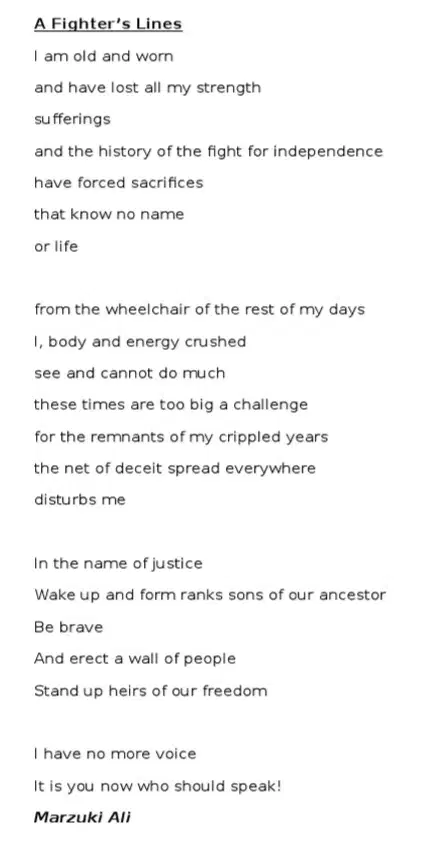
Who is the persona?
a man who fight for freedom
a desperate man
a wiseman
an old and tired soldier
an injustice man
The phrase “body and energy crushed” indicates that the persona is _____.
spoilt
brave
desperate
weak
unhappy
One of the ways to avoid being deceived by others is _____.
be united
be free
be selfish
be kind
be amiable
The theme of the poem is ______.
lies
regret
patriotism
pain
inequality
The ‘forced sacrifices / that know no name or life” would refer to the effort of soldiers who _____.
have died for the country
were captured
lost their names
have won the world war
were freed
The persona is wheelchair bound because he has lost his ____.
sight
hearing
ability to feel
ability to use his limbs
hands
The pronoun “you” in the last line of the poem refers to _____.
the poet
the person
the persona’s heirs
the persona’s countrymen
the reader
Which word in the second stanza shows that the persona is upset?
deceit
crushed
disturbs
challenge
lost
Which phrase indicates that the persona is weak?
have forced sacrifices
lost all my strength
know no name
too big a challenge
disturbs me
What disturbs the persona?
the freedom
the limits
the body
the voice
the corruption
One way to preserve our country’s independence is ____.
fight bravely
be united
work hard
think smart
follow the rules
In the poem the word “wheelchair” symbolizes ____.
dependence
inability
sickness
sacrifice
pain
The persona is a patriotic person because he has helped to ____.
develop his country
restructure his country
worry his country
plan his country progress
fight for his country
The persona says that bravery is needed to ____.
wake up
fight for freedom
ask for a favor
build a wall
speak about past sufferings
The persona sees that the people are destroying themselves by engulfing into the world of lies and dishonesty. It is included into stanza ____.
1
2
3
4
no answer
The phrase ‘crippled years’ refers to ______.
the persona’s old age
the present times when corruption is a big problem
the time when the person was injured
the slow motion of the time
the years when the persona was a fighter
An extreme exaggeration
simile
hyperbole
a direct comparison of two unlike things, not using like or as
alliteration
metaphor
a common saying with a meaning completely different than what the words literally means - an old saying or phrase that people use
metaphor
idiom
a comparison of two unlike things, using the words 'like' or 'as'
simile
when the same sounds are used at the beginning of several words in a sentence - 'all the sounds are the same'
simile
alliteration
a word that represents a sound - the word sounds like the sound it makes
simile
onomatopoeia
when a non-human object is given human qualities or emotions
simile
personification
What is the definition of context?
a word or phrase not meant to be taken literally, but rather used for effect
expressions used for descriptive effect that are not literally true but that express some truth beyond the literal level
the events, situations, or language that surround a particular word, phrase or piece of text that help explain its meaning
What is the definition of oxymoron?
a figure of speech in which apparently contradictory terms appear in conjunction
a word or phrase not meant to be taken literally, but rather used for effect
the use of words to express something different from and often opposite to their literal meaning


My mom is always as busy as a bee.
Simile
Metaphor
Alliteration
None of the above
Nature is like an intricate jigsaw puzzle.
Simile
Metaphor
Alliteration
None of the above
Her hair was like the flowing river.
Simile
Metaphor
Alliteration
None of the above

