wayground logo

Free Printable Worksheets

Font size

S
M
L
XL
Worksheets

Congruence Criteria and Proofs

Total questions: 96

Worksheet time: 7hrs 16mins

Name
Class
Date
1.
Angles  a and e are what type of angles?
a)
Vertical Angles
b)
Corresponding Angles
c)
Alternate Interior Angles
d)
Alternate Exterior Angles
2.
Angles  e and d are what type of angles?
a)
Vertical Angles
b)
Corresponding Angles
c)
Alternate Interior Angles
d)
Alternate Exterior Angles
3.
Fill in the missing proofs.
a)
Transitive Property, SAS(Side-Angle-Side)
b)
Reflexive Property, SAS(Side-Angle-Side)
c)
Reflexive Property, Vertical Angles Thm.
d)
Transitive Property, SSS(Side-Side-Side)
4.
a)
Transitive Property, SAS(Side-Angle-Side)
b)
Reflexive Property, SAS(Side-Angle-Side)
c)
Transitive Property, SSS(Side-Side-Side)
d)
Reflexive Property, SSS(Side-Side-Side)
5.
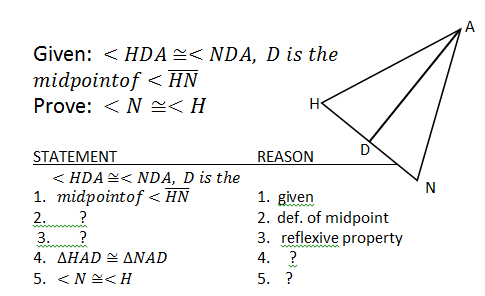
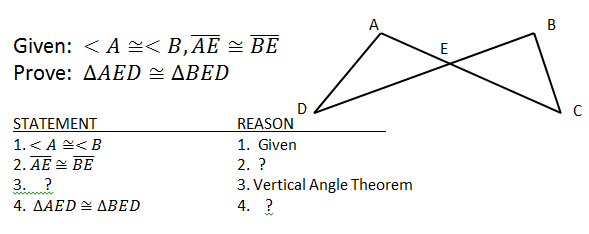
What is the "statement" for step 3 of the proof? 
a)
∡EDA≅∡DCB
b)
∡AED≅∡BEC
c)
DE=CE
d)
∡AED≅∡CED
6.
What is the "reason" for step 4 of the proof?
a)
proof
b)
AAS
≅ Thrm
c)
ASA
≅ Thrm
d)
SAS
≅ Thrm
7.
What is the "statement" for step 2 of the proof?
a)
∆BAC≅∆DAC
b)
BC=DC
c)
∡B≅∡D
d)
∡BAC≅∡DAC
8.
What is the "reason" for step 4 of the proof?
a)
SAS
≅ theorem
b)
ASA
≅ theorem
c)
SSA
≅ theorem
d)
CPTCT
 theorem
9.
What is the "reason" for step 5 of the proof?
a)
Vertical Angle Theorem
b)
proof
c)
def. of angle bisector
d)
CPCTC Theorem
10.
What is the "statement" for step 3 of the proof?
a)
AD=DA
b)
AD=AD
c)
HD=ND
d)
HD=DN
11.
What is the "statement" for step 2 of the proof?
a)
AD=AD
b)
AD=DA
c)
HD=DN
d)
HD=ND
12.
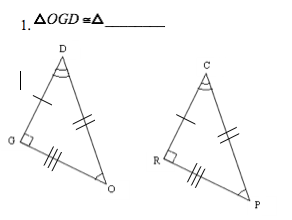
Determine if the triangles are congruent, if "yes" state the theorem.
a)
yes, SAS
b)
not congruent
c)
yes, ASA
d)
yes, AAS
13.
Determine if the triangles are congruent, if "yes" state the theorem.
a)
not congruent
b)
yes, SSS
c)
yes, SAS
d)
yes, ASA
14.
Determine if the triangles are congruent, if "yes" state the theorem.
a)
yes, AAS
b)
yes, SAS
c)
yes, ASA
d)
not congruent
15.
What is the "statement" for step 2 of the proof?
a)
∡JHI≅∡JKL
b)
JL=JI
c)
∡H≅∡K
d)
HI=KL
16.
What is the "reason" for step 3 of the proof?
a)
Proof
b)
Def. of Midpoint
c)
Reflexive Property
d)
Vertical angle Theorem
17.
What is the "statement" for step 3 of the proof?
a)
∡JKL≅∡JHI
b)
JI=JL
c)
∡KJL≅∡HJI
d)
∡JLK≅∡JIH
18.
What is the "reason" for step 5 of the proof?
a)
Angle Bisector Theorem
b)
Reflexive property
c)
CPCTC Theorem
d)
Proof
19.
What is the "statement" for step 3 of the proof?
a)
HA=HA
b)
HA=AH
c)
MA=AM
d)
MA=MA
20.
What is the "statement" for step 4 of the proof?
a)
∡MAH≅∡THA
b)
∆MHA≅∆THA
c)
HM=AT
d)
∆MAH≅∆THA
21.
What is the "statement" for step 5 of the proof?
a)
HM=AT
b)
HM=TA
c)
∆MAH≅∆THA
d)
∡MAH≅∡THA
22.
What would be the correct "given" statements for this diagram?
a)
T is the midpoint of segment BG and
∡B≅∡G
b)
∡B≅∡G and ∡A≅∡W
c)
T is the midpoint of segment BG and ∡A≅∡W
d)
T is the midpoint of segment AW and ∡A≅∡W
23.
What would be the correct "given" statements for this diagram?
a)
∡A≅∡C, and segment DB is the angle bisector of ∡CDA
b)
BD=BD, and DB=DB
c)
∡A≅∡C, and segment DB is the angle bisector of ∡CBA
d)
∡B≅∡D, segment DB is the angle bisector of ∡DCA.
24.
Which of the following is not a valid reason to prove congruent triangles?
a)
SSA
b)
AAS
c)
SAS
d)
SSS
25.
Determine if the triangles are congruent, if "yes" state the theorem.
a)
not congruent
b)
yes, SSS
c)
yes, ASA
d)
yes, SAS
26.
Determine if the triangles are congruent, if "yes" state the theorem.
a)
yes, ASA
b)
yes, AAS
c)
not congruent
d)
yes, SAS
27.
What does CPCTC stand for?
a)
Congruent parts of congruent triangles are congruent
b)
Corresponding parts of congruent triangles are congruent
c)
Corresponding parts of corresponding triangles are corresponding
d)
Corresponding parts of congruent triangles are Canadian.
28.
When do you use "CPCTC in a proof?
a)
ALWAYS at the beginning
b)
ALWAYS at the end
c)
It's optional
d)
NEver
29.
Fill in the blank.
a)
Given
b)
Reflexive Property
c)
Transitive Property
d)
They're the same side!!!!!! 
30.
Fill in the missing proofs.
a)
Transitive Property, SAS(Side-Angle-Side)
b)
Reflexive Property, SAS(Side-Angle-Side)
c)
Reflexive Property, Vertical Angles Thm.
d)
Transitive Property, SSS(Side-Side-Side)
31.
What is the reason?
a)
Definition of Angle
b)
Definition of Congruence
c)
Definition of bisects
d)
Definition of midpoint
32.
What is the reason?
a)
Definition of perpendicular
b)
Definition of Right angle
c)
Definition of 90 
d)
Definition of angle
33.
What congruency postulate proves the triangles congruency?
a)
SAS
b)
ASA
c)
SSS
d)
HL
34.
What postulate would prove triangle ∆NYQ is congruent to ∆PYQ?
a)
ASA
b)
SAS
c)
SSS
d)
HL
35.
What postulate would prove triangle ∆NYQ is congruent to ∆PYQ?
a)
ASA
b)
SAS
c)
SSS
d)
HL
36.
When do you use "CPCTC in a proof?
a)
ALWAYS at the beginning
b)
ALWAYS at the end
c)
It's optional
d)
NEver
37.
What postulate proves these triangles congruent?
a)
HL
b)
SSS
c)
SAS
d)
ASA
38.
What postulate proves these triangles congruent?
a)
SAS
b)
HL
c)
AAS
d)
ASA
39.
What postulate proves these triangles congruent?
a)
SAS
b)
ASA
c)
AAS
d)
Not enough information
40.
State if the two triangles are congruent.  If they are, state how you know.
a)
A
b)
B
c)
C
d)
D
41.
What additional information is required for the 2 triangles to be congruent by ASA?
a)
A
b)
B
c)
C
d)
D
42.
What additional information is required for the 2 triangles to be congruent by SAS?
a)
A
b)
B
c)
C
d)
D
43.
PICK THE CORRECT CONGRUENCE STATEMENT
a)
∆TUV ≅ ∆EUV
b)
∆VUT ≅ ∆UVE
c)
∆TUV ≅ ∆UEV
d)
∆UTV ≅ ∆EUV
44.
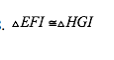
Use the congruence statement to find the missing part of the statement
a)
WV
b)
WU
c)
VU
d)
WB
45.

Which is NOT a congruence postulate used to prove triangles are congruent?

a)

SAA

b)

SSS

c)

SSA

d)

SAS

46.
Fill in the missing proofs.
a)
Transitive Property, SAS(Side-Angle-Side)
b)
Reflexive Property, SAS(Side-Angle-Side)
c)
Reflexive Property, Vertical Angles Thm.
d)
Transitive Property, SSS(Side-Side-Side)
47.
What is the "statement" for step 2 of the proof?
a)
AD=AD
b)
AD=DA
c)
HD=DN
d)
HA = AN
48.
What is the "statement" for step 3 of the proof? 
a)
∡EDA≅∡DCB
b)
∡AED≅∡BEC
c)
DE=CE
d)
∡AED≅∡CED
49.
What are the 2 missing pieces of information?
a)
Transitive Property, SAS(Side-Angle-Side)
b)
Reflexive Property, SAS(Side-Angle-Side)
c)
Transitive Property, SSS(Side-Side-Side)
d)
Reflexive Property, SSS(Side-Side-Side)
50.
What is the "statement" for step 2 of the proof?
a)
∆BAC≅∆DAC
b)
BC=DC
c)
∡B≅∡D
d)
∡BAC≅∡DAC
51.
What would be the correct "given" statements for this diagram?
a)
T is the midpoint of segment BG and
∡B≅∡G
b)
∡B≅∡G and ∡A≅∡W
c)
T is the midpoint of segment BG and ∡A≅∡W
d)
T is the midpoint of segment AW and ∡A≅∡W
52.
What is the "reason" for step 3 of the proof?
a)
Proof
b)
Def. of Midpoint
c)
Reflexive Property
d)
Vertical angle Theorem
53.
When using hypotenuse leg (HL) in a proof, you must first state ...
a)
CPCTC.
b)
there are right triangles.
c)
that vertical angles are congruent.
d)
the reflexive property.
54.

What is Reason B?

a)

Definition of Congruence

b)

Definition of Vertical Angles

c)

Reflexive Property

d)

Vertical Angle Theorem

55.

What is Reason C?

a)

Definition of Congruence

b)

Definition of Vertical Angles

c)

Reflexive Property

d)

Vertical Angle Theorem

56.

What is Reason D?

a)

SSS Congruence

b)

SAS Congruence

c)

ASA Congruence

d)

AAS Congruence

e)

HL Congruence

57.

What is Reason B?

a)

Definition of Congruence

b)

Definition of Equality

c)

Definition of Midpoint

58.

What is Reason C?

a)

Definition of Congruence

b)

Definition of Equality

c)

Definition of Midpoint

59.

What is Reason D?

a)

Vertical Angle Theorem

b)

Reflexive Property

c)

Definition of Congruence

d)

Definition of Vertical Angles

60.

What is Reason E?

a)

Vertical Angle Theorem

b)

CPCTC

c)

Definition of Congruence

d)

Definition of Vertical Angles

61.

What is Reason F?

a)

SSS Congruence

b)

SAS Congruence

c)

ASA Congruence

d)

AAS Congruence

e)

HL Congruence

62.

What is Reason C?

a)

SSS Congruence

b)

SAS Congruence

c)

ASA Congruence

d)

AAS Congruence

e)

HL Congruence

63.

What is Reason C?

a)

SSS Congruence

b)

SAS Congruence

c)

ASA Congruence

d)

AAS Congruence

e)

HL Congruence

64.

What is Reason E?

a)

SSS Congruence

b)

SAS Congruence

c)

ASA Congruence

d)

AAS Congruence

e)

HL Congruence

65.

What is Reason F?

a)

Given

b)

Definition of Congruence

c)

Triangle Congruence

d)

CPCTC

66.

What is Reason E?

a)

SSS Congruence

b)

SAS Congruence

c)

ASA Congruence

d)

AAS Congruence

e)

HL Congruence

67.

What is Reason F?

a)

CPCTC

b)

Given

c)

Definition of Congruence

d)

Definition of Perpendicular

68.

 If DA\overline{DA} bisects IE\overline{IE}  IE, then

a)

ID  EA\overline{ID}\ \cong\ \overline{EA}  

b)

IA  EA\overline{IA}\ \cong\ \overline{EA}  

c)

<IDA \cong <EDA

d)

<IAD and <EAD are right angles

69.

If L is the midpoint of TJ\overline{TJ} , what must be true?

a)

TL  JT\overline{TL}\ \cong\ \overline{JT}  

b)

JL  TJ\overline{JL}\ \cong\ \overline{TJ}

c)

TL  LJ\overline{TL}\ \cong\ \overline{LJ}  

d)

T is also the midpoint of JL\overline{JL}  

70.

If AD\overline{AD} bisects <EDI, then

a)

<ADE=<IDA

b)

IA  AE\overline{IA}\ \cong\ \overline{AE}

c)

ID  ED\overline{ID}\ \cong\ \overline{ED}

d)

All of the above

71.

 If DA\overline{DA} is perpendicular to IE\overline{IE} , then we can immediately conclude that

a)

IA AE\overline{IA}\ \cong\overline{AE}  

b)

<IAD \cong <DAE

c)

<IDA \cong <EDA

d)

<IAD and <DAE are right angles

72.

If DA\overline{DA} is the perpendicular bisector of  EI\overline{EI} , then which is NOT true.

a)

<IAD and <DAE are right angles

b)

DI DE\overline{DI}\ \cong\overline{DE}  

c)

EA IA\overline{EA}\ \cong\overline{IA}

d)

Both 1 and 3 are correct

73.

An angle bisector cuts an angle into two congruent _________

a)

Angles

b)

Segments

c)

Mysteries

74.

A segment bisector cuts a segment into two congruent

a)

Segments

b)

Angles

c)

Mysteries

75.

What would be the correct "given" statements for this diagram?

a)

T is the midpoint of segment BG\overline{BG} and
<B≅<G

b)

<B≅<G and <A≅<W

c)

T is the midpoint of BG\overline{BG} and <A≅<W

d)

T is the midpoint of AW\overline{AW} and <A≅<W

76.
a)

AB = 22

b)

AB = 11

c)

AB = 10

d)

AB = 3

77.
a)

x = -36

b)

x = 1/5

c)

x = 1

d)

x = 3

78.
a)

BC = 8

b)

BC = 30

c)

BC = 34

d)

BC = 156

79.
a)

x = 20

b)

x = 10

c)

x = 15

d)

Not enough information

80.
a)

m4 =20m\angle4\ =20

b)

m4 =60m\angle4\ =60

c)

m4 =80m\angle4\ =80

d)

m4 =120m\angle4\ =120

81.

Find the measure of angle A.

a)

75o

b)

60o

c)

30o

d)

38o

82.
Solve for x and then find the measure of angle A.
a)
180
b)
70
c)
54
d)
56
83.
Find the measure of the missing angle.
a)
90o
b)
100
c)
130o
d)
50o
84.
Complete the congruence statement.
a)
CRP
b)
PCR
c)
RPC
d)
PRC
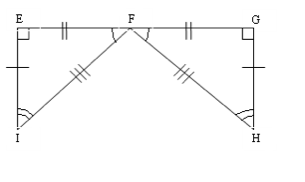
85.
Use the congruency statement to answer the following: 
<F = ___
a)
<H
b)
<I
c)
<G
d)
not congruent to another angle
86.
Which segment is congruent to EF? 
a)
HG
b)
HF
c)
GF
d)
IE
87.
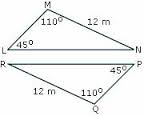
Are these triangles congruent? If so, state the rule which you used to determine congruence.
a)
Yes by ASA
b)
Yes by AAS
c)
Yes by SSA
d)
Not congruent
88.
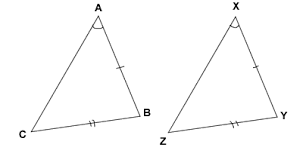
Are these triangles congruent? If so, state the rule which you used to determine congruence.
a)
AAA
b)
AAS
c)
ASA
d)
Not necessarily congruent
89.
Are these triangles congruent? If so, state the rule which you used to determine congruence.
a)
SSA
b)
AAS
c)
ASA
d)
Not necessarily congruent
90.
How are these two triangles congruent?
a)
Not enough information
b)
SAS
c)
ASA
d)
SSA
91.
What are the five ways to prove triangles congruent?
a)
SSS, ASA, AAS, SAS, HL
b)
SSS, SSA, HL, AAS, SAS
c)
SAS, SSA, HL, AAS, SSS
d)
HL, SAS, SSA, SSS, ASA
92.
If M is the midpoint of AB, then AM = MB
a)
Addition POE
b)
Def. of Midpoint 
c)
Reflexive POE
d)
Symmetric
93.
If X is between R & T on a line,
then RX + XT = RT
a)
Addition POE
b)
Substitution POE
c)
Angle Addition Post.
d)
Segment Addition Post.
94.
Which property justifies the next step?
a)
Definition of linear pair
b)
Definition of supplementary angles
c)
Congruent supplements thm
d)
Linear pair postulate
95.
Which property justifies the next step?
a)
Segment addition postulate
b)
Definition of an angle bisector
c)
Angle addition postulate
d)
Definition of right angles
96.
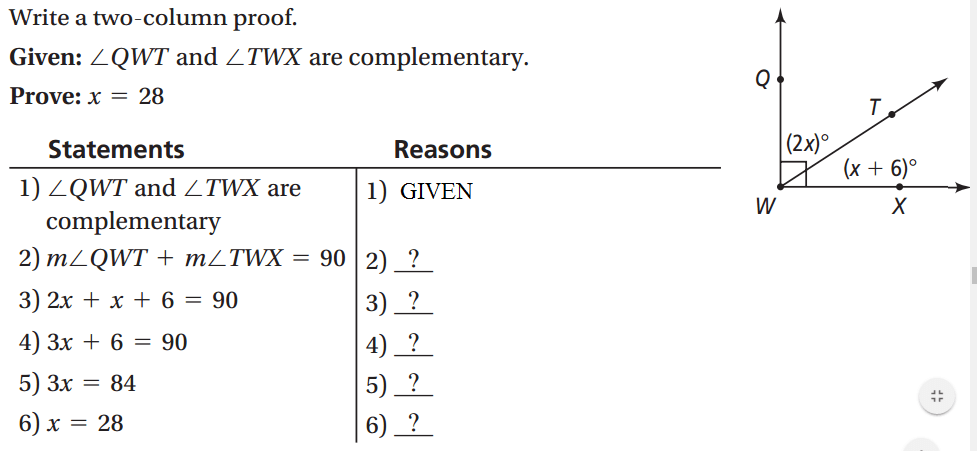
What is the REASON for Statement #2?
a)
Given
b)
Definition of Complementary Angles
c)
Substitution Property
d)
Reflexive Property of Congruence