
 Worksheets
top MCQ part 1
Total questions: 80
Worksheet time: 1hrs 18mins
1. Who prepared a series of four prints visualizing a world made up of “democratic and social republics”?
a) Otto von Bismarck
b) Giuseppe Mazzini
c) Frederic Sorrieu
d) Napoleon Bonaparte
2. Which female figure is used as a national symbol to represent France?
a) Britannia
b) Marianne
c) Germania
d) Liberty
Which event is widely regarded as the beginning of the French Revolution?
a) The coronation of Napoleon
b) The storming of the Bastille
c) The signing of the Treaty of Paris
d) The execution of Louis XVI
4. Who was the key figure behind the unification of Germany using military strength and diplomacy?
a) Napoleon Bonaparte
b) Giuseppe Garibaldi
c) Otto von Bismarck
d) Victor Emmanuel II
5. The Non-Cooperation Movement in India was sparked by factors including:
a) The Jallianwala Bagh Massacre
b) The Rowlatt Act and Khilafat issue
c) Repressive British policies
d) All of the above
6. Who led the Champaran Satyagraha to protest the oppressive plantation system?
a) Bal Gangadhar Tilak
b) Subhash Chandra Bose
c) Mahatma Gandhi
d) Jawaharlal Nehru
7. The Simon Commission was boycotted in India primarily because:
a) It proposed immediate independence
b) It did not include any Indian members
c) It supported the partition of India
d) It was headed by a non-British official
8. What was the significance of the Dandi March?
a) It marked the beginning of the Quit India Movement
b) It was a protest against the salt tax
c) It led to the formation of the Indian National Congress
d) It resulted in the immediate withdrawal of British laws
9. Which country initiated the system of indentured labour migration from India?
a) France
b) Spain
c) Britain
d) Portugal
10. The Great Depression of 1929, which had a global impact, began in:
a) Britain
b) USA
c) Germany
d) France
11. The first phase of the Industrial Revolution began in which country?
a) USA
b) Germany
c) Britain
d) France
12. What led to the decline of Indian textiles in the 19th century?
a) Increase in local demand
b) Competition from British machine-made cloth
c) High-quality of traditional weaving
d) Protective tariffs by the British government
13. Who is credited with inventing the printing press in Europe?
a) Johannes Gutenberg
b) Martin Luther
c) Marco Polo
d) Thomas Edison
14. Which was the first book printed using Gutenberg’s printing press?
a) The Vedas
b) The Bible
c) The Quran
d) The Iliad
15. Which leader played a pivotal role in the unification of Italy by inspiring nationalist sentiments?
a) Giuseppe Garibaldi
b) Giuseppe Mazzini
c) Victor Emmanuel II
d) Count Cavour
16. Which tragic event of 1919 resulted in massive civilian casualties and stirred national outrage in India?
a) The Dandi March
b) The Non-Cooperation Movement
c) The Jallianwala Bagh Massacre
d) The Rowlatt Act
The principle of Satyagraha, as introduced by Mahatma Gandhi, is based on:
a) Violent resistance
b) Passive acceptance
c) Non-violence and truth
d) Economic boycott only
In the Kheda movement, which community’s struggle against oppressive revenue demands was highlighted?
a) Urban industrial workers
b) Peasants
c) Students
d) Artisans
The Chipko Movement was launched with the main aim of:
a) Promoting tourism
b) Protecting forests
c) Urban development
d) Expanding agriculture

I is correct but II is incorrect
I is incorrect bur II is correct
Both I and II are correct
Both I and II are incorrect

I is correct but II is incorrect
I is incorrect bur II is correct
Both I and II are correct
Both I and II are incorrect

A is correct but R is incorrect
A is incorrect but R is correct
Both are correct bur R is not the correct explanation
Both are correct and R is the correct explanation
Who was the writer of the book ‘Hind Swaraj’?
Rabindranath Tagore
B.R. Ambedkar
Mahatma Gandhi
Jawahar Lai Nehru

Which of the following options best signify the event in this image?
People celebrating Baisakhi
Citizens participation in Khilafat movement
Boycott of foreign cloth
None of the Above
Who set up the ‘Oudh Kisan Sabha’?
Alluri Sitaram Raju
Jawahar Lai Nehru and Baba Ramchandra
Jawaharlal Nehru and Shaukat Ali
Mahatma Gandhi

In 1905, who painted the image of Bharat Mata shown as dispensing learning, food and clothing?
Rabindranath Tagore
Bankim Chandra Chattopadhyay
Gandhiji
Abanindranath Tagore
The Simon Commission was boycotted in India because:
There was no Indian member in the Commission.
It supported the Muslim League
Congress felt that people deserved Swaraj
There were differences among the members
The resolution of Poorna Swaraj was adopted at which session of the Congress?
Karachi
Haripur
Lahore
Lucknow
Who among the following were associated with ‘Swaraj Party’ formed during India’s freedom struggle?
C.R. Das and Jawaharlal Nehru
Motilal Nehru and C.R. Das
Motilal Nehru and Subhash Chandra Bose
Muhammad Ali and Shaukat Ali
Poona Pact was signed in_______
1857
1923
1932
1947
Name the Sanyasi who was an indentured labourer in Fiji:
Baba Jaidev
Baba Sitaraman
Baba Ramdev
Baba Ramchandra
IN WHICH CONGRESS SESSION THE NON CO-OPERATION PROGRAMME WAS ADOPTED?
Calcutta session
Madras session
Nagpur session
Lahore session
Abdul Ghaffar Khan a devout disciple of Mahatma Gandhi was arrested in april 1931
True
False
C.R.Das and Motilal Nehru formed the Swaraj party.
True
False
When did Ganthiji started his salt march?
11 march 1931
11 march 1929
11 march 1930
11 march 1932
Who led the movement in Gudem hills of Andhra pradesh?
Baba ramachandra
Alluri Sitaram Raju
C.R.Das
Subash chandra bose
Satyagraha was launched at
Champaran , Bihar
Ahemdabad , Gujarat
Kheda , Uttar Pradesh
Sonbhadra , Uttar Pradesh
How First World create resentment among Indians?
Forced Recruitment into wars
Customs duties were raised
Influenza epidemic
Crop Failure was accompanied
How people show their participation in Non cooperation?
Boycott of civil Services
Boycott khadi Clothes
Boycott foreign clothes
None of the above
Two brothers who proposed Khilafat issue
Shaukat Ali , Mohammad Ali
Mahatma Gandhi , Shaukat Ali
Faruk Ali , Mohammad Ali
Khalifa , Mohammad Ali
Way adopted by Baba Ramchandra to support Awadh Peasants?
Formed Oudh Kisan Sabha
Non Violence was the only key to support peasants
Houses of talukdar were looted , merchants were attacked
All of these
The movement of unification of Italy was led by :
Emmanuel
Bismarck
Cavour
All of these
He was famous Italian revolutionary.
He founded underground societies first 'Young Italy' and 'Young Europe'
Can you identify......
Camillo de Cavour
Philip veit
Garibaldi
Giuseppe Mazzini
The German oak is a symbol of :
Heroism
Freedom
Slavery
Unity
When an abstract idea for instance, greed, freedom, envy and liberty is expressed through a person or a thing, it is known as.........
Liberal
Code
Allegory
Aristocrate
'When France sneezes, the rest of Europe catches cold'. Who made this remark?
Johan Gottfried
Duke Metternich
Jacob Grimm
Kaiser William
Name the act which resulted in the formation of the ‘United Kingdom of Great
Britain’.
The Act of Union, 1707
Tax Reform Act, 1784
Commutation Act, 1784
None of these
Arrange the following in the correct sequence:
(i) Napoleon invades Italy
(ii) Fall of Napoleon
(iii) Greek Struggle for independence begins
(iv) Unifi cation of Italy
(ii) — (iii) — (iv) — (i)
(iv) — (ii) — (iii) — (i)
(i) — (ii) — (iii) — (iv)
(i) — (iii) — (ii) — (iv)
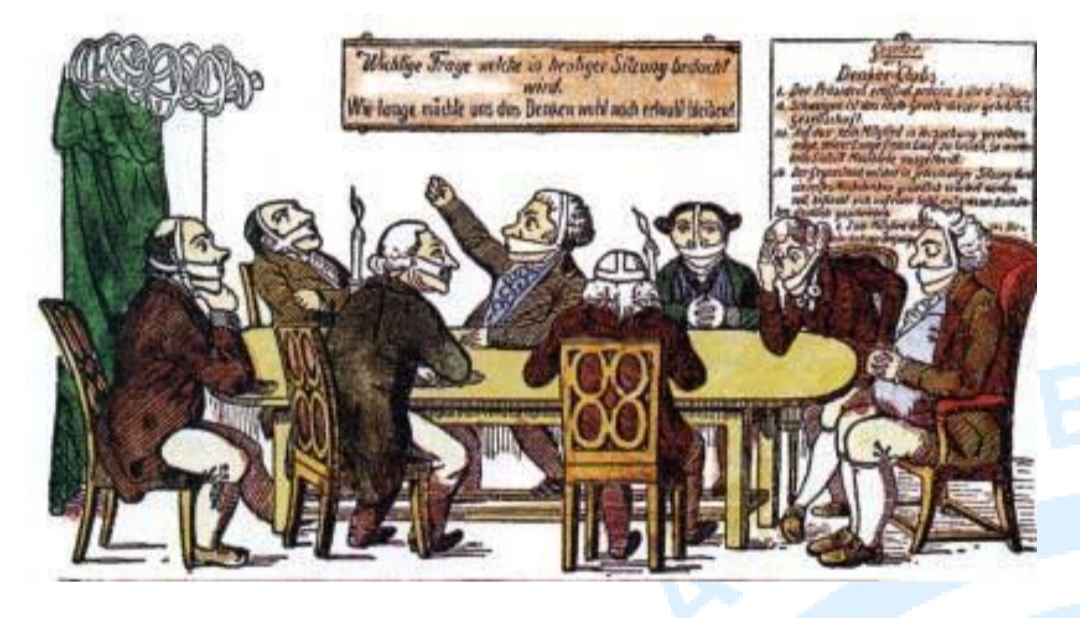
Study the picture and answer the question that follows:
Which of the following option best suited the cartoon?
Silence is the first commandment of this learned society.
To avoid the eventuality whereby a member of this club may succumb to the temptation
of speech, muzzles will be distributed to members upon entering.
Most of them imposed censorship laws to control what was said in newspapers, books,
plays and songs and reflected the ideas of liberty and freedom.
Both A and B
Romanticism refers to
cultural movement
economic movement
political movement
literacy movement
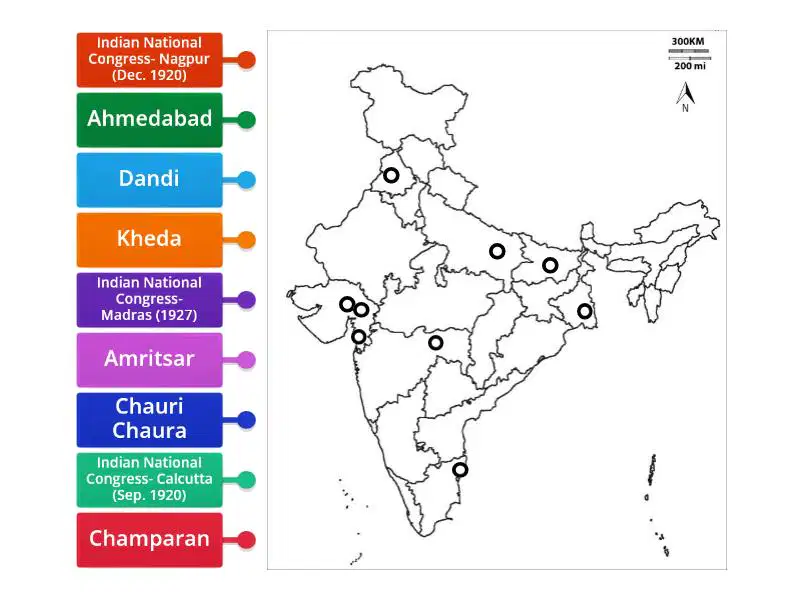
Identify the place where the Movement of Indigo Planters (Champaran) took place.
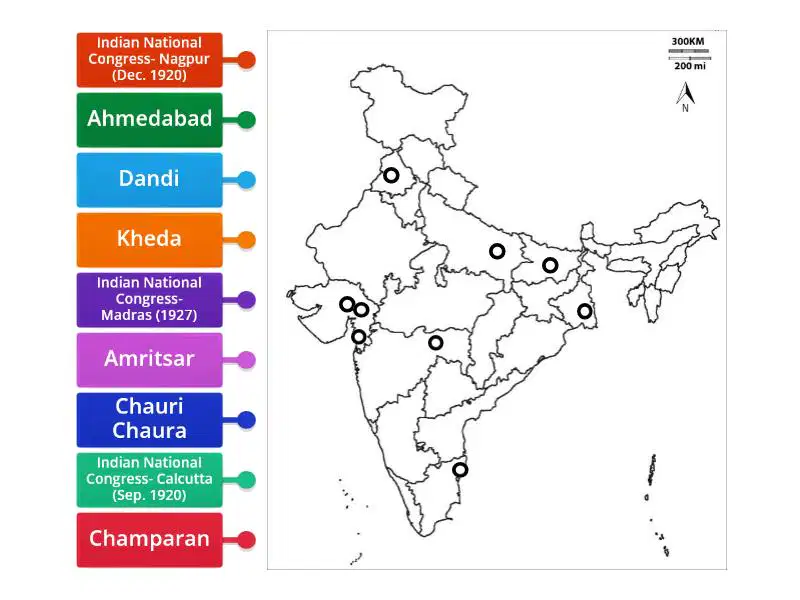

Which location on the map marks the site where the Non-Cooperation Movement was called off due to violence?
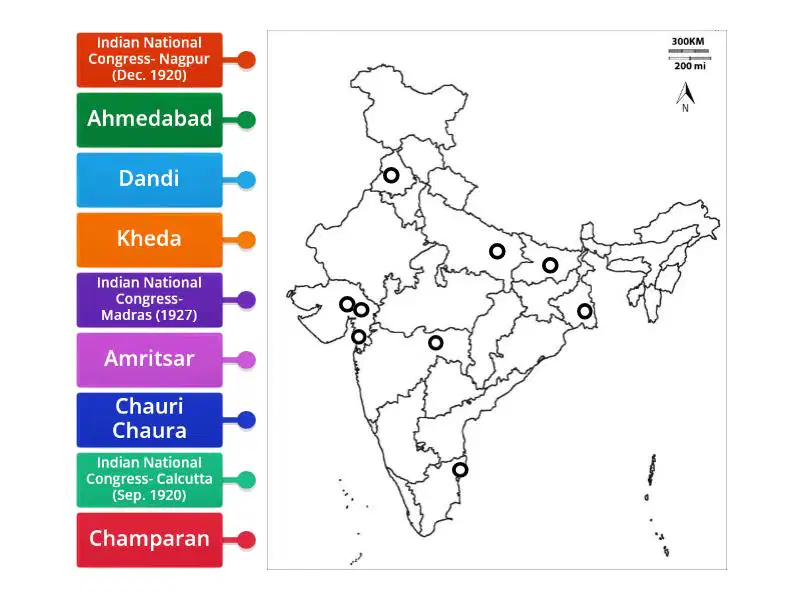
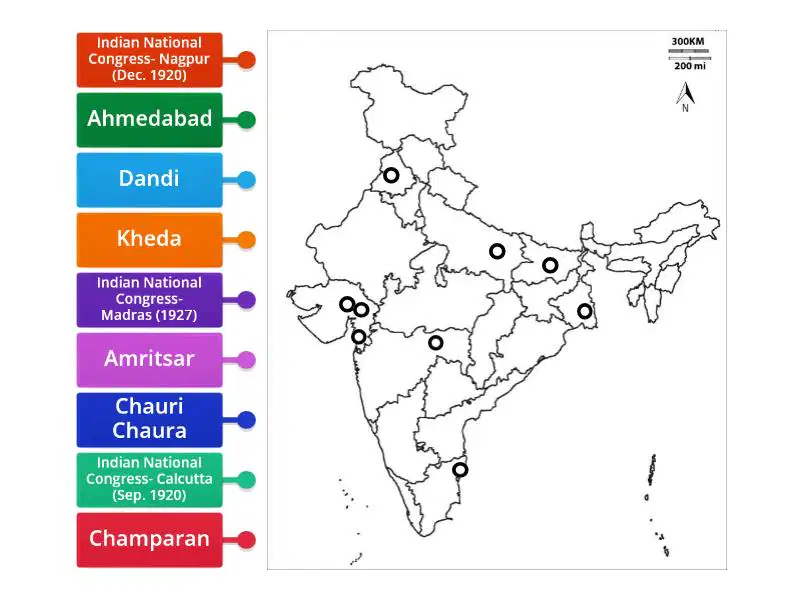
The Indian National Congress (INC) session that formally adopted the Non-Cooperation program , where C. Vijayaraghavachariar presided and C.R. Das moved the crucial resolution, solidifying the mass movement for Swaraj.
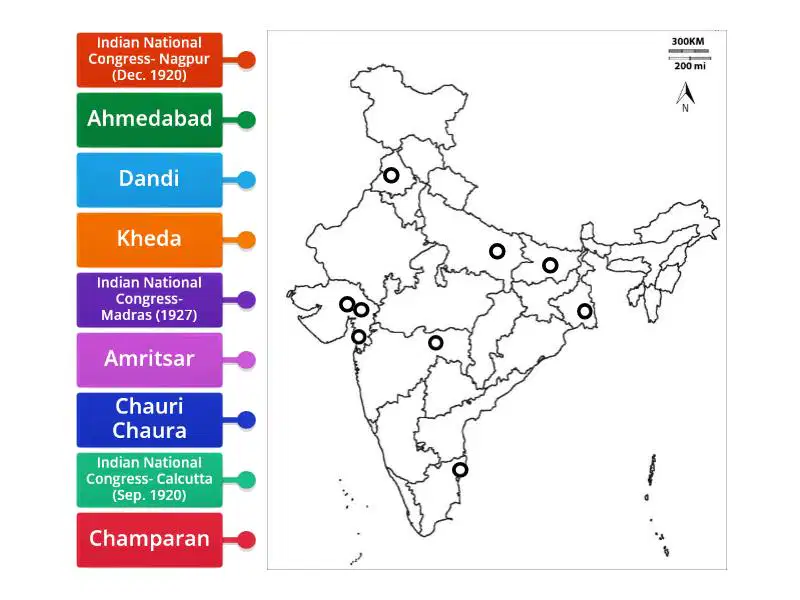
Identify the state where the Movement of Indigo Planters (Champaran) took place.
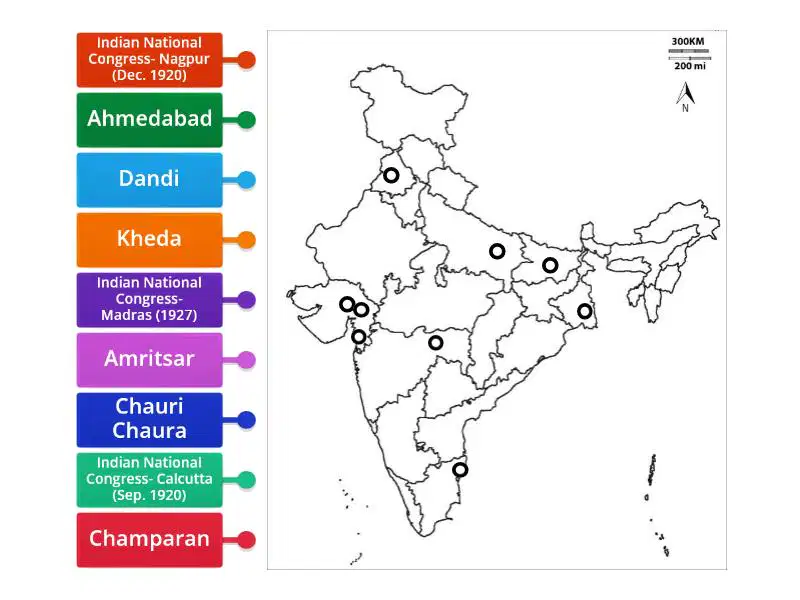
"Identify the location on the map where a special session of the Indian National Congress was held to pass the resolution for the Non-Cooperation Movement."
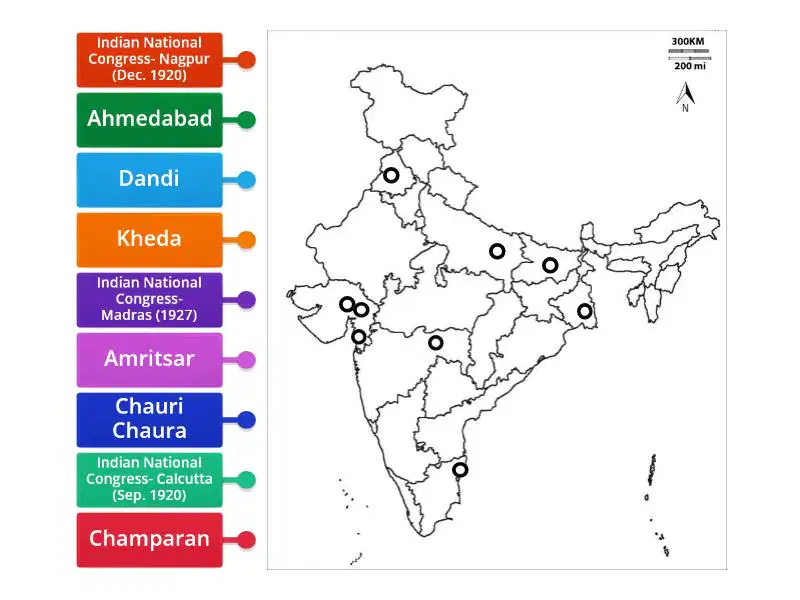
Identify the city in Punjab marked on the map that is famous for the Jallianwala Bagh Massacre on April 13, 1919
Identify the correct statement with regard to ‘The Act of Union -1707’ from the following options.
A. The British monarchy surrendered the power to English Parliament.
B. The British parliament seized power from Ireland.
C. The formation of the ‘United Kingdom of Great Britain’.
D. The British nation was formed as a result of a war with Scotland and Wales.
Which of the following treaty recognized Greece as an independent nation?
A. Treaty of Sevres
B. Treaty of Versailles
C. Treaty of Lausanne
Treaty of Constantinople
Which of the following was the reason for calling off ‘the Non-cooperation Movement’ by Gandhiji?
A. Pressure from the British Government
B. Second Round Table Conference
C. Gandhiji’s arrest
D. Chauri-Chaura incident
Choose the correctly matched pair about the Primitive Cultivation in India from the following options:
A. Dahiya – Madhya Pradesh
B. Kumari-Jharkhand
C. Khil -Andhra Pradesh
D. Koman- Karnataka
Barley: Rabi crop, cotton: kharif, : zaid crop.
A. Wheat
B. Mustard
C. Soya bean
D. Cucumber
A type of millet rich in iron, calcium, other micro nutrients and roughage is:
A. Bajra
B. Rajma
C. Jowar
D. Ragi
Read the information given below and select the correct option -
Mohan is an agricultural labourer. There are several months in a year when he has no work and needs credit to meet his daily expenses. He depends upon his employer, the landowner for credit who charges an interest rate of 5 per cent per month. Mohan repays the money by working physically for the landowner on his farmland.
Over the years his debt will –
A. Increase - because of increasing interest and non-payment of monthly amount
B. Remain constant - as he is working for the employer but is repaying less
C. Reduce - as amount equivalent to his salary is being counted as monthly repayment
D. Be totally repaid - as he is repaying the debt in the form of physical labour
Most of the agricultural labourers like Mohan depend upon loans from informal sector. Which of the following statements about this sector is correct –
A. There are govt. bodies to supervise informal sector
B. Money lenders ask for a reasonable rate of interest
C. Cost of informal loans to the borrower is quite high
D. Money lenders use fair means to get their money back
Which one of the following options describe ‘Collateral’?
A. Double coincidence of wants
B. Certain products for barter
C. Trade in barter
D, Asset as guarantee for loan
Read the given statements in context of ‘globalization’ and choose the correct option -
A. It is the only way for economic development of the country
B. Interlinks only production based activities in dispersed locations in the world
C. It has always given only positive results in all the countries
D. Leads to spread of technology, cultures and diseases from a region to another
In the question given below, there are two statements marked as Assertion (A) and Reason ®. Read the statements and chose the correct option:
Assertion (A): Different people have different development goals.
Reason ®: People want freedom, equality, security and respect
Options:
a. Both A and R are true and R is the correct explanation of A.
b. Both A and R are true but R is not the correct explanation of A.
c. A is true but R is false.
d. A is false but R is true.
Which one of the following statements is not an argument in favour of multi-purpose river projects?
Multi-purpose projects bring water to those areas which suffer from water scarcity.
Multi-purpose projects by regulating water flow help to control floods.
Multi-purpose projects lead to large-scale displacements and loss of livelihood.
Multi-purpose projects generate electricity for our industries and our homes.
Bhakra Nangal River Valley Project is made on the river:
Sutlej-Beas
Ravi-Chenab
Ganga
Son
Hirakud Dam is constructed on the river:
Ganga
Manjira
Manas
Mahanadi
Water of Bhakra Nangal Project is being used mainly for:
hydel power and irrigation
fish breeding and navigation
industrial use
flood control
The diversion channels seen in the Western Himalayas are called:
Guls or Kuls
Khadins
Johads
Recharge pits
Agricultural fields which are used as rainfed storage structures are called:
Kuls
Khadins/Johads
Recharge pits
None of the above
Underground tanks seen in Rajasthan to store rainwater for drinking is called:
Tankas
Khadin
Ponds
Kuls
In Western Rajasthan today plenty of water is available due to:
rooftop water harvesting
perennial Rajasthan Canal
construction of Tankas
none of the above
Bamboo drip irrigation system is prevalent in:
Manipur
Meghalaya
Mizoram
Madhya Pradesh

