
Font size
 Worksheets
Weather and Climate
Total questions: 50
Worksheet time: 37mins

Which TWO describe an air mass?
A fast moving cloud
Similar temperature and humidity throughout
A low pressure zone
Can be 100s of miles across

Where do storms and precipitation BEGIN to DEVELOP?
In the middle of an air mass
Where two air masses with different characteristics meet
Only over the ocean
Only at high elevations

What happens when air is forced upward?
It gets warmer as it get closer to the Sun and holds more moisture
It cools and loses water vapor through condensation and precipitation
The Sun speeds up molecular motion as it rises and turns this fast motion into wind
It continues up till it travels into space
What influences prevailing wind patterns?
Earth's tilt
Ocean currents and topography (land features)
Earth's rotation
All of the above
uneven heating of earth's surface
What happens when a warm air mass meets a cold air mass?
The warm air sinks below the cold air
The warm air rises above the cold air
The two air masses mix evenly
The air masses stop moving

When air is at the MAXIMUM amount of water vapor that it can hold, it is called _____.
Absolute humidity
Related humidity
100% relative humidity
Dew point
Maximum potential
What is one major factor in predicting storm movement?
The movement of low-pressure systems
The number of raindrops in a storm
The height of trees in an area
The shape of the clouds
What is the typical movement direction of air masses in the U.S.?
North to south
West to east
East to west
South to north
What causes prevailing winds?
The daily movement of the sun
The interaction of air masses
The rotation of the Earth
The number of clouds in the sky
What helps predict where air and precipitation come from?
The shape of the land
Patterns in wind movement
The brightness of the sun
The number of clouds in the sky
Why do mountainous areas often receive more precipitation?
Mountains create more clouds
Air is forced upward, cools, and releases moisture
The ground absorbs more heat
Mountains attract storm systems

How does the ocean affect storm formation?
It prevents storms from forming
Warm ocean water increases evaporation, fueling storms
Ocean currents stop air masses from moving
Cold ocean water causes storms to disappear

The following image was taken from the International Space Station. What causes clouds formation?
Water vapor rising cooling then condensing in the air
The wind blowing at high speeds
Strong winds pushing downward towards earth with gravity
The rotation of earth
What happens to air pressure during a large-scale storm?
It rises significantly then falls and this swift change brings severe rain
It remains unchanged and is very steady
it significantly drops at the center of the storm, creating a low-pressure system which fuels the storm's intensity and wind speeds
It falls significantly then rises quickly to the peak pressure and this swift change brings severe rain
What is the main source of energy for storms?
Wind speed
Sunlight heating the Earth's surface
Clouds
The movement of trees
What usually happens behind a cold front?
The temperature rises
The temperature drops
The wind speed decreases
The air pressure increases
What do meteorologists use to track storms?
Radar and satellite images
The color of the sky
The number of clouds in the sky
The shape of trees
How does the wind affect storm development?
It moves air masses and fronts
It slows down storm formation
It stops clouds from forming
It makes storms disappear
What is the boundary between two air masses called?
A storm center
A climate zone
A front
A high-pressure area
What happens to air pressure when a storm is forming?
It increases
It decreases
It stays the same
What is the main cause of wind?
The rotation of the Earth
The uneven heating of the Earth's surface
The movement of the moon
The gravitational pull of the sun
What is the effect of a high-pressure system on weather?
It brings clear skies
It causes storms
It increases humidity
It lowers temperatures
When air cools, what happens to the water vapor in it?
It disappears
It condenses into clouds
It turns into wind
It becomes warmer
What do scientists study to predict storms?
The number of birds in the sky
Air mass movement and wind patterns
The color of the clouds
The shape of trees
How do large-scale STORMS form?
By the interaction of warm and cold air masses
Through the evaporation of ocean water
Due to tectonic plate movements
From the gravitational pull of the moon
Pressure and humidity play a role in storm formation by:
Increasing the temperature and causing evaporation
Decreasing the temperature and causing condensation
Creating wind patterns and influencing precipitation
Stabilizing the atmosphere and preventing storms
What is the difference between climate and weather?
Climate refers to long-term atmospheric conditions, while weather refers to short-term changes.
Climate and weather are the same and can be used interchangeably.
Weather refers to long-term atmospheric conditions, while climate refers to short-term changes.
Climate and weather both refer to short-term atmospheric conditions.
Understanding air masses, pressure systems, and ocean currents helps in predicting storms because they:
influence weather patterns and storm development
have no effect on weather predictions
only affect temperature changes
are unrelated to meteorology

How do oceans affect whether a place gets a lot or a little precipitation?
Ocean currents stay put so they are warm near the equator and cold near the poles.
Ocean currents can bring warmer water toward the poles and cooler water toward the equator.
Ocean currents do not have a predictable pattern of travel to determine ocean temperatures.
The ocean evaporates only near the equator, so only areas near the equator get rain.

What type of storm front is this?
warm front
cold front
stationary front
occluded front

What type of storm front is this?
warm front
cold front
stationary front
occluded front
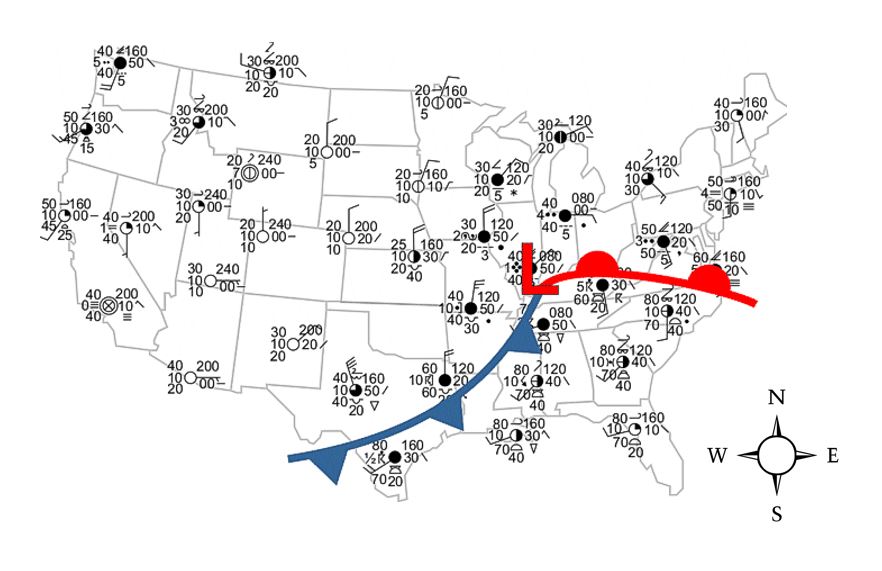
What direction is the cold front moving on the map?
Southwest
Northwest
Southeast
Northeast
When warm air rises, ______ pressure forms at the surface of the land or sea.
high
none
Regardless of the season, the temperature of the air always gets _________ as you go up in the atmosphere
warmer
colder
colder at first then warmer
all of these
Hail events happen _____
Generally at night, when there are meteoroid showers
Only in the early morning, when the temperature is still cold
In the winter, when it is freezing out
In the Spring, Summer and Fall, when it is warm out
A warm air mass has ________________ pressure.
high
low
no
medium
As a warm air mass cools off, what is happening to the energy it had? Where does the energy it had go?
The energy falls back to earth in a cycle.
The energy disappears.
The energy goes back to the sun.
The energy is shared with or transferred to other cooler particles.
Hail is more likely to occur on sunny days because _____
there is more moisture in the air from evaporation of water on the ground
all of these answers are correct
there is more sun to warm the ground
there are opportunities for wind gusts
The warm air rises till ____
the wind stops blowing
it transfers its energy to the surrounding air
it runs out of density
all of these
Which is true?
all air hold the same amount of moisture
warm air holds the most moisture
hot air holds the most moisture.
cold air holds the most moisture.

What landform causes the rain shadow effect which can cause a very green and thriving area to be fairly near a desert area?
mountains
lakes
plains
valley


Think back to the article we read in Lesson 20 "How the ocean changes our weather." If I have two locations in the same latitude, will they ALWAYS have the same type of climate?
Yes because they are the same distance from the equator so they get the same heat
Not always because

Kentucky has the weather it does because of _____
the maritime tropical air mass
the continental tropical air mass
the maritime polar air mass
its location it receives many different types of air masses


Scientists study climate to understand long-term weather patterns. Which statement best describes climate?
Summers are typically hot and dry.
It rained this week.
Yesterday it was cold and windy.
When air is heated, its volume _____ and its mass _____.
increases, stays the same
decreases, increases
stays the same, increases
increases, decreases

Why are the rainforests are located where they are? (pick two)
this region receives consistent, high levels of sunlight throughout the year, leading to warm temperatures
being near the equator AND and ocean lead to an abundant (lots of) rainfall
The land is in an ocean
Warm air come up from the South to warm the continent
Are there patterns to how air masses move that can help predict where large storms will form?
The ocean is warmer near the equator and cooler near the poles.
More evaporation occurs over warmer ocean waters.
The temperature of the ocean affects the humidity of the air moving over it.
All of these contribute to large storms.

