
 Worksheets
Chem/Water/Macros Quiz Review
Total questions: 36
Worksheet time: 18mins
Fill in the blank: Organic molecules are all ______ based
carbon
hydrogen
oxygen
nitrogen
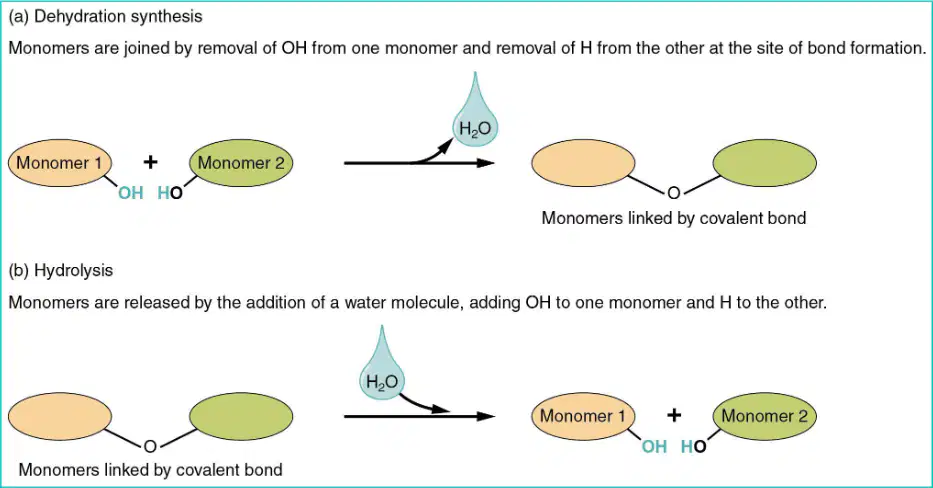
Explain the process of dehydration synthesis as shown in the diagram.
Dehydration synthesis involves the removal of water to form a bond between molecules.
Dehydration synthesis involves the addition of water to break a bond between molecules.
Dehydration synthesis is a process that requires oxygen to form a bond between molecules.
Dehydration synthesis is a process that releases carbon dioxide as a byproduct.
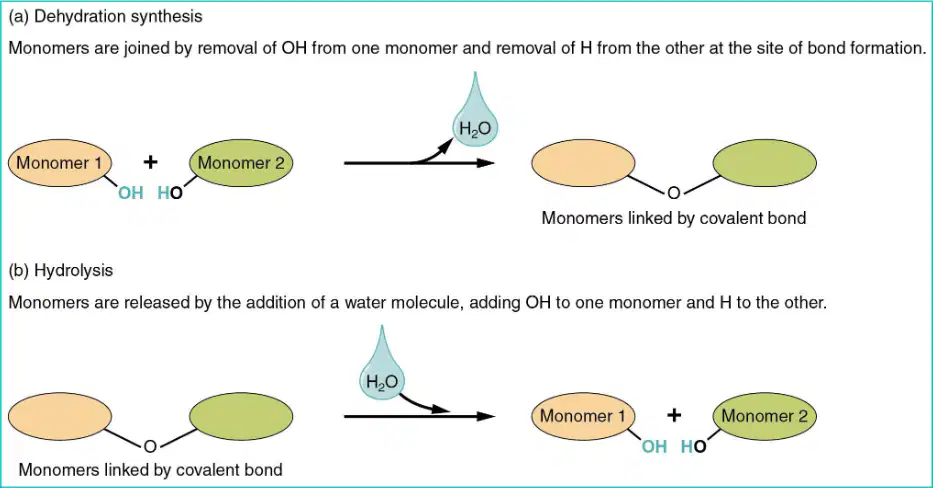
The role of water in the hydrolysis process as depicted in the diagram is:
to act as a solvent
to break chemical bonds
to provide energy
to act as a catalyst
True or False: The form of an organic molecule determines its function.
True
False
What is the monomer of carbohydrates?
monosaccharides
disaccharides
polymers
polysaccharides
Fill in the blank: Starches are very valuable because they provide a quick form of ______ for the body.
energy
protein
fiber
vitamins
The process of detecting sugars in food using a simple lab test is known as:
Benedict's test
Biuret test
Iodine test
Sudan III test
Which of the following is used for structural support in plants?
cellulose
glucose
lactose
sucrose
What happens to a food containing starch when iodine is placed on it?
Lipids are a type of what and what is their function in the body?
Carbohydrate; Provide energy
Protein; Build muscle
Fat; Store energy and insulate
Vitamin; Support immune function
Which of the following is a characteristic of saturated fats?
A) Contain at least one double bond
B) Found in animal fats like butter
C) Kinked in shape
D) Include oils
Lipids are hydrophobic. They are soluble in oil but are ______ in water.
insoluble
soluble
neutral
amphipathic
The main component of cell membranes are
Proteins
Lipids
Carbohydrates
Nucleic acids
Which part of the phospholipid is polar?
Fatty acid tail
Glycerol
Phosphate head
Hydrophobic tail
Proteins are made of?
Carbohydrates
Lipids
Amino acids
Nucleic acids
How many different kinds of amino acids are there?
20
15
25
30
Which of the following is a type of protein?
Fibrous Proteins
Carbohydrates
Lipids
Nucleic Acids
The role of enzymes in chemical reactions is to:
increase the rate of reactions
decrease the rate of reactions
act as a reactant
act as a product
Fill in the blank: Proteins can denature when their bonds are disrupted by ______ or pH changes.
heat
cold
light
pressure
What is the sequence of a chain of amino acids called?
Primary structure
Secondary structure
Tertiary structure
Quaternary structure
What is the three-dimensional folding pattern of a protein due to side chain interactions called?
Tertiary structure
Primary structure
Secondary structure
Quaternary structure
The main function of DNA in the body is to:
Store genetic information
Provide energy
Fight infections
Regulate temperature
What are the three parts of a nucleotide?
Sugar, phosphate, and nitrogenous base
Protein, lipid, and carbohydrate
DNA, RNA, and protein
Amino acid, peptide, and enzyme
Which of the following bases always attach to 'T' bases in DNA?
A) A
B) T
C) G
D) C
List one difference between DNA and RNA.
DNA contains deoxyribose sugar, while RNA contains ribose sugar.
DNA is single-stranded, while RNA is double-stranded.
DNA is found only in the cytoplasm, while RNA is found only in the nucleus.
DNA and RNA have the same nitrogenous bases.
In RNA, which base takes the place of the T in DNA?
U (Uracil)
A (Adenine)
C (Cytosine)
G (Guanine)
What is the sugar in RNA called?
The sugar in RNA is called ribose.
The sugar in RNA is called glucose.
The sugar in RNA is called fructose.
The sugar in RNA is called sucrose.
The polarity of water molecules affects their properties by:
allowing them to form hydrogen bonds
making them non-polar
causing them to repel each other
preventing them from dissolving substances
Fill in the blank: Water molecules are composed of polar molecules, the hydrogen and oxygen within water molecules (H2O) form ________ bonds.
covalent
ionic
hydrogen
metallic
Water has a lower density in its solid form compared to its liquid form because:
water molecules are more tightly packed in solid form
water molecules form a crystalline structure in solid form
water molecules are more loosely packed in liquid form
water molecules form a gaseous structure in solid form
When NaCl is added to water, what happens to the Na+ and Cl- ions?
They form a solid precipitate.
They dissolve and dissociate into Na+ and Cl- ions.
They react to form a new compound.
They remain unchanged.
What property of water allows it to form a dome-like shape above the rim of a glass without overflowing?
Cohesion
Adhesion
Surface tension
Viscosity
Which property of water is responsible for the development of surface tension?
Cohesion
Adhesion
Density
Viscosity
Capillary action is related to water's adhesive properties because it involves the ability of water to:
stick to other substances
evaporate quickly
resist temperature changes
form droplets
How many protons does magnesium have?
24
What part of an atom is used during formation of a bond?

