
 Worksheets
Ecology Test Review
Total questions: 40
Worksheet time: 50mins


What happens when different species try to occupy the same niche?
The species compete with each other
The species cooperate with each other
The species coexist with each other
All of the above

Which list describes the types of relationships the sunfish has with other marine organisms?
Seabirds: mutualism
Jellyfish: predation
Copepods: parasitism
Seabirds: parasitism
Jellyfish: commensalism
Copepods: predation
Seabirds: predation
Jellyfish: mutualism
Copepods: commensalism
Seabirds: commensalism
Jellyfish: parasitism
Copepods: mutualism

Based on this food web, which organism occupies multiple trophic levels?
Canada goose
Eastern cottontail
Loggerhead sea turtle
Sand dollar
A farmer is struggling to control the population of a certain insect on his farm. After researching population control techniques, he discovers that a particular bird is a predator of this insect. The farmer purchases a number of these birds and releases them onto his farm. How might the farmer's action most likely have a negative impact on the ecosystem?
The birds will increase biodiversity of native plant species.
The birds will pollinate native species, increasing genetic variation.
The birds will consume beneficial insects, as well as the pest species.
The birds will mate with native birds and create a new species.

Which statement best describes these two species?
Species A is a producer and species B is its consumer.
Species A is a host and species B is its parasite.
Species A is a predator and species B is its prey.
Species A is a scavenger and species B is its decomposer.

Which of the following is a long-term effect on the removal of the redfish from the ecosystem represented by the food web above?
The osprey population will increase.
The amphipod population will increase.
The clam worm population will increase.
The phytoplankton population will increase.

How does the burning of fossil fuels affect the cycle shown?
It releases ozone into the atmosphere.
It removes carbon from the atmosphere.
It both releases and removes carbon from the atmosphere.
It releases carbon into the atmosphere.

How do plants affect the given cycle above?
They only release carbon into the atmosphere.
They both release and remove carbon from the atmosphere.
They do not contribute to this cycle.
They only remove carbon from the atmosphere.
What is the most stable and biodiverse ecosystem called?
Climax Community
Primary Succession
Secondary Succession
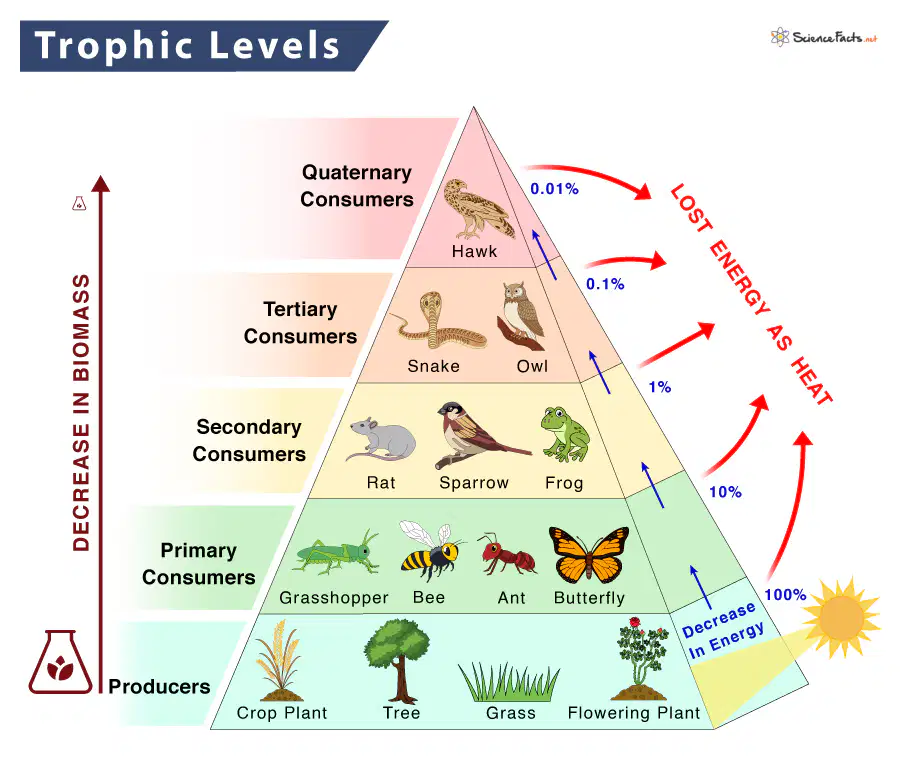
What happens to the 90% of energy that is not transferred to the next trophic level?
Lost at 10%
Gained as heat through cell processes
Lost as heat through cell processes

What percent of the available energy moves from one trophic level to the next?
90%
100%
10%
25%
White clovers, Trifolium repens, are plants that are native to Europe
and Central Asia and are able to produce the poison cyanide within
their cells. Skunk cabbage, Symplocarpus foetidus, is a plant that
is native to eastern North America and can produce a chemical that
makes it have a strong, foul odor and bitter taste.
The chemicals produced by both the white clovers and skunk
cabbages are adaptations that allow them to —
attract more pollinators
survive a long-term drought
protect against herbivores
grow better in colder habitats
Leaf-cutter ants harvest leaves and carry them to fungi that convert
plant material into a usable form for the ants to digest. The fungi
depend on the leaves for nutrients. The ants also produce an antibiotic
on their bodies that helps protect the fungi from harmful bacteria.
Which of these explains the relationship between the leaf-cutter ants
and the fungi?
Predation, because the ants feed on the fungi
Mutualism, because both the ants and the fungi benefit from
each other
Competition, because both organisms consume the same resource
for energy
Commensalism, because the ants receive energy from the fungi
and the fungi are unaffected
Students designed an experiment to model the carbon cycle. The
students combined water and carbon dioxide-producing disks in a
sealed flask. The flask represented Earth’s atmosphere, and the lamp
represented the sun. Which component can be added to the flask to reduce the
concentration of carbon dioxide in the model atmosphere created
by the disks?
Bacteria to use carbon during nitrification
Plants to absorb carbon in the process of photosynthesis
Snails to use carbon through cellular respiration
Mushrooms to absorb carbon during decomposition
Sort the following organism into their categories.
sunflower
algae
strawberry
chemosynthetic bacteria
Human
Dog
Caterpillar
Mouse
Bacteria
Fungi


Which one is most likely the pyramid of biomass?
A
B


A species that is not native to an area is called:
Native Species
Natural Species
Nonnative Species
Symbiotic Species
What can absorb Carbon Dioxide from the atmosphere?
Wetlands ;photosynthesis; ocean phytoplankton
Burning of fossil fuels; increase deforestation
Increased Co2 in the atmosphere by breathing more.
Denitrifying bacteria in the soil.
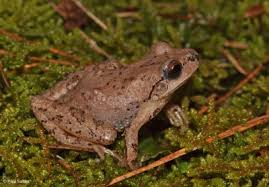
What converts nitrogen gas into a usable form for plants and animals?
bacteria
rain
fungi
car exhaust
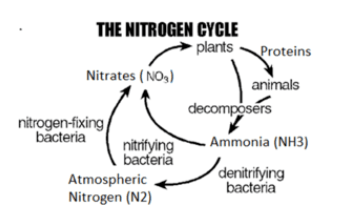
According to this diagram, plants absorb
nitrates
nitrogen fixing bacteria
animals
decomposers
Match the following

Variety of habitats in biosphere

Different types of organisms in area

Different alleles present in species

