

wayground logo

Free Printable Worksheets

Font size

S
M
L
XL
Worksheets

Unit 3: Macroeconomics

Total questions: 40

Worksheet time: 13mins

Name
Class
Date
1.
Which of the following is studied in "macro" economics?
a)

An examination of the change in unemployment over the last ten years.

b)
An examination of negative externalities caused by production in the automotive industry.
c)
An examination of the average incomes of people with advanced degrees from CSU.
d)
An examination of trending prices in the housing market of Fortson and Cataula.
2.

Which of the following combinations of monetary tools represents an attempt to expand the money supply using easy money (expansionary) policy? (SSEMA2c)

a)

Decreasing the discount rate, decreasing reserve requirements, and selling government securities

b)

Increasing the discount rate, increasing reserve requirements, and selling government securities

c)

Decreasing the discount rate, decreasing reserve requirements, and buying government securities
d)

Increasing the discount rate, decreasing reserve requirements, and buying government securities

3.
Which of the following statements identifies the role or structure of the Federal Reserve correctly? (SSEMA2a)
a)
The Federal Reserve runs through fourteen district banks.
b)
There are nine members on the FED’s Board of Governors.
c)
One major tool of the Federal Reserve is the power to increase or decrease taxes.
d)
The job of the Federal Open Market Committee is to decide to sell or buy government securities.
4.
How does the CPI provide an accurate indication of inflation within a country? (SSEMA1a)
a)
The CPI measures urban household spending on a "market basket" in a calculation to see how the average prices of goods and services have changed over time.
b)
The CPI measures the average change over time in the selling prices received by domestic producers for their output using start and end dates.
c)
The CPI involves the calculation of price changes in the purchase of luxury items to indicate inflation.
d)
The CPI uses a calculation to indicate how consumers spend more money on inferior goods as income rises.
5.
Which of the following is an example of a fiscal policy action used by Congress to stop a recession? (SSEMA2)
a)
Congress will decrease spending.
b)
Congress will decrease the reserve requirement on banks.
c)
Congress will increase taxes.
d)
Congress will increase the amount of tax deductions.
6.
_________________ is an inflation-adjusted measure that reflects the value of ALL final goods and services produced and sold by an economy in a given year.
a)
The Consumer Price Index
b)
The Real Gross Domestic Product
c)
The Nominal Gross Domestic Product
d)
The Business Cycle
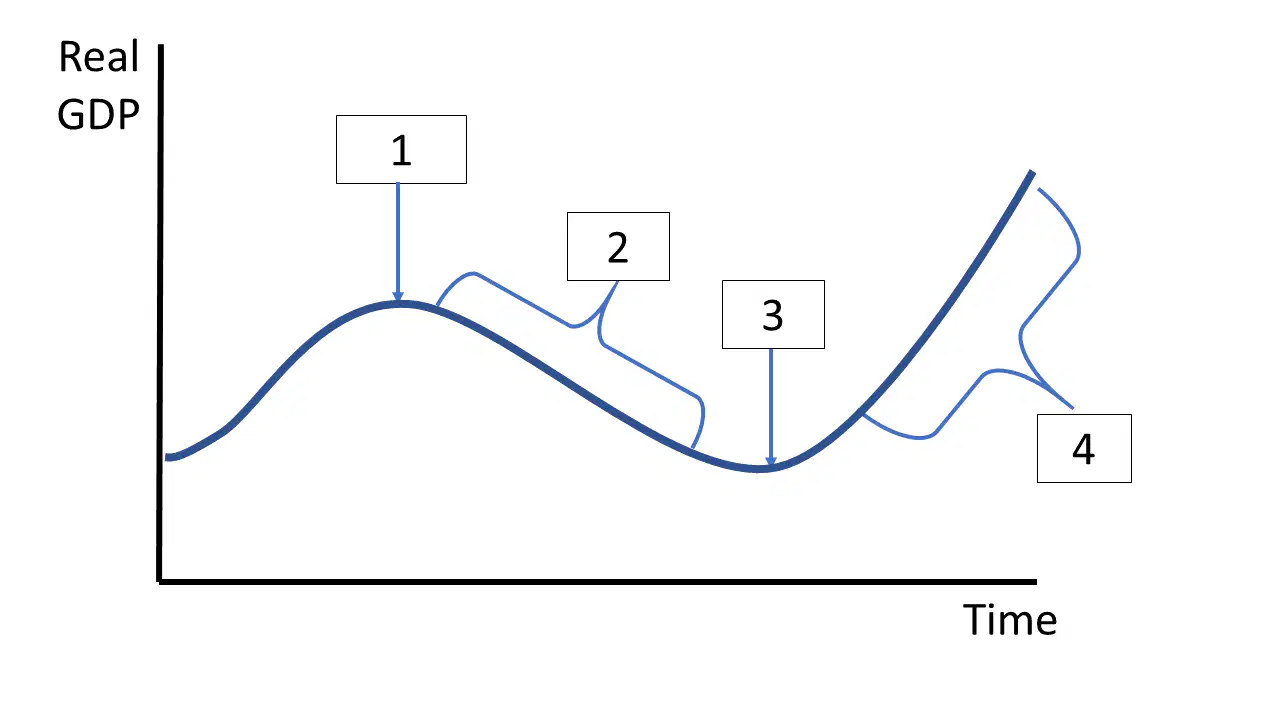
7.

At which point of the business cycle would you find the following characteristics: inflation, lowest unemployment, and the highestGDP.

a)
1
b)
2
c)
3
d)
4
8.
Which of the following is NOT counted in the Output Expenditures Model?
a)
Consumer and Business expenditures.
b)

Transfer payments from the Government.

c)
Exported capital and consumer goods.
d)
Government expenditures.
9.
Which of the following is NOT considered an intermediate good?
a)

Furniture

b)

Lumber

c)

Fiberglass

d)
Steel
10.
What is the accepted "full" or "normal" rate of unemployment?
a)
1%
b)
4%
c)
8%
d)
12%
11.

__________________unemployment is short-term unemployment that happens when people are between jobs. It can occur when people quit to find a better job, when people graduate and look for their first job, or when people change jobs. 


a)
structurally
b)
frictionally
c)
cyclically
d)
seasonally
12.

______________ unemployment occurs when there is a mismatch between the skills of job seekers and the skills needed for available jobs in the market. This can happen when new technologies or industries replace older ones. 


a)

cyclical

b)

frictional

c)

structural

d)

seasonal

13.
The Federal Government raised the minimum wage by 2% due to a price level increase of 3% over the last year. Which of the following is true based on the government's actions?
a)
Real wages have increased, but nominal wages have decreased.
b)
Nominal wages have increased, but real wages have decreased.
c)
Both nominal and real wages have decreased.
d)
Both nominal and real wages have increased.
14.

The _______________ is an economic theory that states that the amount of money in circulation directly affects the price of goods and services, potentially leading to inflation if not controlled.


a)
demand-pull theory
b)
cost-push theory
c)
quantity theory
d)
deflator theory
15.

_______________ theory is an economic theory that explains how inflation occurs when consumers' wants and needs for goods and services exceeds supply. It's the most common cause of inflation.

a)
Price Level Theory
b)
Quantity Theory
c)
Cost-Push Theory
d)
Demand-Pull Theory
16.

______________ is an economic theory that explains how rising production prices leads to a supply decrease, further pushing prices up.
a)
Cost-Push Theory
b)
Demand-Pull Theory
c)
Quantity Theory
d)
Supply-Fall Theory
17.
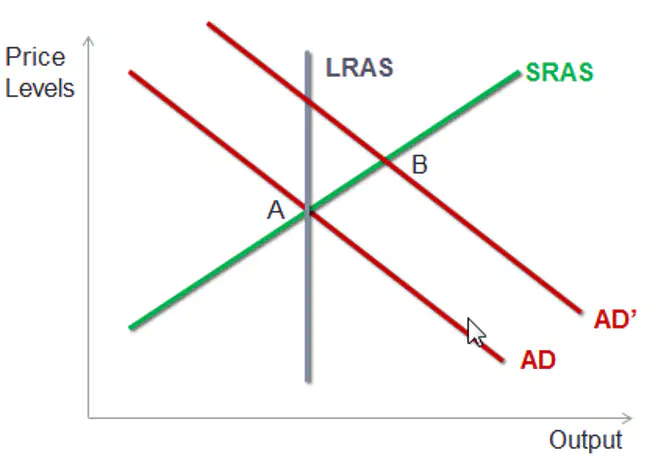
Explain how the market, over time, will correct the expansionary gap caused by the shift in aggregate demand?
a)
AD(1) will gradually shift back to the original LRAS at AD(0) as imports begin to exceed exports and drive the GDP down.
b)
SRAS will shift left (decrease) as a result of inflation and higher costs of production, bringing the equilibrium back to the original LRAS curve.
c)
LRAS will shift to the right and create a new equilibrium at P(1) due to gradual inflation over time.
d)
The shift to AD(1) will cause a supply shock. shifting the SRAS right, bringing the LRAS with it over time.
18.
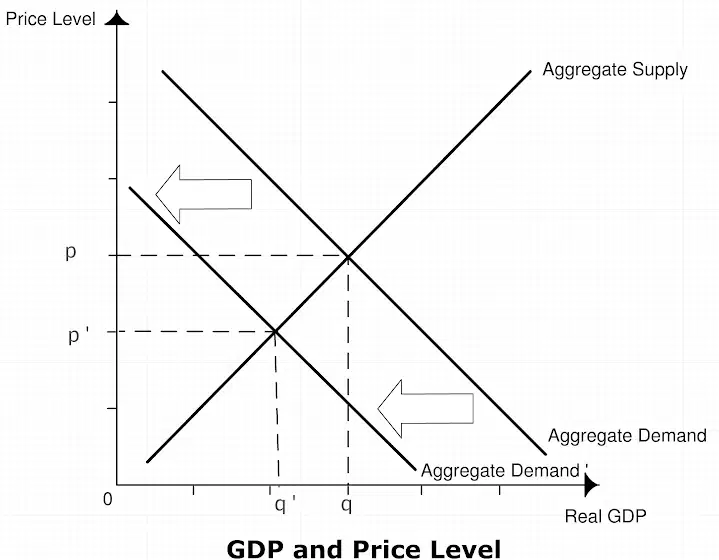
Which of the following monetary policies would cause the shift shown below?
a)
Congress raises taxes by 3%.
b)
The Fed lowers the discount rate.
c)
The Fed raises the reserve requirement from 10% to 12%.
d)
Commercial banks begin selling bonds to the Federal Reserve Banks.
19.
The Fed uses __________________ to control the money supply through buying and selling bonds to consumer banks.
a)
reserve requirements
b)
the discount rate
c)
open market opperations
d)
the government budget
20.
The efficiency of a nation's productivity can be measured by calculating the ________________________, or how much is given up per each unit produced.
a)
absolute advantage
b)
marginal propensity to consume
c)
foreign exchange rate
d)
marginal opportunity cost
21.
When a country can produce a good or service in greater quantity than other nations, they have a/an _________________________.
a)
absolute advantage
b)
comparative advantage
c)
trade surplus
d)
trade deficit
22.
When a country can produce something at a lower opportunity cost, they have a/an ________________________.
a)
absolute advantage
b)
comparative advantage
c)
trade surplus
d)
trade deficit
23.
A tax on imported goods is called a/an ___________________.
a)
embargo
b)
quota
c)
tariff
d)
subsidy
24.
A limit, or _______________, can be placed on the production, consumption, or sale of a good or service.
a)
tariff
b)
embargo
c)
standard
d)
quota
25.
The _______ is the price of one country's currency in terms of another country's currency.
a)
exchange rate
b)
price index
c)
terms of trade
d)
inflation rate
26.
When the US Dollar is "strong," domestic goods become ________ expensive; therefore, _____________ will decrease and _____________ will increase.
a)
less / imports / exports
b)
more / exports / imports
c)
less / exports / imports
d)
more / imports /exports
27.
Which of the following barriers to trade could potentially benefits, domestically, both producers and consumers.
a)
subsidy
b)
embargo
c)
tariff
d)
quota
28.
Which of the following trade barriers calls for an outright ban against trade with a specific country?
a)
tariff
b)
embargo
c)
quota
d)
subsidy
29.
According to the chart below, what is the per-unit opportunity cost of clothing for Country B?
a)
1/2 Clothing
b)
1/2 Food
c)
2 Clothing
d)
2 Food
30.
A _____________ is a type of intergovernmental organization whose goals are to reduce and eliminate barriers to trade.
a)
communist bloc
b)
trading bloc
c)
treaty organization
d)
block party
31.
Which of the following trading blocs uses a common currency?
a)
EU
b)
NAFTA
c)
ASEAN
d)
USMCA
32.
Which of the following trading blocs includes the U.S.?
a)
NATO
b)
USMCA
c)
ASEAN
d)
EU
33.
When imports exceed our exports, countries have a _____________________ (in terms of money, not goods).
a)
balance of trade
b)
trade surplus
c)
inflationary gap
d)
trade deficit
34.
Which of the following statements best describes the differences between absolute advantage and comparative advantage? (SSEIN1a)
a)
Absolute advantage is when a nation can make more of a product while comparative advantage focuses on the opportunity cost of making that product.
b)
Absolute advantage compares nations’ opportunity cost of making a product while comparative advantage is based on which nation makes more.
c)
Absolute advantage looks at the opportunity cost of a nation to produce a product while comparative advantage is based on public opinion.
d)
Both absolute advantage and comparative advantage is based on opportunity cost.
35.
Which of the following is true of the impact of trade barriers on imports? (SSEIN1b)
a)
Trade barriers can decrease the price of targeted imports.
b)
Trade barriers can increase the price of targeted imports.
c)
Trade barriers force nations to produce everything themeselves.
d)
Trade barriers increase the money supply through open market operations.
36.

When the U.S. Dollar appreciates in value to the Euro, which of the following could happen? (SSEIN3c)

a)
U.S. consumers will be able to buy more domestic goods.
b)

U.S. producers will sell more goods to European consumers.

c)

U.S. consumers will be able to buy more European goods.

d)
U.S. producers will increase production of exports.
37.
Which of the following occurs as a result of the Fed selling bonds to consumer banks?
a)
Banks increase lending.
b)
The money supply decreases.
c)
Prices begin to inflate.
d)
The market will not change.
38.
The _________________ is the interest percentage the Fed charges commercial (member) banks for loans.
a)
reserve requirement ratio
b)
discount rate
c)
fractional reserve
d)
open market rate
39.
The __________________ is the percentage of deposits that banks must hold in cash.
a)
discount rate
b)
fractional reserve
c)
reserve requirement ratio
d)
open market rate
40.

Which of the following is a primary function of the World Trade Organization (WTO)?

a)

To regulate international trade agreements

b)

To impose tariffs on non-member countries

c)

To control global currency exchange rates

d)

To provide loans to developing countries
