
Font size
 Worksheets
Science DCP #3 Review 24-25
Total questions: 77
Worksheet time: 5hrs 32mins
A student plugs a hot plate into an outlet and turns on the hot plate to melt the ice. Complete the example to identify another object that used the same source of energy as the hot plate.
Drag and drop the correct answer in each box.
(a) using (b) energy.

What is the best use for the energy form shown below?
To produce sound energy
To produce solar energy
To produce mechanical enegy
To produce electrical energy

The slingshot below is made with wood and a rubber band. When a ball is placed in the slingshot and the rubber band is pulled, it forces the ball outward. Which kind of energy is produced by pulling the rubber band back?
Mechanical
Thermal
Electrical
All of these
A campfire, fireworks, and a burning candle all produce which forms of energy?
Select TWO correct answers.
Mechanical Energy
Thermal energy
Light energy
Solar energy
Electrical energy

A class is learning about states of matter. The teacher shows the students how to set up the investigation shown in the diagram. What kinds of energy are needed in this investigation to change the state of matter of the candle?(5.6A)
Light, mechanical, and thermal
Electrical and thermal
Mechanical, light, and electrical
Thermal and mechanical

Many people ride a bicycle for fun and exercise. Some people ride a bicycle to work because it saves money and benefits the environment by reducing the use of fossil fuels. Which of these is not an example of the bicycle using mechanical energy? (5.6A)
The pedals, gears, and chain help turn the wheels.
The wheels turn when the bicycle moves.
The front wheel guides the bicycle as it moves.
The reflector allows the bicycle to be seen at night.
Which object requires only mechanical energy to perform its main function? (5.6A)


A student builds a circuit made up of a battery, two light bulbs, and a switch. What will the student most likely observe in this circuit?
Light bulb 1 and light bulb 2 will both be on
Light bulb 1 will be off, but light bulb 2 will be on
Light bulb 1 and light bulb 2 will both be off
Light bulb 1 will be on, but light bulb 2 will be off

Which of these changes to the electric circuit shown above will cause the lightbulb to light up.
Straightening the wire so that the current can flow more easily
Adding a switch and more wire so that the current can flow more easily
Turning one battery so that its positive end connects to the other battery's negative end
Making the length of wire the same on both sides of the lightbulb

A group of students built the circuit shown above. The lightbulb does not glow. Which statement explains this observation?
The battery is not charged
The lightbulb is not part of a complete circuit
The circuit does not have a switch
The bell uses most of the energy from the battery

The diagram shows a series circuit with three lit bulbs. How many of the bulbs will remain lit if the wire is cut a the point shown by the arrow?
0
1
2
3
A student builds a circuit made up of a battery, two light bulbs, and a switch. What will the student most likely observe in this circuit?
Light bulb 1 and light bulb 2 will both be on
Light bulb 1 will be off, but light bulb 2 will be on
Light bulb 1 and light bulb 2 will both be off
Light bulb 1 will be on, but light bulb 2 will be off
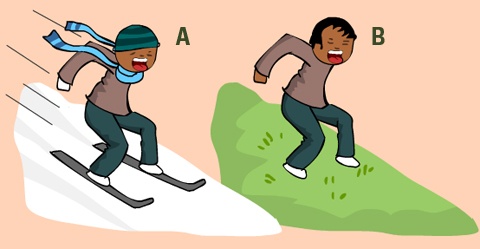
Why is it harder for the boy in Image B to get down the hill?
Motion
Friction
Work
Displacement

How does the light behave differently when it enters the prism?
The ray of light becomes shorter when it strikes the glass.
The ray of light straightens as it strikes the glass.
The ray of light bends as it strikes the glass.
The ray of light transforms to heat when it strikes the glass.
Brandy wants to know how long taffy candy will stretch if she pulls hard on one end of the candy. What should she do to determine how long the taffy will stretch?
Test what will happen when she pulls with varying amounts of force on many pieces of different types of taffy
Test what will happen when she pulls with varying amounts of force on three pieces of one type of taffy
Test what will happen when he pulls with the same amount of force on many identical pieces of taffy
Test what will happen when he pulls with the same amount of force on three pieces of one type of taffy
When light strikes the surface of the mirror ball, it is--
destroyed by the mirrors.
absorbed by the mirrors.
reflected by the mirrors.
refracted by the mirrors.
Andres wants to determine if he can consistently hit a baseball out of the park when he swings the bat as hard as he can. What should Andres do to determine whether he can consistently hit a baseball out of the park?
Hit different types of balls, many times, with varying amounts of force.
Hit the same ball, a few times, with varying amounts of force.
Hit the same ball, many times, with same amount of force.
Hit different types of balls, a few times, with the same amount of force.


Lenses always________light.
reflect
refract
transmit
absorb
Day and night on the Earth are caused by -
the orbit of the Moon around the Earth
the rotation of the Sun on it axis
the orbit of the Earth around the Sun
the rotation of the Earth on its axis

A student observed the Sun throughout the day over the neighbor’s house. The change the student observed is caused by -
orbit of Earth around the Sun
rotation of Earth on its axis
orbit of the Sun through space
reflection of the Sun off the Moon

The diagram here illustrates Earth rotating as well as the Sun’s light illuminating Earth. According to the diagram above, which point on Earth is about to experience sunset?
A
B
C
D
The diagram here illustrates Earth rotating as well as the Sun’s light illuminating Earth. According to the diagram above, which point on Earth is about to experience sunset?
A
B
C
D
About how many hours are there between one sunrise and the next?
8
12
24
36

Which position shows where the sun would most likely be at 12:00 P.M. ?
Position A
Position B
Position C
Answer is not here

3.What rock process drops sediments in a new place?
erosion
cementation
weathering
deposition
6.Small pieces of rock
imprint
sediment
erosion
boulders
A fan-shaped landform created by sediment being deposited at the mouth of a river.
Delta
Canyon
U-Shaped Valley
Sand Dunes
Formed when water acts as an agent of weathering and erosion. The water breaks the rocks into sediment and carries the sediment away.
U-Shaped Valley
Sand Dunes
Canyon
Delta
Formed by a glacier that carved a deep valley as it slowly moved forward.
Delta
Canyon
U-Shaped Valley
Sand Dunes
A hill or ridge of sand, formed when wind erodes sand and deposits sand in new locations.
Canyon
Sand Dunes
Delta
U-Shaped Valley
The breaking down of rocks on Earth’s surface into smaller pieces.
Erosion
Deposition
Cementation
Weathering
When water, wind, and ice move sediment to new places.
Erosion
Weathering
Deposition
Compaction
A type of rock that forms when existing rock is weathered, eroded, and deposited in layers on land or underwater.
Granite Rock
Graphite
Metamorphic Rock
Sedimentary Rock

A teacher set up the model shown to represent the formation of a landform. What landform does this model most likely represent?
Delta
Cave
Canyon
Sand dune

A canyon with tall, vertical sides is shown. Which of the following most likely led to the formation of this canyon?
Rapidly moving water
A hurricane
Burrowing animals
Volcanic activity

Wind, water, and ice change Earth’s surface. Which landform was most likely formed by the slow movement of glaciers?
Arch
River delta
V-shaped valley
U-shaped valley

The images show a river delta and sand dunes. Which statement best explains how the formation of deltas and sand dunes is similar?
Both are formed by the movement of glaciers.
Both are formed by water eroding sediments.
Both are formed by wind weathering rocks.
Both are formed be deposition of sediments.
Which pair of landforms are the result of the same agent of change?
Note: The agents are wind, water or ice.
A canyon and V-shaped valley
A U-shaped valley and delta
A sand dune and cave
A delta and sand dune
Which table correctly identifies the agents of
change for the corresponding landforms?


When the weight of new sediment layers is deposited on top of older layers, causing the particles to squeeze together
erosion
compaction
production
weathering
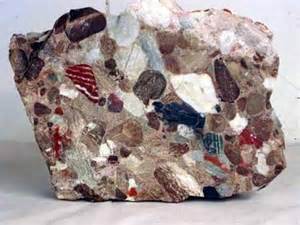
The process of layers become stuck together forming sedimentary rocks
weathering
erosion
cementation
deposition

Decay or decomposition means to
break into smaller parts
make into larger parts
fix something

Preserved parts or traces of animals and plants that lived in the past (a)
Coal, oil, and natural gas formed over millions of years are called (a)
Which sentence best describes the formation of sedimentary rock?
Lava erupts from a volcano, cools, and turns into hard rock.
Small pieces of sediment settle in a basin and are cemented and compacted together.
Rock buried deep within the Earth changes under pressure into a new kind of rock.
Magma cools beneath the surface of the Earth, forming large rock crystals.
Two students who live near Dallas found fossils in rocks near their homes. They constructed a model of an ocean or sea to show the environment they thought was there when the fossils were created. Which of the following fossils found would provide the evidence that this was the correct environment to model?
fern leaves
dinosaur bone
insect imprint
clam shell
Preserved parts or traces of animals and plants that lived in the past (a)
Coal, oil, and natural gas formed over millions of years are called (a)
All of these are related to the formation of oil or natural gas EXCEPT
decomposed animals
decayed plants
sedimentary rocks
volcanic eruptions
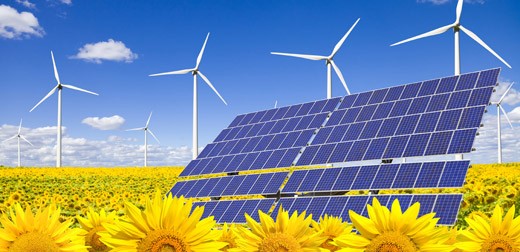
__________ is an energy resource that WILL NOT run out in the next several hundred years.
Renewable Energy Resource
Nonrenewable Energy Resource
Fossil fuels
biodegradable
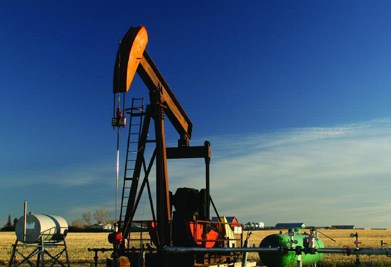
__________ is an energy resource that WILL run out in the next several hundred years.
Renewable Energy Resource
Nonrenewable Energy Resource
natural resources
pollution

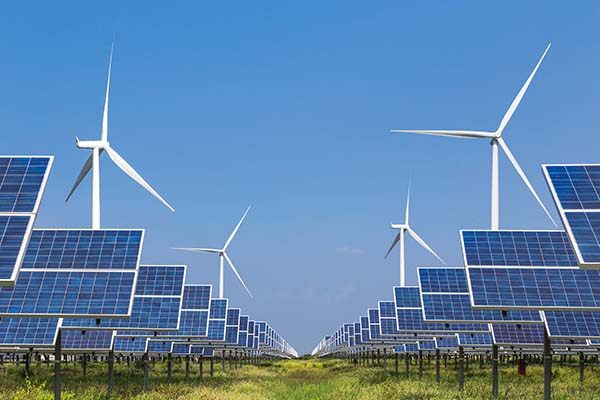
What are renewable resources?
A limited amount and cannot be replaced in a human life time.
Plastic bags
Coal, oil, and natural gas
Can be replaced in our lifetime through natural processes
A living or once-living organism in an ecosystem is a(n):
A nonliving element in an ecosystem is a(n):
Sunlight is an example of a ____________ factor.
abiotic
biotic
An ecosystem is made up of __________.
living things only
non-living things only
both living and non-living things

Lion
Abiotic (non-living)
Biotic (living)
A hollow, sealed glass sphere contains sand, water, air, algae, and tiny brine shrimp. The sphere is a model ecosystem. Which of these is a biotic factor of this ecosystem?
air
algae
sand
water
Which of the following is a biotic factor in an ocean ecosystem?
the salt content of the water
the temperature of the water
the fish in the water
the oxygen in the water
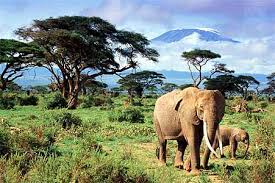
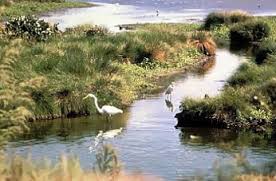
How can a rock play an important role in an ecosystem?
It can provide sunlight to plants.
It can provide shelter to animals.
It can provide carbon dioxide to plants.
It can provide carbon dioxide to animals.
Which abiotic factor plays a role in why Polar Bears have thick fur?
rocks
fish
soil
temperature/climate

We got three inches of rain yesterday.
Weather
Climate

Chicago received more snow this decade than in past decades.
Weather
Climate
Which statement best describes the weather?
The temperature is increasing as the cloud cover decreases
Wind speeds are greatest during the spring
Since 1970, yearly rainfall averages are lower than usual
Flash flooding has increased in many areas during the last few decades
A team of meteorologists are recording daily temperatures in their city and comparing the measurements with data collected over several decades. What type of information are they investigating?
Weather, because they are measuring temperature
Climate, because they are comparing data over time
Weather, because the measurements can change daily
Climate, because the data is collected for only one city
What is one difference between weather and climate?
Weather describes conditions near the ground, but climate does not
Climate describes energy from the Sun, but weather does not
Weather includes precipitation, but climate does not
Climate describes long-term conditions over an entire region, but weather does not

