
 Worksheets
Waves
Total questions: 72
Worksheet time: 1hrs 24mins
1-5.
Answer the questions below after watching the video
What determines if a wave is classified as transverse or longitudinal?
The material the wave travels through
The direction of particle vibration relative to the wave's energy movement
The frequency of the wave
The amplitude of the wave
What are compressions and rarefactions associated with?
Transverse waves
Longitudinal waves
Electromagnetic waves
None of the above
How do sound waves travel through air?
By electromagnetic radiation
By transferring energy through particle vibration parallel to the wave direction
By causing air particles to vibrate up and down
By moving air particles in a circular motion
What is the direction of particle vibration in transverse waves?
Parallel to the direction of energy movement
At a 45-degree angle to the direction of energy movement
Perpendicular to the direction of energy movement
In the same direction as the wave travels
Which of the following is an example of a transverse wave?
Sound waves
Seismic P-waves
Water surface waves
None of the above
6-15.
Answer the questions below after watching the video
What is essential for the existence of the modern world and our daily lives, yet is invisible?
Gravity
Electromagnetic radiation
Air
Sound
How do electromagnetic waves differ from ocean waves?
They require water to travel
They can only travel through air
They can travel through the vacuum of space
They have no frequency
What determines the frequency of an electromagnetic wave?
The height of the wave
The number of crests passing a point per second
The speed of light
The distance between crests
Which waves have the shortest wavelength and highest energy in the electromagnetic spectrum?
Gamma rays
Infrared waves
Microwaves
Radio waves
What range of wavelengths can the human eye detect?
300 to 400 nanometers
700 to 1000 nanometers
100 to 200 nanometers
400 to 700 nanometers
Why do leaves appear green to the human eye?
They emit green light
They reflect green light
They absorb green light
They convert green light
What allows scientists to study phenomena beyond visible light?
Microscopes
Magnifying glasses
Telescopes
Spectral signatures
What is a spectral signature?
A scientist's autograph
A graph showing interactions across the electromagnetic spectrum
A signature of a spectrum
A type of light
What did NASA's Spitzer Space Telescope discover in a galaxy 3.2 billion light-years away?
Alien life
A black hole
Water and organic molecules
A new planet
How do solar flares and eruptions affect Earth?
They increase global temperatures
They are harmless
They can disrupt satellites and communications
They cause earthquakes
16-20.
Answer the questions below after watching the video
What does the letter 'F' represent in the context of waves?
Function
Force
Fusion
Frequency
What unit is obtained by multiplying a wave's frequency by its wavelength?
Cycles
Meters per second
Seconds
Meters
If a wave's frequency is 1 cycle per 2 seconds and its wavelength is 3 meters, what is its speed?
1.5 meters per second
0.5 meters per second
3 meters per second
6 meters per second
What happens to the wavelength if the frequency of a wave increases?
It increases
It decreases
It becomes zero
It remains constant
What primarily determines the speed of a wave?
The amplitude of the wave
The medium it travels through
Its wavelength
Its frequency
21-35.
Answer the questions below after watching the video
What analogy is used to explain the concept of current in electrical circuits?
Water flowing through a pipe
Cars on a highway
Air moving through an atmosphere
Sound waves through a medium
What remains constant throughout a wire even when obstructed by resistors?
Resistance
Voltage
Current
Power
Which factor does NOT affect the resistance of a material?
Temperature
Color
Cross-sectional area
Material type
Which component is likened to friction in explaining resistance?
Transformer
Inductor
Capacitor
Resistor
What does voltage in a circuit primarily do?
Decreases current
Increases resistance
Reduces power output
Pushes electrons through
In a series circuit, how is the total resistance calculated?
Subtracting the resistances
Adding the resistances
Multiplying the resistances
Dividing the resistances
How does the voltage drop across each resistor in a series?
It varies depending on the resistance
It increases
It remains constant
It decreases
What does the term 'voltage drop' refer to in a circuit?
A reduction in current
An increase in power
A decrease in resistance
A decrease in voltage across a component
How do you calculate the voltage drop across a resistor in a series circuit?
Add the resistances of all resistors
Divide the total voltage by the number of resistors
Subtract the resistance from the total current
Multiply the current by the resistance of the resistor
What happens to the total resistance in a parallel circuit when more resistors are added?
It increases
It becomes zero
It decreases
It remains the same
In a parallel circuit, how does the current behave?
It only flows through the path with highest resistance
It stops flowing
It varies depending on the resistance of each path
It is the same through each path
In a parallel circuit, if one path has a lower resistance, how does the current behave?
Equal current flows through all paths
Current stops flowing through the lower resistance
No current flows through the lower resistance
More current flows through the lower resistance
What is the effect of adding more resistors in parallel on the total resistance?
Makes the resistance infinite
Has no effect on the resistance
Decreases the resistance
Increases the resistance
What is the first step in solving a complex circuit with both series and parallel resistors?
Replace all resistors with a single equivalent resistor
Identify and solve series and parallel sections separately
Add all resistances
Calculate the total power
What is the key difference in current flow between series and parallel circuits?
Current stops in series when a resistor is added
Current is constant in series and variable in parallel
Current doubles in parallel circuits
Current is variable in series and constant in parallel
36-45.
Answer the questions below after watching the video
What starts the movement of waves in a pond?
Raindrops
Fish swimming
A pebble thrown into the water
A strong wind
Where do most waves get their energy from?
Underwater earthquakes
Wind
The moon's gravitational pull
The sun
What is the highest point of a wave called?
Wavelength
Amplitude
Trough
Crest
What happens to waves as they approach the shore?
They move faster
They get taller and closer together
They disappear completely
They turn into sound waves
How do sound waves travel?
Perpendicular to the disturbance
In a circular motion
In the same direction as the disturbance
In a straight line
What type of wave is demonstrated with a slinky?
Ocean wave
Longitudinal wave
Transverse wave
Both A and B
How does the surface of a drum create sound when hit?
It vibrates and sends waves through the air
It creates heat
It reflects light
It absorbs water
What determines the loudness of a sound?
The amplitude of the sound wave
The color of the sound wave
The speed of the sound wave
The temperature of the sound wave
What kind of sound has a longer wavelength?
A soft sound
A high-pitched sound
A loud sound
A low-pitched sound
What are the two types of waves mentioned?
Loud and quiet waves
High and low waves
Transverse and longitudinal waves
Ocean and sound waves
A mechanical wave is a disturbance in matter that transfers energy through ________.
solid
liquid
gas
all of the above
Which one of the following descriptions fits a wave with a large amount of energy?
Low amplitude
Long wavelength
High frequency
Low frequency
The position the medium would be in if no energy was moving through the medium, or if the medium was at rest
Crest
Trough
Rest position

Which letter represents wavelength of a longitudinal wave?
A
B
C

Which letter represents the rarefaction of this longitudinal wave?
A
B
C

What is the name of the part represented with the letter A?
Crest
Congestion
Compression
Congregation

How many total waves (compression to compression) are represented in the image?
(a)
A transverse wave must have a medium to travel through, otherwise the energy can't go anywhere.
True
False
The particles of matter move perpendicular (at a right angle) to the wave direction in this type of wave
Transverse
Longitudinal
Compression
Surface

What is the name of this part of a transverse wave?
(a)

What is the name of this wave measurement?
(a)

What is the name of this wave part?
(a)

What is the name of this wave measurement?
(a)
A wave moving on a rope would be an example of which type of wave?
Transverse wave
Compression wave
Longitudinal wave
Surface wave
A wave with a high amplitude carries _______ energy than a wave with a low amplitude.
more
less
What is frequency?
The height of a wave
The distance between waves
The amount of waves produced in a given amount of time
The shape of a wave
As the frequency of a wave decreases, the wavelength _________.
also decreases
stays the same
increases
Draw a transverse wave with a high frequency and short wavelength.

A wave is a disturbance that transfers energy
TRUE
FALSE
2. EM waves consist of changing electric and magnetic fields moving perpendicular with respect to each other. What kind of wave is it?
Longitudinal waves
Transverse waves
Mechanical waves
Compressional waves
10. Which of the following lists the visible spectrum in order of decreasing frequency?
yellow orange, violet
yellow, blue, violet
yellow, green, white
yellow, orange, red
The invisible spectrum contains all the colors of the rainbow.
TRUE
FALSE
The source of all electromagnetic waves is oscillating electrons.
TRUE
FALSE

How many waves are in this image?
2
4
3.5

"A" on the diagram is the measure of....
Wavelength
Frequency
Radiation

The number of waves per second is called the
frequency.
wavelength
amplitude
radiation

Which wave in the diagram has the highest frequency?
1
2
3
4

The wavelength is
2.2 cm
0.2 cm
4.5 cm

Which wave in the diagram has the longest wavelength?
1
2
3
4

Which has the LONGEST wavelength and, therefore, the lowest frequency/energy
Gamma rays
Visible light
Radio waves
Infrared

Which section of the electromagnetic spectrum can we sense with our eye?
Ultraviolet
Visible light
Infrared
X-rays

Which has the SHORTEST wavelength and, therefore, the highest frequency/most energy
Radio waves
Gamma rays
Ultraviolet
Microwaves


The type of electromagnetic wave that is used to cook food. It has a higher frequency than radio waves.

Which part of the electromagnetic spectrum can be detected by night vision goggles as heat?
infrared
radio
x-rays

Which type of radiation is dangerous to living things?
Ultraviolet
Radio
X-rays
Gamma Rays
Visible light
HOW DOES TRANSVERSE WAVE MOVE TO THE ENERGY TRANSFER?
Parallel to the energy transfer.
Vertical to the energy transfer.
Perpendicular to the energy transfer.
Horizontal to the energy tranfer
HOW DOES A LONGITUDINAL WAVE MOVE TO THE ENERGY TRANSFER?
Perpendicular to the energy transfer.
Horizontal to the energy transfer.
Vertical to the energy transfer.
Parallel to the energy transfer.
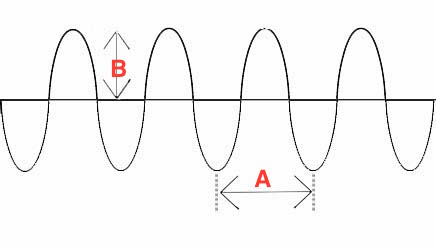
Which statement about sound waves are correct?
sound waves cannot be reflected.
sound waves are longitudinal.
sound waves are electro magnetic.
sound waves are transverse.

Which electromagnetic wave from this PAIR has the most energy?
Yellow
Green

Which electromagnetic wave from this PAIR has the highest frequency?
Orange
Ultraviolet Radiation
Electromagnetic waves vary in
the speed they travel in a vacuum.
wavelength and frequency.
the way they reflect.
the orientation of their electric and magnetic fields.
The full range of frequencies of electromagnetic radiation is called
visible light.
radio waves.
the electromagnetic spectrum.
invisible radiation.
The visible light spectrum ranges between
radar waves and X-rays.
television waves and infrared rays.
infrared rays and ultraviolet rays.
ultraviolet rays and gamma rays.
Which of the following occurs as a light wave bends when it passes from one medium into another?
constructive interference
refraction
destructive interference
reflection
Light in the form of a particle that has discrete amount of energy is called a
Charm
Photon
Exciton
Muon
How are Electromagnetic waves different from Mechanical waves?
EM waves have very short wavelengths
EM waves transmit energy instead of matter
EM waves can travel through the vacuum of space (without particles)
EM waves can change direction by reflection

All waves carry ______________.
Sound
Light
Matter
Energy

What kind of wave is pictured below?
compressional wave
transverse wave
sound wave
longitudinal wave

What type of wave is pictured?
Transverse wave
Longitudinal wave
Wave, what wave?
Slinky wave
The highest point of the transverse wave is called _____
trough
amplitude
crest
wavelength
The lowest point on the transverse wave is called_______
trough
crest
wavelength
frequency

This is the distance from the equilibrium position to the crest or to the trough.
crest
trough
wavelength
amplitude

The wavelength can be measured from ( check all that apply)
crest to crest
crest to trough
trough to crest
trough to trough


