
Font size
 Worksheets
UNIT 3 - EARTH'S PLACE IN THE UNIVERSE
Total questions: 40
Worksheet time: 1hrs 17mins
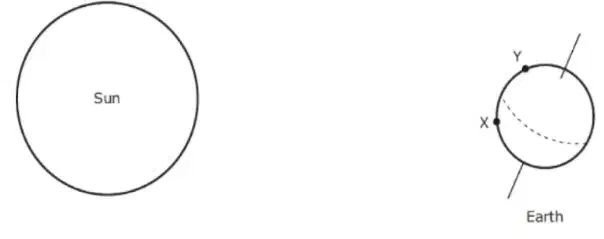
A student draws the model shown below. Which of the following statements best explains the conditions at location X and Y?
It is daytime at Location X and nighttime at Location Y.
There are more hours of daylight at Location X than at Location Y.
It is winter at Location X and summer at Location Y.
The moon is brighter when viewing it from Location X than Location Y.
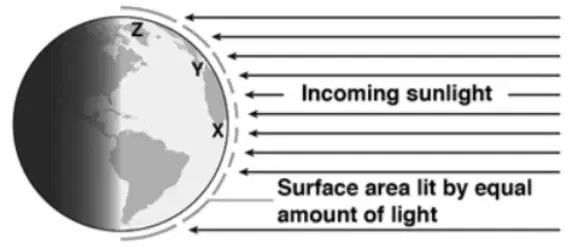
The arrows in the diagram show how the Sun's rays hit Earth. Each part of the dashed line shows an area lit by an equal amount of sunlight. Which accurately describes the strength of the sunlight?
The light is strongest at Z and weakest at Y.
The light is strongest at Z and weakest at X.
The light is strongest at X and weakest at Z.
The light is strongest at X and weakest at Y.
At 2 p.m. one winter afternoon, Mrs. Montgomery’s students noticed the sun shining directly through the classroom window because it was low in the sky. During the summer, at the same time of day, the sun was too high in the sky to be seen shining through the classroom windows. Why did the path of the sun across the sky change during the winter?
The Sun takes a lower path across the sky during the winter, because of the rotation of the Earth on its axis.
The Sun takes a lower path across the sky during the winter, because of the tilt of the Earth on its axis.
The Sun takes a higher path across the sky during the winter, because of the tilt of the Earth on its axis.
The Sun takes a higher path across the sky during the winter, because of the rotation of the Earth on its axis.
John is visiting Nashville, Tennessee during the Summer Solstice. Which of the following statements best explains what John will experience during his visit?
John will experience more hours of day than night, because the Northern Hemisphere is closer to the sun in the summer.
John will experience more hours of night than day, because the Northern Hemisphere is farther from the sun in the summer.
John will experience more hours of night than day, because the Northern Hemisphere is tilted towards the sun in the summer.
John will experience more hours of day than night, because the Northern Hemisphere is tilted towards the sun in the summer.
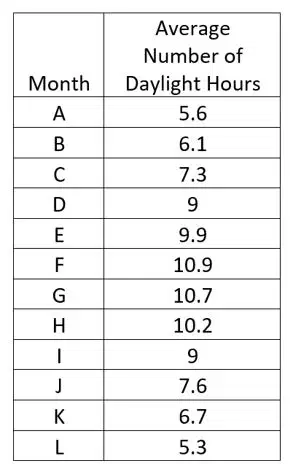
According to the data, which months represent summer in Clarksville?
Months A, B, and C
Months L, A, and B
Months F, G, and H
Months D, E, and F
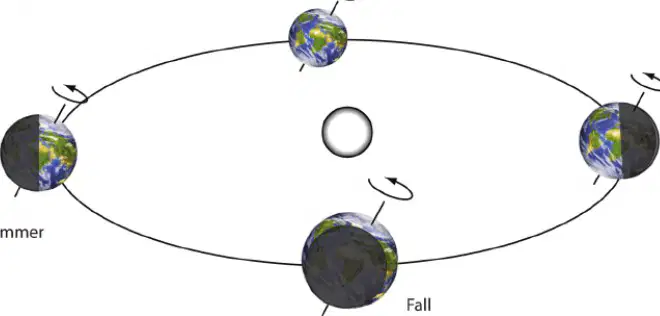
Select the cause of the seasons shown for the Northern Hemisphere.
The tilt of Earth's axis
The rotation of the Earth along its axis
The revolution of the Earth around the Sun
The side of the Earth facing the Sun experiences daylight
Equinoxes and solstices mark very important times throughout the year. Which of the following dates would give the shortest amount of daylight?
vernal equinox
autumnal equinox
winter solstice
summer solstice
Which of the following statements best explains why it is warmer at the equator than at the North Pole?
The equator has a larger area than the North Pole.
The equator is closer to the Sun than the North Pole.
The equator receives more direct sunlight than the North Pole.
The equator has more hours of daylight per year than the North Pole.
The girls record an observation of the stars’ locations at 11:00 pm. Then, they wake up at 5:00 am, while it is still dark, to record a second observation. What will they notice in their second observation?
The stars have spread out far apart.
The stars will have completely disappeared.
Everything will look the same.
The stars will appear to have moved across the sky into new locations.
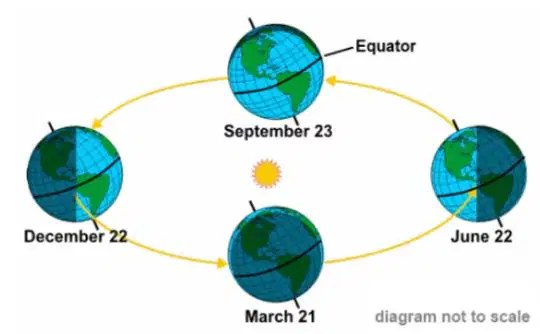
Based on the information in the diagram, what causes the Earth to have seasons?
the Earth's rotation on its axis only
the Earth's tilt and its rotation on its axis
the Earth's tilt and its revolution around the Sun
the Earth's revolution around the Sun only
Students studying constellations noticed that some constellations, like the Big Dipper, can be seen in the Tennessee night sky all year long. Other constellations can be seen only during certain parts of the year. Four students explained why some constellations can be seen during certain parts of the year. Which student best describes why some constellations can be seen only during certain parts of the year?
Mary said, “The Earth rotates which causes us to see all of the constellations every night.”
John said, “The stars are farther away at different times of the year.”
Terrance said, “The stars move randomly, so you never know which constellations will appear in the night sky.”
Jasmine said, “The Earth revolves around the sun, therefore, we can only view certain constellations at certain times of the year.”
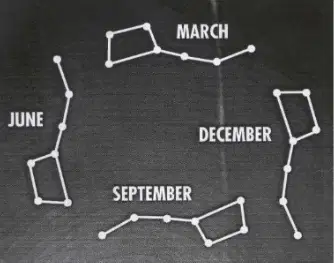
Suzanne noticed that throughout the year, she can always see the constellation Ursa Major but its appearance tends to change. Which best describes why the appearance changes?
A. The Earth is orbiting around the sun so our view changes throughout the year.
B. The Earth is rotating on its axis so our view changes throughout the year.
C. The Earth changes its gravitational pull so the constellation moves each month.
D. As the moon orbits the Earth, the stars orbit the moon. This changes the view throughout the year.
Which of these demonstrations would be best to show why the sun appears to be the brightest star from the Earth?
Create and present a model of the solar system using different colors of clay.
In a dark room, compare the light from two identical flashlights from different distances.
Turn the classroom lights on and off several times to compare the brightness.
Using a lamp, compare the light from three different bulbs by switching them out.
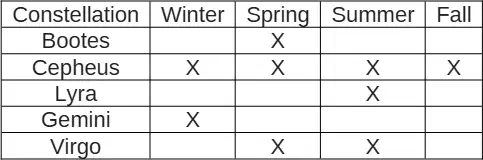
Which constellation(s) can be viewed all year long?
A. Cepheus
B. Lyra
C. Gemini
D. Virgo
A group of scouts went camping over the summer in the woods and wanted to get more practice using a telescope. While using the telescope, they found the constellation Scorpius. The same group of scouts went camping in the winter but could not find Scorpius when they used the same telescope as before. Why could they not find Scorpius in the winter?
The days are shorter in the winter
The stars are not as bright and seen in the winter
The Earth is orbiting the sun, so the stars don't appear to be in the same place throughout the seasons
The Earth is rotating on its axis, so the stars don't appear to be in the same place throughout the seasons
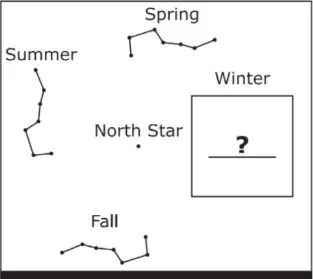
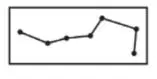
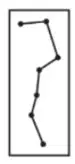
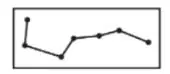
A student uses binoculars to observe how Ursa Major looks in the sky during different seasons of the year. Which of these most likely shows how Ursa Major looks in winter?

Mrs. Morgan asks the class to classify the sun based on their knowledge of the four different types of stars.
The sun is a large sized star that is very hot and is classified as a White Dwarf star.
The sun is a small sized star that is very hot and is classified as a Giant star.
The sun is a bright medium sized star that is very cool and is classified as a Supergiant star.
The sun is a medium sized star that is hot and is classified as a Main Sequence star.
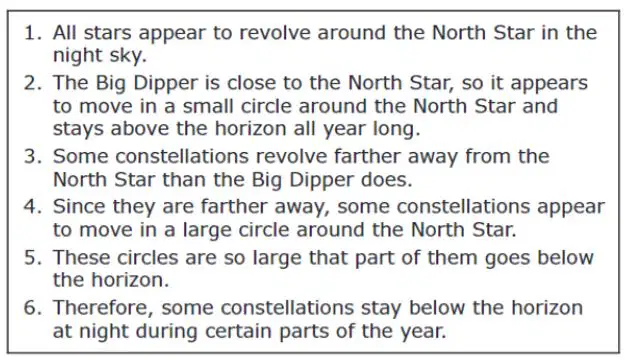
Students studying constellations noticed that some constellations, like the Big Dipper, can be seen in the Tennessee night sky all year long. Other constellations can be seen only during certain parts of the year. One of the students explained why some constellations can be seen only during certain parts of the year. Which part of the student’s explanation best describes why some constellations stay below the horizon at night?
Statement 1
Statement 2
Statement 3
Statement 5

There are two stars in the night sky that appear to have the same brightness. What is most likely the reason for this?
They are the same distance from Earth.
They are different distances from Earth.
They are closer to Earth than the sun.
One star must be much larger than the other.
The sun can be classified as a yellow, medium-sized star. If it is not the biggest, brightest, or largest, why does it appear so large and hot to us?
The sun is the only star in our solar system and is closest to the Earth.
The sun is larger than any of the other stars in our galaxy.
The sun reflects light from the moon and produces its own heat.
The sun blocks out the light from other larger, brighter stars.
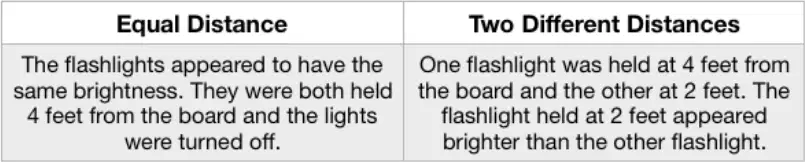
Mrs. Johnson's class is investigating the brightness of stars. Mrs. Johnson sets up the investigation, and the students begin working. The first two student volunteers held identical flashlights at an equal distance from the whiteboard. The class decides after noting the lights on the board look the same that when two stars are at an equal distance, they have the same actual brightness. For the second part of the investigation, two student volunteers held the identical flashlights at two different distances. Students observed that the flashlight that is closer to the whiteboard appears to be brighter than the flashlight that is further away from the whiteboard. Their observations are recorded in the data table. What inference can the students draw from this demonstration?
The closer a star is to Earth, the brighter it will appear.
The closer a star is to Earth, the dimmer it will appear.
There is no inference that students can draw from this demonstration.
The further a star is to Earth, the brighter it will appear.
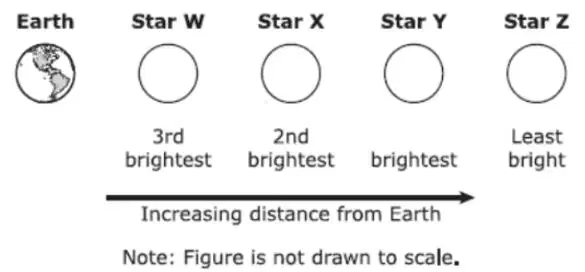
Students are learning about the difference between how bright stars appear to be when viewed from Earth and how bright stars actually are. The students draw four stars at different distances from Earth. The stars are labeled by how bright they actually are, not by how bright they appear to be when viewed from Earth. The students want to know how bright these stars appear to be from Earth’s point of view. Which two statements are true based on the actual brightness of the stars?
M. It is possible that Star W could appear brighter than Star X.
P. It is possible that Star X could appear dimmer than Star Z.
R. It is possible that Star Y could appear brighter than Star X.
S. It is possible that Star X could appear dimmer than Star Z.
T. It is possible that Star Z could appear brighter than Star W.
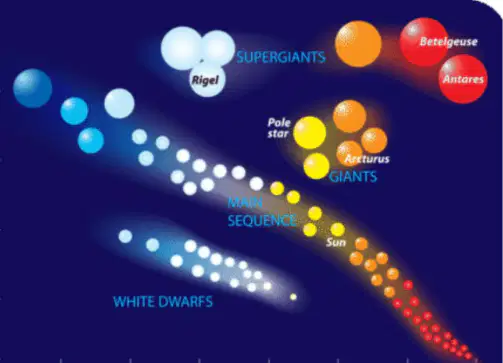
Students were discussing the classifications of stars. Which student best describes the four star types and how they are classified?
A. Jenn says, “The stars are classified by their mass and temperature. The order from coolest to hottest is Main Sequence, Giants, Super Giants, and White Dwarfs.”
B. Terry says, “The stars are classified by their distance from the Earth. The order is from closest to furthest from the Earth, Main Sequence, Giants, Super Giants, and White Dwarfs.”
C. Hallie says, “The stars are classified by their brightness. The order of the stars is White Dwarfs, Super Giants, Main Sequence, and Giants.”
D. Joseph says, “The stars are not classified. There is no order to the stars.”

Mrs. Richard’s class is looking at the following chart to identify meters, meteoroids, and meteorites. Which students’ statement is correct?
A. Ainsley says that object A is a meteorite because it is the closest to the surface of the Earth.
B. Brigham says that object B is a meteorite because it has hit the surface of the Earth.
C. Charles says that object C is a meter because it has entered the Earth’s atmosphere.
D. Delaney says none of these objects are meters, meteorites or meteoroids because those objects are made of ice and dust.

Based on the data from the chart, which object describes a moon?
Object A
Object B
Object C
None of the objects describe a moon

Look at the chart of characteristics describing a celestial body found in space. Bobby says that the object being described is an inner planet. Which of the following statements is true?
Amy says that Bobby is incorrect because inner planets are the only ones to orbit the sun.
Sarah says that Bobby is correct because the inner planets have are made of gaseous sludge.
Lamar says that Bobby is correct because the revolution of the inner planets is longer than the revolution of the outer planets.
Terrance says that Bobby is incorrect because the inner planets rotate faster than the outer planets.
Terry notices a celestial body through his telescope. The object has a tail and seems to emit light. What may this object be?
Moon
Asteroids
Comets
meteoroids
Three girls are having a sleepover. It’s a clear summer evening and the stars are shining brightly in the sky. All of a sudden, a girl points to a place in the sky and says, “Look! It’s a shooting star!” The girls saw a bright streak in the sky and then it was gone. They each wondered what a shooting star actually is. Here are their responses. Which girl is correct?
Kaitlyn said, “I think it is a comet with a bright glowing tail.”
Maria said, “I think it is a star falling out of the sky.”
Tiara said, “I think it is a rock from outer space that is burning up.”
Mikaela said, “I think it is a planet spinning out of control in the solar system.”
Candace argued that “All meteors eventually become meteorites.” Is she correct? If so, which statement best supports her claim?
Candace is correct because a meteorite is a small fragment of debris that travels through space. It becomes a meteor once it has reached Earth’s surface.
Candace is correct because a meteor is the debris that is passing through the atmosphere causing a visible path. If it survives the fall to the ground, it becomes a meteorite.
Candace is incorrect because a meteor is a large frozen ball of gas and dust that travels through space.
Candace is incorrect because a meteor is the debris that is passing through the atmosphere causing a visible path. If it survives the fall to the ground, it can be called a meteorite.
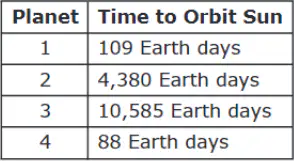
Inner planets are closer to the sun than outer planets are. Inner planets have a smaller orbit around the sun. The table shows orbit data for four planets. Which planets from the table are most likely inner planets?
A. Planets 1 and 2
B. Planets 2 and 3
C. Planets 3 and 4
D. Planets 1 and 4
What causes different constellations to be seen throughout the year?
The movement of stars around the Earth
The rotation of Earth on its axis
The revolution of Earth around the Sun
The movement of the Sun around the planets
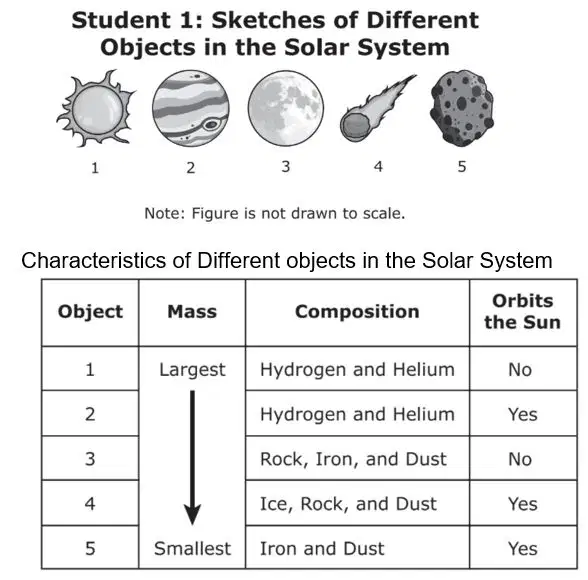
A student identifies image 4 as a comet, which of the following supports his conclusion. Choose two correct answers.
Object 4 contains craters on its surface.
Object 4 has the least mass of the objects.
Object 4 has a tail and is composed of ice.
Object 4 orbits the sun.
Object 4 is composed of iron, rock, and ice.
Students were discussing the various phases of the moon and why we are only able to see part of the moon throughout each month. Which student has the BEST reasoning?
Student 1 said “We only see part of the Moon because the Earth is revolving around the Moon”.
Student 2 explained “We only see part of the Moon because the Moon only produces a certain amount of light throughout the month”.
Student 3 said “As the Moon revolves around Earth, only part of the Moon is illuminated by the Sun for us to see”.
Student 4 explained “The Moon is only visible partially because of the effect of gravity”.
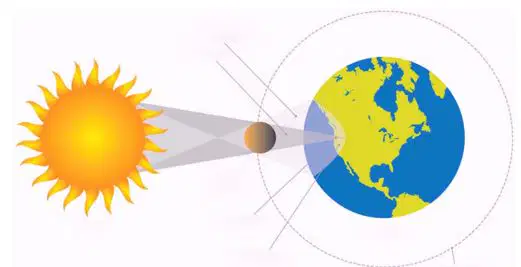
Which explanation best describes what causes a solar eclipse?
The Earth is blocking the light of the Sun on the Moon
The Moon is blocking the light of the Sun on Earth
The Sun is blocking the light of the Moon on Earth
The Earth is blocking the Moon and the Sun

Four students were discussing the earth-sun-moon system model that is pictured below. Which student correctly identifies the model and uses the evidence to explain their thinking?
A. Isabella says, “It is a solar eclipse, because a solar eclipse happens when the moon passes between the sun and Earth casting its shadow on Earth.”
B. Drake says, “It’s a lunar eclipse, because a lunar eclipse happens when the Earth is between the sun and the moon casting a shadow on the moon.”
C. Laura says, “It’s a solar eclipse, because a solar eclipse happens when the Earth is between the sun and the moon casting a shadow on the moon.”
D. Michael says, “It’s a lunar eclipse, because a lunar eclipse happens when the moon passes between the sun and Earth casting its shadow on Earth.”
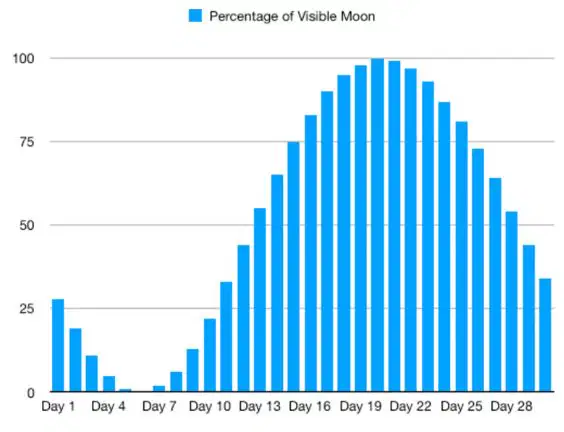
The image is a graph that follows the pattern of the Moon phases and presents a visual representation of how much of the Moon is visible during the month. What pattern can be observed throughout the month?
Around the 10th of the month, the percentage of visible Moon increases and reaches a peak around the 20th and then starts to decrease.
Around the 10th of the month, the percentage of visible Moon decreases and reaches a peak around the 20th and then starts to increase.
Around the 20th of the month, the percentage of visible Moon decreases and reaches a peak around the 10th and then starts to increase.
Around the 20th of the month, the percentage of visible Moon increases and reaches a peak around the 10th and then starts to decrease.

Based on the model, which student is identifying the correct position of the moon based on their explanation?
Mary says, “the full moon is occurring at position 1, because it is closest to the Sun.”
Josh says, “the new moon is happening at position 2, because that’s when you start to see the moon at night.”
Addison says, “the full moon is occurring at position 5, because that is when the face of the moon that receives light is totally visible at night.”
Madison says, “the new moon is happening at position 8, because that is the last time we see the moon before it is dark at night.”
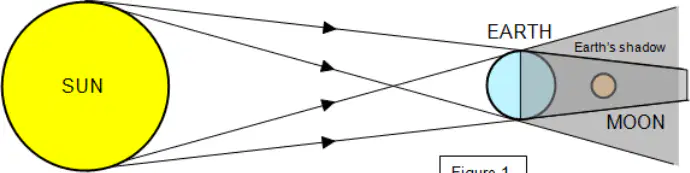
Based on the models below, which student gives the best reasoning for this being a lunar eclipse?
Student 1 says, “This is a lunar eclipse because the moon is blocking light from the sun.”
Student 2 says, “This is a lunar eclipse because the moon is making a shadow.”
Student 3 says, “This is a lunar eclipse because the sun is casting light on Earth.”
Student 4 says. “This is a lunar eclipse because the Earth is casting a shadow on the Moon.”
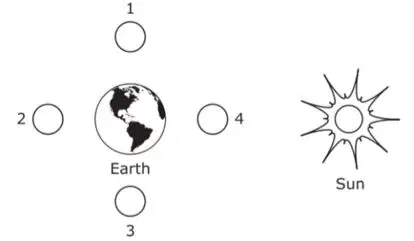
The model represents the sun-Earth-moon system. The numbers represent four positions of the moon in its orbit around Earth. Which number represents the location of the moon when it is in the new moon phase?
A. 1
B. 2
C. 3
D. 4
What phenomena is occurring in the photo below and how do you know?
A. A solar eclipse because the Sun is casting a shadow onto Earth.
B. A lunar eclipse because the Moon is casting a shadow onto Earth.
C. A lunar eclipse because Earth is casting a shadow onto the Moon.
D. A solar eclipse because the Moon is casting a shadow onto Earth.

