
Font size
 Worksheets
DNA, RNA, Protein Synthesis
Total questions: 48
Worksheet time: 2hrs 48mins
The four bases of DNA are
Thymine, Adenine, Uracil, and Cytosine
Thymine, Guanine, Adenine, and Cytosine
Cytosine, Adenine, Ribose, and Deoxyribose
Adenine, Guanine, Cortisol, and Medicine

A segment of DNA is shown in the diagram. Which of these identifies the part of the DNA segment labeled X?
Nucleotide
Phosphate group
Hydrogen bond
Deoxyribose

What part of the Nucleotide is labeled "3"?
Sugar
Phosphate
Nitrogenous Base
What part of the Nucleotide is labeled "2"?
Sugar
Phosphate
Nitrogenous Base
What part of the Nucleotide is labeled "1"?
Sugar
Phosphate
Nitrogenous Base
In the DNA double helix, what type of bond holds the two strands together?
Covalent bond
Hydrogen bond
Ionic bond


molecule 1 is found in
The process of DNA to mRNA is
Transcription
Translation
Replication
The process of mRNA to polypeptide is
Transcription
Translation
Replication
What three parts make up a nucleotide?
Phosphate Group
Hydrogen Base
Sugar
Nitrogen Base
What makes up the backbone of DNA?
Phosphate group and Nitrogen Base
Phosphate group and sugar
Sugar and Nitrogen Base
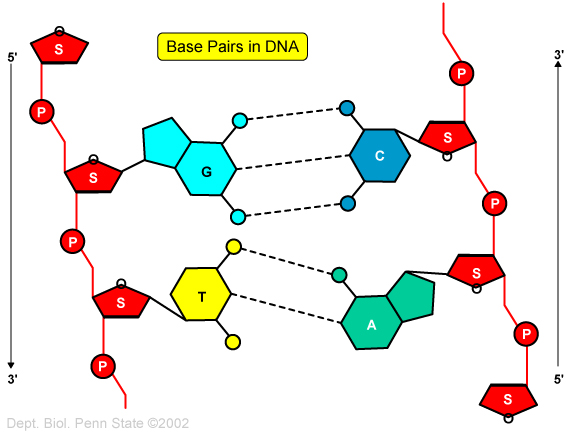
In DNA, G pairs with
T
A
C
U
In DNA, A pairs with
T
G
C
U
In RNA, A pairs with
T
U
C
G
DNA sequence is TCA
What is the mRNA sequence?
CAT
GAT
AGT
AGU
polypeptides

ribose and phosphate
deoxyribose and a hydrogen bond
deoxyribose and ribose
deoxyribose and phosphate
A process in which DNA makes an exact copy of itself.


RNA nucleotide
DNA nucleotide
polypeptide

What is the correct sequence?
DNA -> RNA -> protein
Protein -> DNA - > RNA
DNA -> Protein -> RNA
DNA -> RNA -> DNA -> Protein

You use the codon chart to find the correct _______
RNA
nitrogen base
phosphate
amino acid
Where does transcription take place?
cell membrane
nucleus
cytoplasm
ribosome
What does tRNA do during translation?
it brings a specific segment of DNA to the ribosome for transcription
it brings any amino acid to the ribosome
it brings a specific amino acid (decided by the codon) to the ribosome for translation
RNA contains which sugar?
deoxyribose
Ribose
glucose
fructose
Which RNA brings amino acids?
rRNA
tRNA
mRNA

Transcribe the following DNA sequence:
AAT TAG GGC TCG
AAT TAG GGC TCG
TTA ATC CCG AGC
UUA AUC CCG AGC
TTU UTC CCG UGC

Translate the following mRNA sequence:
AUG AAC GGC
Met - Asp - Gly
Gly - Met - Pro
Met - Asp - Stop
Leu - His - Pro

AATCATGGA
polypeptide
anticodon
deoxyribose
ATG GGA ACT CCA
important component of the ribosomes, bonds the amino acids together to create the polypeptide chain
mRNA
rRNA
tRNA
codon
takes the message from DNA out of the nucleus
mRNA
rRNA
tRNA
codon
Process in which the cell copies or duplicates its DNA; occurs during the S-phase of interphase
DNA Replication
Transcription
Translation
Central Dogma
the sugar that is found in the nucleotides that make up DNA
Ribose
Deoxyribose
RNA
DNA
DNA strands are _____, which means they are side by side but going in opposite directions
Double helix
Antiparallel
Complementary
Semiconservative
"twisted ladder", the shape of DNA
Double helix
Antiparallel
Complementary
Semiconservative
Mutations can be...
Harmful
Beneficial
Neutral
All of the Above
A substitution mutation occurs when
a base pair is missing from the DNA strand
a base pair is added to the DNA strand
a base pair is replaced with a different base pair
An insertion/additon mutation occurs when
a base pair is missing from the DNA strand
a base pair is added to the DNA strand
a base pair is replaced with a different base pair
A deletion mutation occurs when
a base pair is missing from the DNA strand
a base pair is added to the DNA strand
a base pair is replaced with a different base pair

This is considered the most harmful type of gene mutation. It occurs when the codon reading frame is shifted and creates a chain reaction of errors in amino acids.
Substitution
Frameshift
Point mutation
Gene

