Font size
 Worksheets
PMA review Day 2
Total questions: 36
Worksheet time: 1hrs 26mins
Which of the following elements are found in all macromolecules? (Select all that apply).


Match the following MONOMERS and MACROMOLECULES

Nucleic Acid

Protein

Lipid

Carbohydrate
An enzyme is a ______________.
carbohydrate
lipid
nucleic acid
protein


Which macromolecule is shown?
lipid
protein
nucleic acid
carbohydrate


Give immediate/short term energy.

Which macromolecule is shown?
lipid
protein
nucleic acid
carbohydrate

What is the macromolecule of structure A2 and what is its function?
Nucleic Acid - it stores genetic information for protein production
Lipid - it regulates the movement of materials into and out of the cell
Protein - it speeds up chemical reactions in the cytoplasm of the cell
Carbohydrate - it stores short term energy to produce ATP for the cell
All of the biological macromolecules found in organisms contain hydrogen, oxygen and carbon. However, there are distinguishing features of each. Which of the following could be used to differentiate between a carbohydrate and a nucleic acid?
Carbohydrate molecules have a nitrogen base, whereas, nucleic acid molecules have an R-group.
Carbohydrate molecules have nitrogen atoms, whereas, a nucleic acids have an attached phosphate group.
Carbohydrate molecules are only found in rings, while nucleic acid molecules form ring or branched chain shapes.
Carbohydrate molecules contain only carbon, hydrogen and oxygen atoms, whereas, nucleic acid molecules also have a nitrogen base and phosphate group.
Carbohydrates are a macromolecule that provides short term energy while Lipids are a macromolecule that provides long term energy. In terms of their structure, carbohydrates and lipids have what in common?
Both structures are the shape of a hexagon
Both structures are the shape of a long chain
Both structures contain the elements Carbon, Hydrogen, and Oxygen
Both structures contain the elements Carbon, Hydrogen, Nitrogen, and Oxygen
Ovalbumin is a protein found in eggs. Which of the following best describes the molecular structure of ovalbumin?
A group of six carbon atoms joined in a ring
A chain of amino acids folded and twisted into a molecule
A set of three fatty acids attached to a molecule of glycerol
A sequence of nitrogenous bases attached to a sugar phosphate backbone
Plants get their nutrients from the soil. If the phosphorus was removed from the soil, what macromolecule would be decreased in the plant?
Carbohydrate
Lipid
Protein
Nucleic Acid
Match the following.
Carbohydrate
Short Term Energy Storage
Protein
Structure, support, assists in chemical reactions
Lipid
Long Term Energy Storage
Nucleic Acid
Stores genetic information

What is the optimum temperature for this enzyme?
20 degrees Celsius
45 degrees Celsius
52 degrees Celsius
64 degrees Celsius
How do enzymes speed up chemical reactions? Enzymes
lower the activation energy of chemical reactions.
raise the temperature of the cell, speeding chemical reactions.
store ATP, allowing more energy to be used in chemical reactions.
act as miniature "transfer trucks", gathering materials for chemical reactions, and placing them together.

What can be inferred using the graph?
Cells can function equally as well at all pH values.
Cells do not function well at pH values that are too high or too low.
Cells function best at high pH values.
Cells function best at low pH values.

What is the optimum pH for the enzyme salivary amylase?
2
5
6.2
9.1
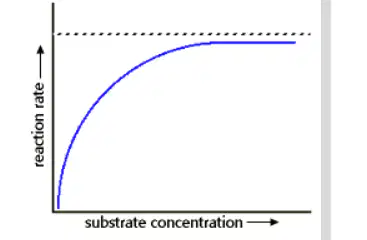
Based on the graph, which of the following describes why continually adding substrate does not lead to a continuous increase in reaction rate?
More substrate needs to be added for the reaction to occur
The rate of reaction slows down as enzymes are used up
There is only a certain amount of enzyme present in the reaction
Enzymes do not replicate fast enough to keep up with the substrate
ATG TGA CAG

The new DNA strand formed after DNA replication is an exact copy of its parent strand
True
False
What would be the complementary strand to T A G G A C T
T A G G A C T
A T C C T G A
A T G G T G A
T T C C A G T
GAT-TAC-AGA-TTA-CAT?
Which base pairs with adenine in DNA?
cytosine
guanine
uracil
thymine
Cytosine bonds with ____
Adenine
Thymine
Guanine
Uracil