Worksheets
Forces and Motion
Total questions: 60
Worksheet time: 2hrs 5mins
Which graph would be used to show an object that has a speed of zero
for the entire time represented?


Which would most likely be the title of a graph with the y-axis labeled
miles and the x-axis labeled hours?
Speed of the Car
Hours Spent Driving
Volume of a Car Over Time
Friction on a Moving Vehicle

This graph shows the motion of an object.
Between which two hours was the object at rest?
hours 1 and 2
hours 4 and 5
hours 7 and 8
hours 8 and 9
Joe rolls a ball to Cindy, and Cindy rolls it back to Joe at the same speed.
Which graph shows the motion of the ball as it rolls between them?


Below is a graph displaying the speed of a car. Which best describes the
time the driver began applying the brakes of the car?
at 10 seconds
at 20 seconds
at 30 seconds

Two sailboats are moving as shown in the graph. Which statement is correct based on the data in the graph?
Boat A traveled faster than Boat B.
Boat B traveled faster than Boat A.
Boat A traveled for a longer time than Boat B.
Boat B traveled for a longer time than Boat A.

A toy robot moved from a starting point and traveled in a straight line at different speeds.
Then the robot turned around and traveled in a straight line at different speeds as it returned to its starting point.
Which sentence describes the motion of the robot between seconds 3 and 4?
The robot was moving away from the starting point.
The robot was moving toward the starting point.
The robot was stopped in one place away from the starting point.
The robot was moving back and forth around the starting point.

Jane made this graph of the distance her family traveled during a trip.
How far did they travel during the first 2 hours of the trip?
50 km
100 km
200 km
350 km

This graph shows how a delivery truck traveled in one workday.
How far did the truck travel from hour 4 to hour 5 of its delivery schedule?
0 km
50 km
100 km
150 km

This graph shows the motion of a bus for 5 minutes.
How far did the bus travel in 4 minutes?
500 m
800 m
1000 m
2000 m
What is friction?
A force that accelerates the motion of an object.
A force that opposes the motion of an object when it comes into contact with another surface.
A type of energy that is lost during motion.
A force that increases the speed of an object.
How does mass affect the speed of a rolling ball?
Increasing the mass of the ball generally makes it harder to accelerate, affecting its speed.
Mass has no effect on the speed of a rolling ball.
A heavier ball will always roll faster than a lighter ball.
The speed of a rolling ball increases with mass due to greater momentum.
How can you investigate the effect of mass on speed?
By changing the mass of the ball in an experiment while keeping other factors constant.
By measuring the speed of the ball at different heights.
By using a heavier ball to see if it rolls faster on a flat surface.
By increasing the temperature of the ball before the experiment.
What is the difference between contact and non-contact forces?
Contact forces act at a distance, while non-contact forces require physical contact between objects.
Contact forces require physical contact between objects, while non-contact forces act at a distance, like gravity.
Contact forces are stronger than non-contact forces in all situations.
Non-contact forces can only be observed in space.
What is an example of gravity as a non-contact force?
A ball falling from a height demonstrates gravity as a non-contact force.
A person pushing a car demonstrates gravity as a non-contact force.
A magnet attracting a paperclip demonstrates gravity as a non-contact force.
A balloon rising in the air demonstrates gravity as a non-contact force.
What is an example of a contact force?
A book sliding across a table
The gravitational pull of the Earth
A magnet attracting a paperclip
The friction between two surfaces in space
What is the role of friction on different surfaces?
Friction is the same on all surfaces, allowing objects to move at the same speed.
Friction varies on different surfaces; for example, a toy car moves slower on a carpet than on a smooth wooden floor due to higher friction on the carpet.
Friction only affects objects that are stationary, not moving ones.
Friction is only present on rough surfaces and has no effect on smooth surfaces.
How does increasing friction affect the motion of a moving object?
It causes the object to speed up.
It has no effect on the object's motion.
Increasing friction causes the object to slow down.
It changes the direction of the object's motion.
Why do objects roll differently on various surfaces?
Because of the varying levels of friction present.
Due to the weight of the objects.
Because of the color of the surfaces.
Due to the shape of the objects.
What happens to a soccer ball when it rolls across grass?
The soccer ball speeds up due to the smooth surface of the grass.
The soccer ball slows down due to the friction between the ball and the grass.
The soccer ball bounces higher because of the grass.
The soccer ball rolls at a constant speed without any change.
What is mass?
The weight of an object measured in pounds.
The amount of matter in an object, usually measured in grams or kilograms.
The volume of an object measured in liters.
The density of an object calculated by its mass and volume.
What is gravity?
A force that pushes objects away from each other.
A force that pulls objects toward each other, such as the Earth pulling objects toward its center.
A type of energy that objects possess due to their mass.
A phenomenon that only occurs in outer space.
What is the effect of gravity on falling objects?
Gravity causes falling objects to decelerate as they approach the ground.
Gravity has no effect on falling objects.
Gravity causes falling objects to accelerate towards the ground.
Gravity causes falling objects to float in the air.
What is air resistance?
A force that propels an object forward in the air.
A force that opposes the motion of an object moving through the air.
A type of friction that occurs on solid surfaces.
A gravitational force acting on objects in the atmosphere.
What is the relationship between friction and motion?
Friction has no effect on motion.
Friction opposes motion, causing objects to slow down or stop.
Friction increases the speed of moving objects.
Friction only affects objects at rest.
What can cause a moving object to increase its speed in a forward direction?
a force pushing on the object from the opposite direction
a force that continually acts on the object in the direction the object is moving
an increase in the mass of the object
a decrease in the mass of the object
When a wagon is moving down a hill, what force is primarily acting against its motion?
Gravity
Friction
Wind
Magnetism
Fill in the blank: The mass of an object affects its _______ when moving down a hill.
speed
color
shape
sound
What happens to the speed of a wagon as it moves down a hill?
It increases
It decreases
It stays the same
It disappears
Fill in the blank: As a wagon moves down a hill, _______ helps it to eventually stop.
friction
speed
color
shape
Which of the following statements is true about friction?
Friction always slows things down.
Friction can never be useful.
Friction only occurs on rough surfaces.
Friction is not affected by the type of surface.
Which of the following is NOT a way to reduce friction?
Adding oil to a machine.
Using ball bearings.
Making a surface rougher.
Polishing a surface.
Which of the following is an example of increasing friction to improve safety?
Installing anti-slip mats in a bathroom.
Using a fan to cool a room.
Wearing sunglasses on a sunny day.
Drinking water to stay hydrated.
Friction can be increased by using a rough surface. Which of the following surfaces would increase friction?
Smooth glass
Polished wood
Rough sandpaper
Wet ice
Which of the following is an example of friction being reduced for efficiency?
Greasing a bicycle chain.
Using a rough towel to dry hands.
Walking on a gravel path.
Writing with chalk on a blackboard.
Friction is necessary for which of the following sports?
Ice hockey
Basketball
Swimming
Surfing
Which of the following is an example of friction being increased to stop motion?
Applying brakes on a car.
Sliding on a slippery floor.
Gliding on ice.
Floating in a pool.
Which best describes the distance an object moves in a given amount of time?
speed
gravity
momentum
friction
Fill in the blank: If Molly rides her bike at a speed of 16 kilometers per hour and Caleb rides at 14 kilometers per hour, then ______ will arrive at the library first.
A. Molly
B. Caleb
C. Both at the same time.
Study the distance-time graph. Which situation below is represented in the graph?
A. Dr. Houchard traveled 50 km away from his office and then stopped at a school for a while. He again drove 20 km and stopped briefly to visit another school. He then traveled 30 km back to his office.
B. Dr. Houchard traveled 30 km away from his office and then stopped at a school for a while. He again drove 20 km and stopped briefly to visit another school. He then traveled 50 km back to his office.
C. Dr. Houchard traveled 20 km away from his office and then stopped at a school for a while. He again drove 30 km and stopped briefly to visit another school. He then traveled 50 km back to his office.
D. Dr. Houchard traveled 20 km away from his office and then stopped at a school for a while. He again drove 30 km and stopped briefly to visit another school. He then traveled 50 km back to his office.

What direction is the force of gravity?
Up
Down
Sideways

What is gravity?
The force that pulls objects together
The force that pushes objects apart
Any object with mass experiences gravity
True
False

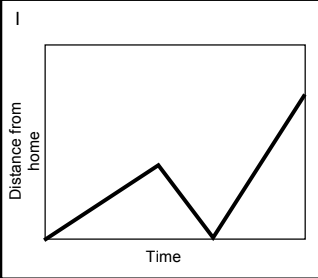
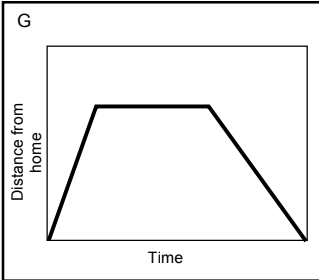
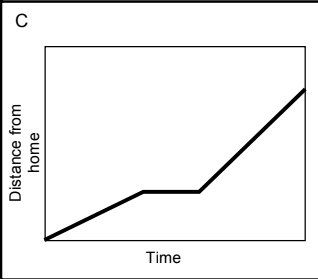
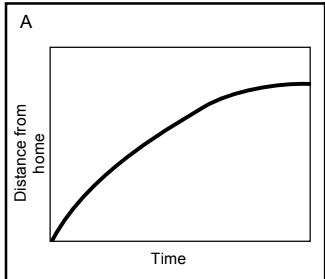
A graph that tell us a lot about an object's motion
Speed Graph
Distance
Time
Just a graph
If graph slopes up then the the object is going ________
Speeding Up /Constant Speed
At rest
Slowing Down (Deacceleration)
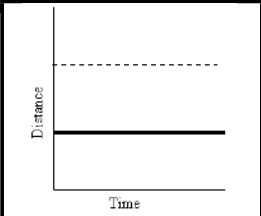
If graph makes a flat or horizontal line then the the object is...
Speeding Up /Constant Speed
At rest
Slowing Down (Deacceleration)


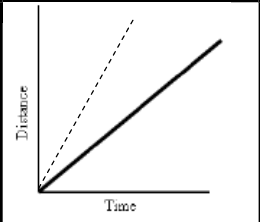


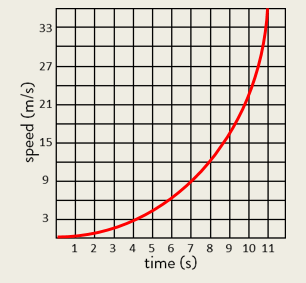
What is this graph showing?
Gradually slowing down
Gradually speeding up
Constant speed
Stopped
Match the graph to the description:
"The car is accelerating."
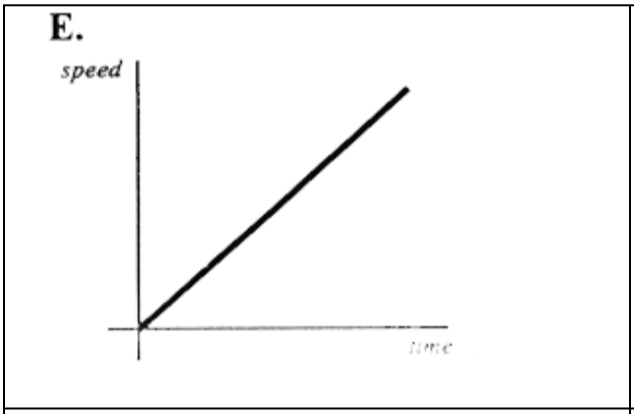
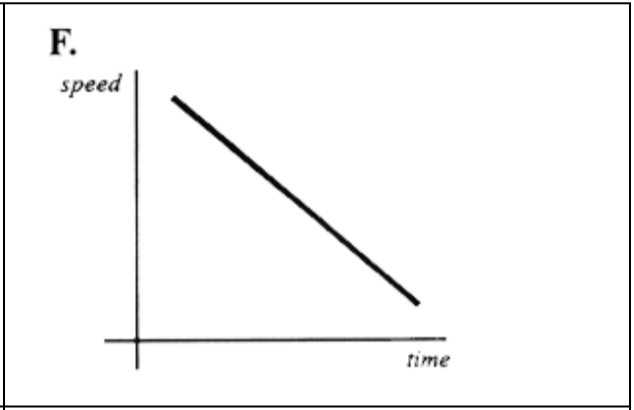
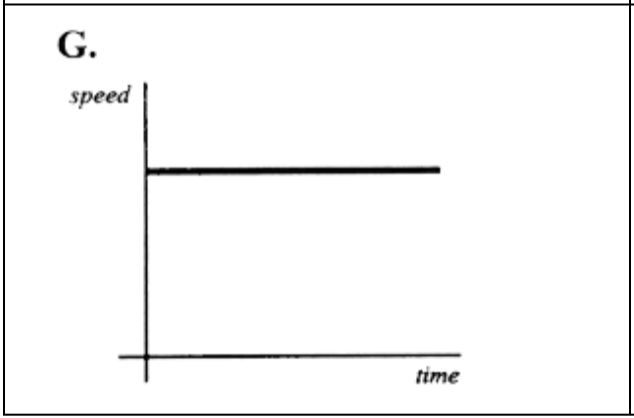
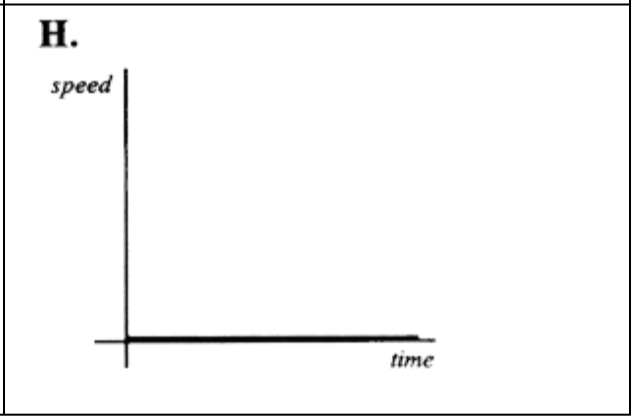
Match the graph to the description:
"The car is stationary."

A ____________ is a push or a pull on an object.
friction
force
magnet
gravity