
 Worksheets
DNA chapter 13
Total questions: 63
Worksheet time: 58mins


DNA can determine...choose ALL correct answers
how tall we will be
our risk for disease
hair color
eye color
A nucleotide is made up of the following: choose all correct answers
sugar
phosphate
nitrogenous
carbohydrate
The pneumonic used to remember which nitrogenous bases pair is:
apple tree; car garage
cold apple; guava tree
top coat; giant ant
carrot top; aunt gertie
How many chromosomes are found in each of our somatic (body) cells?
23
46
92
1
Which best defines heredity?
The passing of traits from parent to offspring.
The passing of traits from offspring to child.
A portion of DNA that codes for a protein.
The building blocks of a gene.
What codes for your traits?
DNA that is found in the rough ER
Proteins found in the nucleus
Proteins found in the cytoplasm
DNA found in the nucleus
DNA belongs to a group of biomolecules called
Proteins
Lipids
Carbohydrates
Nucleic acids
Which best describes DNA?
Its monomers are called amino acids which consist of a sugar, a phosphate, and a carbon base.
Its monomers are called nucleotides which consist of a sugar, a phosphate, and a nitrogen base.
Its monomers are called nucleotides which consist of a sugar, a nitrate, and a phosphorus base.
Its monomers are called monosaccharides which consist of a sugar, a phosphate, and a hydrogen base.
Which part of the DNA molecule determines your traits?
The sequence of the carbon bases
The sequence of the phosphorus bases
The sequence of the nitrogen bases
The sequence of the hydrogen bases


DNA Replication occurs during which phase of the cell cycle?
G 1 phase
S phase
G 2 phase
Mitotic phase

Why does DNA replicate?
To create a duplicate copy in case the original gets damaged
New cells will have a copy of the DNA
To create a new copy to replace the damaged original

What makes up the SIDES of a DNA ladder?
nitrogen bases
sugars & phosphates
genes & chromosomes
RNA

What makes up the rungs (steps) of a DNA ladder?
sugars & phosphates
nitrogen bases
sugars
genes & chromosomes
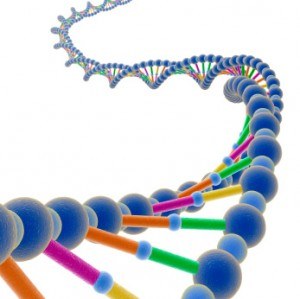
double helix
contains ribose
made of amino acids
contains Uracil
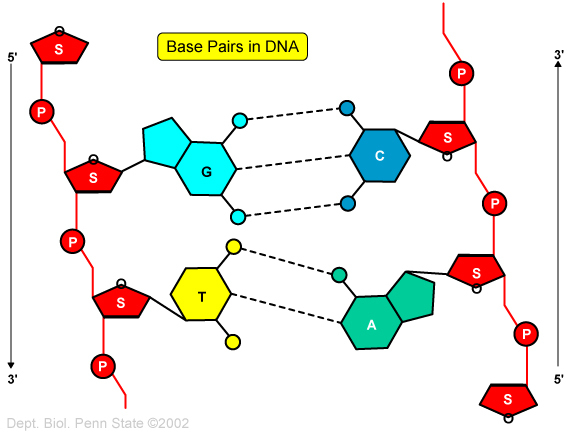
polar bonds
ionic bonds
covalent bonds
hydrogen bonds
Adenine
Thymine
Uracil
Guanine
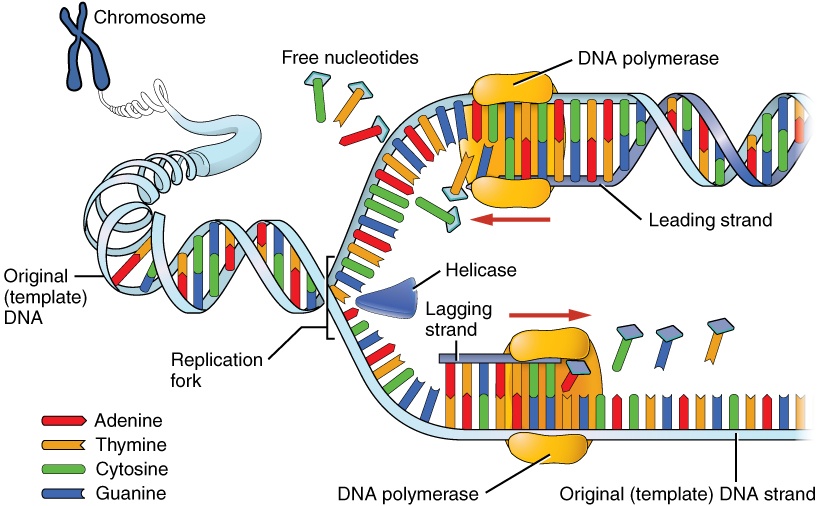
What is the complement to the DNA strand below:
5'-ATGCCAT-3'
(a)
adenine, thymine, cytoplasm, and guanine
adenine, thymine cytosine, and guanine
adenine, thymine, cytosine, and gylcerol
adenine, thymine, cytosine, and glucose
cell membrane
vacuole
chloroplast
nucleus

If 23% of the nitrogenous bases in a DNA molecule are guanine, what percentage of the nitrogenous bases will be adenine?
27%
23%
46%
54%
DNA's overall shape/structure was FIRST discovered using x-rays by ____.
Watson and Crick
Oswald Avery
Erwin Chargaff
Rosalind Franklin
Who FIRST showed that DNA was the transforming factor?
Griffith
Avery
Chargaff
Franklin
What is a virus that infects bacteria called?
bacteriophage
infectious virus
transformation
gene change
What occurred when Griffith injected a mouse with heat-killed smooth pneumonia mixed with rough pneumonia?
The mouse lived
The mouse died
What occurred when Griffith injected a mouse with heat-killed smooth pneumonia?
The mouse lived
The mouse died
What occurred when Griffith injected a mouse with the smooth pneumonia?
The mouse lived
The mouse died
What occurred when Griffith injected a mouse with the rough pneumonia?
The mouse lived
The mouse died
Which of the following is NOT a nitrogenous base?
adenine
cytosine
thymine
guanine
uranine
What is the name of the scientist that came up with the rule where A must combine with T and G must combine with C?
Hershey-Chase
Chargaff
Franklin
Griffith
Rosalind Franklin worked with what type of radiation in her study of the DNA?
X-ray
UV Ray
Microwave
Nuclear
Watson and Crick was responsible find the ______________ shape of the DNA
double helix
triple helix
single helix
antiparallel
Which scientist won the Nobel Prize for their work on the DNA model?
Watson and Crick
Franklin
Chargaff
Hershey and Chase
If one side of the DNA is TCAGCTTTA, what DNA would bond to it on the other side?
A G A C G A A A T
A C T C G A A A C
A G T C G A A A T
None of these is correct
Why do cells need to do replication?
To make enzymes
So new cells can have a copy of DNA
So new cells can have a copy of the organelles
To get information out of the nucleus
Making two identical copies of DNA is called __________.
Duplication
Transcription
Translation
Replication
Which is the correct order for the steps of replication?
Add to it, unzip it, unwind it, connect it
Unzip it, Unwind it, add to it, connect it
Unwind it, add to it, connect it, unzip it
Unwind it, unzip it, add to it, connect it
What is the function of DNA?
To build proteins
To store genetic information
To carry a code to the ribisome
To carry amino acids to the ribisome
Which of these is NOT part of DNA?
deoxyribose
adenine
ribose
a phosphate group
Which of these scientists was NOT involved in figuring out the structure of DNA?
Mendel
Watson
Franklin
Crick

Name the round, blue structure in the diagram.
Deoxyribose
Phosphate
Nitrogen base
Ribose

