
 Worksheets
EXAM 2 Review (Chem, Respiration, Photosynthesis)
Total questions: 60
Worksheet time: 1hrs 25mins
Which of the following best defines the term 'atom'?
The smallest unit of a chemical element that retains its chemical properties; the building blocks of matter.
A negatively charged particle orbiting the nucleus of an atom.
A positively charged particle found in the nucleus of an atom.
A neutral particle found in the nucleus of an atom.
What elements make up a molecule of water, and what are the types of bonds that hold the atoms together and connect different water molecules?
Water is composed of hydrogen and oxygen atoms, joined by covalent bonds within the molecule and hydrogen bonds between molecules.
Water is composed of carbon and hydrogen atoms, joined by ionic bonds within the molecule and covalent bonds between molecules.
Water is composed of nitrogen and oxygen atoms, joined by metallic bonds within the molecule and ionic bonds between molecules.
Water is composed of oxygen and neon atoms, joined by hydrogen bonds within the molecule and covalent bonds between molecules.
When water dissociates (“breaks”), what parts of the molecule are formed?
Hydrogen ions and hydroxide ions
Oxygen and hydrogen gas
Water vapor and ice
Salt and water

Looking at the pH scale in the lecture slides (or your textbook), which of the following substances is characterized as a base? (Click the image to make it larger for viewing.)
Ammonia
Coffee
Pure water
Wine
Which statement about carbohydrates is true?
They are polymers made of monosaccharides and serve as an energy source and structural component.
They are composed of fatty acids and mainly function in long-term energy storage.
They are made of nucleotides and store genetic information.
They consist of amino acids and are responsible for enzyme activity in cells.
Which of the following statements best describes lipids?
Lipids are true polymers composed of repeating fatty acid units, and phospholipids have hydrophilic tails and hydrophobic heads.
Lipids are not true polymers but are formed from components like fatty acids and glycerol; phospholipids feature a hydrophilic head and hydrophobic tails, and other lipids include triglycerides, steroids, and waxes.
Lipids are polymers made of amino acids that form cell membranes.
Lipids are polymers built from nucleotide subunits that store genetic information.
Which statement about proteins is true?
They are polymers made of amino acids and function in structure, transport, and enzymatic activity.
They are composed of monosaccharides and primarily serve as an energy source.
They are made of nucleotides and store genetic information.
They are made of nucleotides and store genetic information.
Which of the following statements about nucleic acids is correct?
Nucleic acids are polymers made of amino acids and store energy.
Nucleic acids are polymers made of nucleotides, and the two main types are DNA and RNA.
Nucleic acids are composed of fatty acids and glycerol, mainly for long-term energy storage.
Nucleic acids are made of monosaccharides and provide immediate energy.
Which nitrogenous bases are present in DNA and RNA?
Adenine, Thymine, Cytosine, Guanine in DNA; Adenine, Uracil, Cytosine, Guanine in RNA
Adenine, Uracil, Cytosine, Guanine in DNA; Adenine, Thymine, Cytosine, Guanine in RNA
Adenine, Thymine, Uracil, Guanine in DNA; Adenine, Thymine, Cytosine, Guanine in RNA
Adenine, Thymine, Cytosine, Guanine in DNA; Adenine, Thymine, Cytosine, Uracil in RNA
Which of the following statements about essential amino acids is correct?
They are produced in sufficient quantities by the human body
They must be supplied through dietary sources because the body cannot synthesize them
They are not required for human nutrition
They are only present in animal-based foods
Which of the following molecules is best at storing energy: carbohydrate, fat or protein?
carbohydrate
fat
protein
A diet rich in fibers is preferred over a diet of refined grains because:
it helps in weight management and improves digestion.
it contains more calories and fats.
it is more expensive and less accessible.
it lacks essential nutrients.
The difference between kinetic and potential energy is:
Kinetic energy is energy of motion, while potential energy is stored energy.
Kinetic energy is stored energy, while potential energy is energy of motion.
Kinetic energy and potential energy are both forms of stored energy.
Kinetic energy and potential energy are both forms of energy of motion.
Which organisms, besides plants, are able to photosynthesize?
Fungi
Animals
Algae
Viruses
State the first and second laws of thermodynamics. How are they relevant to living systems?
The first law states that energy cannot be created or destroyed, only transformed. The second law states that entropy of an isolated system always increases. They are relevant to living systems as they govern energy transformations and metabolic processes.
The first law states that energy can be created and destroyed. The second law states that entropy of an isolated system always decreases. They are relevant to living systems as they govern energy transformations and metabolic processes.
The first law states that energy cannot be created or destroyed, only transformed. The second law states that entropy of an isolated system always decreases. They are relevant to living systems as they govern energy transformations and metabolic processes.
The first law states that energy can be created and destroyed. The second law states that entropy of an isolated system always increases. They are relevant to living systems as they govern energy transformations and metabolic processes.
Contrast anabolic and catabolic reactions. Give an example of each.
Anabolic reactions build larger molecules from smaller ones, such as photosynthesis; catabolic reactions break down molecules, such as cellular respiration.
Anabolic reactions break down molecules, such as cellular respiration; catabolic reactions build larger molecules from smaller ones, such as protein synthesis.
Anabolic reactions and catabolic reactions both build larger molecules from smaller ones.
Anabolic reactions and catabolic reactions both break down molecules.
What is an electron transport chain?
A series of protein complexes that transfer electrons
A type of chemical bond
A cellular organelle
A type of cell division
ATP is an important molecule for cells because:
it stores and provides energy for many cellular processes.
it is a structural component of cell membranes.
it acts as a genetic material.
it is involved in cell signaling pathways.
The downside of ATP is:
It is unstable and cannot be stored for long-term energy needs.
It is too stable and cannot release energy quickly.
It is only used in plant cells.
It is not involved in cellular respiration.
The two components of a solution are:
Solvent and Solute
Acid and Base
Metal and Non-metal
Reactant and Product
Which of the following best defines an enzyme?
A molecule that is produced by a chemical reaction and binds to the active site of a substrate.
A type of protein that speeds up chemical reactions by lowering the activation energy.
A molecule that provides energy for cells to carry out metabolic processes.
A substrate that is modified during an enzyme-catalyzed reaction.
Why are enzymes important to living organisms?
They speed up chemical reactions.
They provide structural support.
They store genetic information.
They transport oxygen.
What are the three different pathways organisms can use to obtain energy from food molecules?
Photosynthesis, Respiration, Fermentation
Glycolysis, Krebs Cycle, Electron Transport Chain
Digestion, Absorption, Metabolism
Osmosis, Diffusion, Active Transport
Which of the following correctly lists the steps of aerobic respiration, along with their inputs and outputs?
Glycolysis (input: glucose, output: 2 pyruvate), Krebs Cycle (input: 2 acetyl-CoA, output: CO₂, NADH, FADH₂), Electron Transport Chain (input: NADH, FADH₂, output: ATP, H₂O).
Glycolysis (input: oxygen, output: 2 ATP), Krebs Cycle (input: glucose, output: 2 pyruvate), Electron Transport Chain (input: ATP, output: NADH).
Glycolysis (input: NADH, output: 2 acetyl-CoA), Krebs Cycle (input: glucose, output: ATP), Electron Transport Chain (input: FADH₂, output: CO₂).
Glycolysis (input: glucose, output: NADH), Krebs Cycle (input: 2 pyruvate, output: ATP, CO₂), Electron Transport Chain (input: glucose, output: ATP, CO₂).
How does breathing support the process of cellular respiration?
It supplies oxygen needed for cellular respiration and removes carbon dioxide produced by cells.
It provides energy directly to the cells.
It only occurs during exercise.
It is not connected to cellular respiration in any way.
The step of aerobic respiration that yields the most ATP is:
Glycolysis
Krebs Cycle
Electron Transport Chain
Fermentation
Which molecule is the final acceptor of electrons in aerobic respiration, and what molecule does it form after gaining electrons?
Oxygen, forming water (H₂O)
NAD+, forming NADH
Glucose, forming pyruvate
Carbon dioxide, forming bicarbonate (HCO₃⁻)
Stopping the electron transport chain causes death as when cyanide is ingested in large quantities because:
it leads to a buildup of oxygen in cells.
it prevents the production of ATP, essential for cellular functions.
it causes an increase in carbon dioxide levels.
it enhances the production of glucose.
If an organism could choose between aerobic respiration, anaerobic respiration, and fermentation, which one do you think it would choose?
Aerobic respiration
Anaerobic respiration
Fermentation
Anaerobic organisms thrive in environments that lack what?
Oxygen
Sunlight
Water
Nutrients
Give examples of the economic importance of fermentation.
Production of alcoholic beverages and bread
Manufacture of plastics and metals
Development of software and electronics
Construction of buildings and roads
Contrast aerobic respiration with anaerobic respiration.
Aerobic respiration requires oxygen, while anaerobic does not.
Anaerobic respiration produces more energy than aerobic.
Both processes occur in the mitochondria.
Aerobic respiration occurs only in plants.
Contrast aerobic respiration with fermentation.
Aerobic respiration requires oxygen, while fermentation does not.
Fermentation produces more ATP than aerobic respiration.
Both processes occur in the mitochondria.
Aerobic respiration and fermentation produce the same amount of energy.
Fermentation and anaerobic respiration are two processes that cells use to generate energy without oxygen. Which of the following statements best contrasts these two processes?
Fermentation produces ATP only through glycolysis, while anaerobic respiration uses an electron transport chain.
Fermentation occurs in the mitochondria, while anaerobic respiration occurs in the cytoplasm.
Fermentation requires oxygen, while anaerobic respiration does not.
Fermentation produces more ATP than anaerobic respiration.
The sea slug Elysia chlorotica is unique because it can spend the later part of its life without feeding on other organisms. How is this possible?
It can photosynthesize like a plant.
It stores food in its body.
It absorbs nutrients from water.
It hibernates for long periods.
Photosynthesis is an example of a/an:
anabolic reaction
catabolic reaction
Why is photosynthesis so important for life on earth?
It produces oxygen and glucose, essential for life.
It consumes carbon dioxide and water, reducing pollution.
It provides energy for the sun.
It creates soil nutrients.
The relevance of photosynthesis to the evolution of life on earth is:
It provided oxygen and food, enabling complex life forms to evolve.
It caused the extinction of early life forms.
It had no impact on the evolution of life.
It only benefited plant life.
How is wavelength related to amount of energy?
Wavelength is directly proportional to energy.
Wavelength is inversely proportional to energy.
Wavelength and energy are not related.
Wavelength is equal to energy.
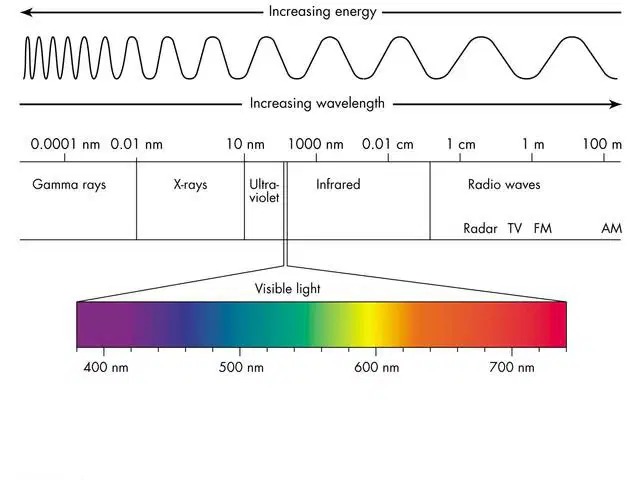
Which of the following parts of the light spectrum has the shortest wavelength? (Click on the image to make it larger for viewing.)
Blue
Green
Red
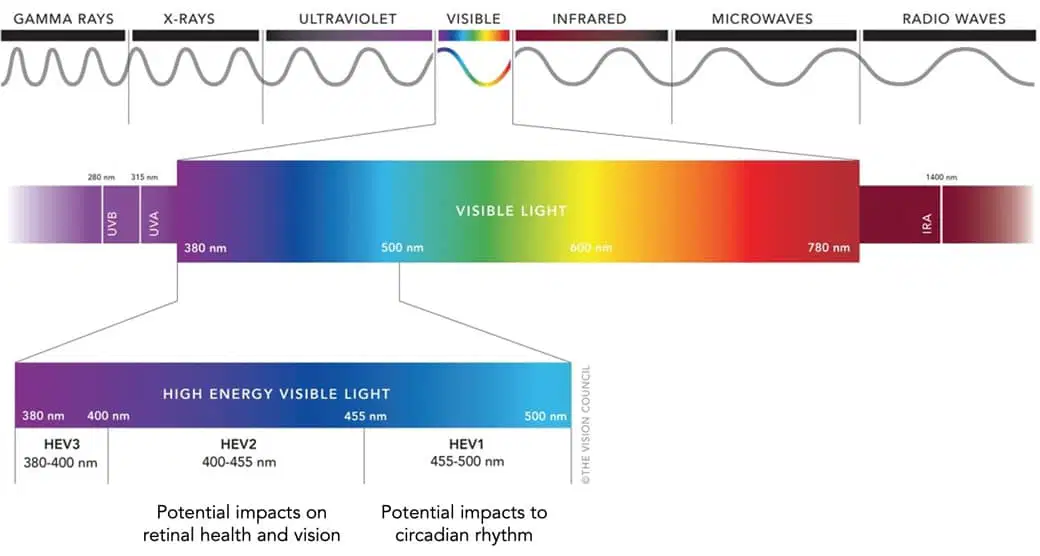
Put in order of highest to lowest in terms of amount of energy: ultraviolet, infrared, red, blue, green. (Click on the image to make it larger for viewing.)
Ultraviolet, Blue, Green, Red, Infrared
Ultraviolet, Green, Blue, Red, Infrared
Ultraviolet, Red, Blue, Green, Infrared
Ultraviolet, Blue, Red, Green, Infrared
What part of the solar radiation spectrum is available for photosynthesis?
Ultraviolet
Visible light
Infrared
Gamma rays
If an object is green, does it absorb or reflect wavelengths of green?
Absorb
Reflect
What are pigments? What is the most abundant pigment in plants?
Pigments are substances that give color to plants, and chlorophyll is the most abundant pigment in plants.
Pigments are substances that give color to plants, and carotenoids are the most abundant pigment in plants.
Pigments are substances that give color to plants, and anthocyanins are the most abundant pigment in plants.
Pigments are substances that give color to plants, and xanthophylls are the most abundant pigment in plants.
What are the 2 major parts of a chloroplast?
Thylakoid and Stroma
Nucleus and Cytoplasm
Cell Wall and Cell Membrane
Mitochondria and Ribosome
What are the 2 major steps of photosynthesis?
Light-dependent reactions and Calvin cycle
Glycolysis and Krebs cycle
Electron transport chain and fermentation
Oxidative phosphorylation and photolysis
Can the Carbon Reactions occur in the dark? Why or why not?
Yes, because they do not require light.
No, because they require light.
Yes, because they occur only in the presence of light.
No, because they occur only in the dark.
What molecule is the electron donor for the Light Reactions of photosynthesis?
Water (H₂O)
Carbon dioxide (CO₂)
Glucose (C₆H₁₂O₆)
Oxygen (O₂)
Which of the following correctly contrasts photosynthesis with aerobic respiration based on inputs, outputs, organelles involved, and organisms that perform each process?
Photosynthesis (input: glucose, output: oxygen) occurs in mitochondria of animals, while aerobic respiration (input: oxygen, output: glucose) occurs in chloroplasts of plants.
Photosynthesis (input: sunlight, carbon dioxide, water; output: glucose, oxygen) occurs in chloroplasts of plants and some bacteria, while aerobic respiration (input: glucose, oxygen; output: carbon dioxide, water, ATP) occurs in mitochondria of eukaryotes.
Photosynthesis (input: glucose, output: ATP) occurs in mitochondria of bacteria, while aerobic respiration (input: oxygen, output: glucose) occurs in chloroplasts of fungi.
Photosynthesis (input: oxygen, output: glucose) occurs in chloroplasts of animals, while aerobic respiration (input: carbon dioxide, output: oxygen) occurs in mitochondria of plants.

Which of the following is the correct equation for PHOTOSYNTHESIS?
6CO2 + light + 6H2O --> 6O2 + Glucose
6CO2 + sugar + 6H2O -----> 6O2 + light
6O2+ light + 6H2O --> 6CO2 + Sugar
6CO2 + 6O2 + 6H2O --> Light+ Sugar

The Krebs cycle takes place in the of a cell?
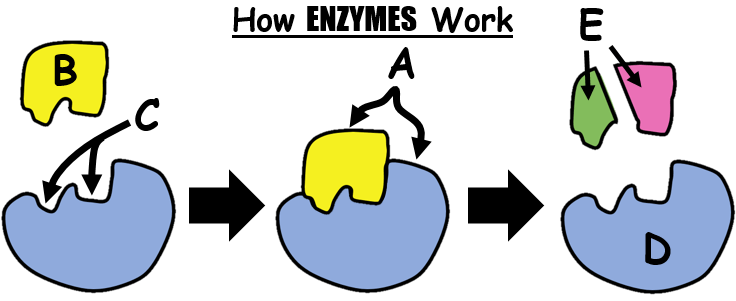
Identify Letter E. (Click the image to make it larger for viewing.)
What does pH measure?
the amount of hydrogen (H+) ions
the amount of hydroxide (OH-) ions
amount of water
all of the above

The products of the process in the figure shown are:
monosaccharides
molecules of glycerol
representative of a glycoside linkage
enzymes


How many electrons are in Potassium?
19
20
58
39
How do scientists think that lactase persistence EVOLVED?
Out of necessity in famine times
Randomly
We were always lactose tolerant, lactose Intolerance is what developed
We don't know when lactose tolerance developed
Lactase breaks lactose into what type of sugar?
Surlacose
Frutose
Glycrien
Glucose

