
Font size
 Worksheets
Transcription
Total questions: 30
Worksheet time: 15mins
What is the chemical composition of DNA?
A. Amino acids
B. Nucleotides
C. Fatty acids
D. Carbohydrates
What is the structure of DNA?
Single helix
Double helix
Triple helix
Quadruple helix
Where is DNA located in eukaryotic cells?
Cytoplasm
Nucleus
Mitochondria
Ribosomes
What is the process of generating an RNA molecule called?
Translation
Transcription
Replication
Transformation
What type of reaction is transcription?
Hydration
Dehydration
Hydrolysis
Condensation
What is the difference between DNA and RNA?
DNA is single-stranded, RNA is double-stranded
DNA is double-stranded, RNA is single-stranded
DNA contains uracil, RNA contains thymine
DNA is found in the cytoplasm, RNA is found in the nucleus
Which of the following is an RNA nucleotide, not found in DNA?
A. Adenine
B. Uracil
C. Cytosine
D. Thymine
What is the direction in which RNA polymerase reads the template DNA?
3' to 5'
5' to 3'
2' to 4'
4' to 2'
Why aren't nucleosides incorporated into DNA?
There are no phosphates to make the phosphodiester bonds
The bases are not fully assembled
The sugar is not in the right form
The peptide bonds don't form
Why is the interaction between adenine and cytosine unstable in a DNA mutation?
The chemical groups that form hydrogen bonds are in the wrong positions
The phosphate groups of the two bases repel each other
An ionic bond cannot be formed between the two
The charges on the bases repel one another
In the DNA of certain bacterial cells, 16% of the nucleotides are adenine. What are the percentages of the other nucleotides?
16% thymidine, 34% guanine, 34% cytosine
34% uracil, 16% guanine, 16% cytosine
34% thymidine, 34% guanine, 16% cytosine
34% thymidine, 16% guanine, 34% cytosine
In the DNA sequence 5'-TGAC-3', the phosphodiester linkage between the guanine and the adenine connects:
The 5’ end of the guanine to the 1’ end of the adenine
The 2' end of the adenine to the 3' end of the guanine
The 3' end of the guanine to the 5' end of the adenine
The 3' end of the adenine to the 5' end of the guanine
Transcription continues until:
A transcription factor signals the end of the gene
All bases in the DNA are copied
A stop codon is encountered
A ribosome pulls RNA polymerase off the DNA
A terminator sequence is encountered
In a long double-stranded DNA molecule, the template strand for one gene may be the nontemplate strand for another gene.
True
False
Why might a eukaryotic cell not produce the correct protein when eukaryotic DNA is inserted into a bacterial cell?
The bacterial cell lacks the necessary transcription factors
The bacterial cell cannot process introns
The bacterial cell does not have the correct ribosomes
Which error would make an mRNA less stable in eukaryotes?
Either the 5' cap was not added or the poly(A) tail was not formed
The 5' cap was not added
The poly(A) tail was not formed
None of the other answer options is correct
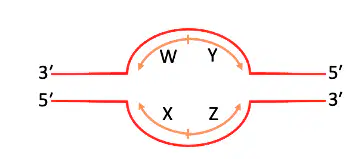
Which letter(s) could represent proper RNA transcripts in the given diagram?
W
X
X and Y
W and Z
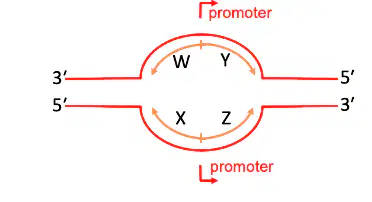
Noting the orientation of the promoter, which letter(s) could represent proper RNA transcripts in the given diagram?
A. W
B. Y
C. Z
D. Y and Z

Which strand is used as a template for transcription in the given DNA sequence?
A. Top strand
B. Bottom strand
What is the role of RNA polymerase during transcription?
To unwind the DNA double helix
To synthesize RNA from a DNA template
To add nucleotides to the growing RNA strand
All of the above
Which of the following is the template strand for transcription?
The strand that is read 5' to 3'
The strand that is read 3' to 5'
The strand that is identical to the RNA sequence
The strand that contains the promoter
What is the function of the promoter in transcription?
To terminate transcription
To initiate transcription
To elongate the RNA strand
To splice the RNA transcript
Which of the following sequences signals the end of transcription?
Promoter
Start codon
Stop codon
Terminator
During transcription, which direction is the RNA strand synthesized?
A. 3' to 5'
B. 5' to 3'
C. 2' to 4'
D. 4' to 2'
What is the primary transcript in eukaryotic cells?
A. mRNA
B. tRNA
C. rRNA
D. Pre-mRNA
Which of the following modifications occur to the primary transcript in eukaryotes?
Addition of a 5' cap
Addition of a poly(A) tail
Splicing of introns
All of the above
What is the role of the 5' cap in mRNA processing?
A. To protect the mRNA from degradation
B. To assist in ribosome binding during translation
C. To facilitate the export of mRNA from the nucleus
D. All of the above
Which enzyme is responsible for splicing introns from the primary transcript?
A. RNA polymerase
B. DNA polymerase
C. Spliceosome
D. Ligase
What is the significance of RNA processing in eukaryotic cells?
It increases the stability of the mRNA
It allows for the production of multiple proteins from a single gene
It facilitates the export of mRNA from the nucleus
All of the above
1. A segment of one strand of a double-stranded molecule has the sequences 5’-ACTTTCAGCGAT-3’. What is the sequence of an RNA molecules synthesized from this DNA template?
5’-ACTTTCAGCGAT-3’
5ʹ–AUCGCUGAAAGU–3ʹ
5ʹ–AUCGCUGAAAGU–5'
3ʹ–AUCGCUGAAAGU–3ʹ

