
 Worksheets
LvlA U7 Sec. 1 Grammar
Total questions: 43
Worksheet time: 2hrs 15mins

Rewrite the underlined words to include a possessive noun.
One of the jobs of a librarian is to put books back on the shelves.
"La frase subrayada se puede reescribir como 'the librarian's jobs' para incluir un sustantivo posesivo, indicando que los trabajos pertenecen al bibliotecario.""'A librarian' es una persona, por lo que el apóstrofo va antes de la 's'."
Correctly pronounce: One of the librarian's jobs is to put books back on the shelves.
Rewrite the underlined words to include a possessive noun.
Maribel restacks the books of the library.
"La forma posesiva de 'the books of the library' es 'the library's books'. Por lo tanto, la oración debería leer: Maribel restacks the library's books." "Es una sola biblioteca, por lo que el apóstrofo va antes de la 's'."
Say: Maribel restacks the library's books.
Rewrite the underlined words to include a possessive noun.
Maribel answers the questions of patrons, too.
"La forma posesiva de 'the questions of patrons' es 'patrons' questions'. Esto indica que las preguntas pertenecen a los patrons." "Hay más de un 'patron', por lo que el apóstrofo va después de la 's'."
Say: Maribel answers the patrons' questions, too
Rewrite the underlined words to include a possessive noun.
She also organizes the magazines of teens.
Say: She also organizes the teens' magazines.

Rewrite each sentence to include a possessive noun.
Maribel likes the books of Joseph Bruchac.
Rewrite each sentence to include a possessive noun.
She studies the illustrations of the artists.
Rewrite each sentence to include a possessive noun.
The dream of Maribel is to be an illustrator.

Answer each question. Use a possessive noun in your answer.
Whose job is it to check out books in the library?
Explanation: In English, the possessive form of a singular noun is made by adding an apostrophe and an "s" (e.g., librarian's). This indicates that the job of checking out books belongs to the librarian.
Explicación: En español, la forma posesiva de un sustantivo singular se hace agregando un apóstrofo y una "s" en inglés (por ejemplo, librarian's). Esto indica que el trabajo de prestar libros pertenece al bibliotecario.
Answer each question. Use a possessive noun in your answer.
What could you do to help in a library room for patrons?
Explanation: In this sentence, "patrons' books" uses a possessive noun to show that the books belong to the patrons.
Explicación: En esta oración, "patrons' books" utiliza un sustantivo posesivo para mostrar que los libros pertenecen a los usuarios.
Answer each question. Use a possessive noun in your answer.
When do you use the library at your school?
Explanation: The possessive noun "school's" indicates that the study period belongs to the school.
Explicación: El sustantivo posesivo "de la escuela" indica que el período de estudio pertenece a la escuela.
Answer each question. Use a possessive noun in your answer.
What are some books by your favorite author?
Write three sentences about the library at your school or in your city or town. Use possessive nouns that name one and more than one owner.
Spanish: Usa sustantivos posesivos para indicar propiedad. Para un propietario, agrega 's al sustantivo. Para más de un propietario, agrega ' si el sustantivo termina en -s. Por ejemplo, "El libro del maestro" muestra un propietario, mientras que "El salón de los maestros" muestra más de un propietario.
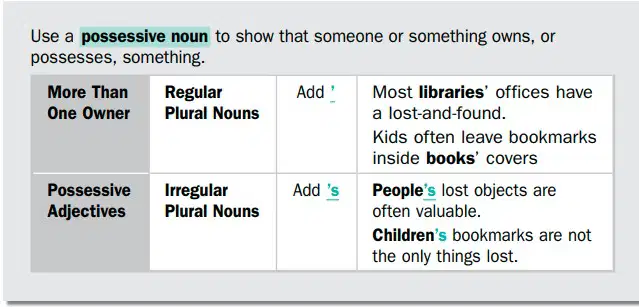
Rewrite the underlined words to include a possessive noun
Few things are left inside the covers of books.
"La frase se puede reescribir como 'the books' covers' para mostrar posesión, indicando que las cubiertas pertenecen a los books."
Rewrite the underlined words to include a possessive noun
Valuable things are often left in the purses of women.
"La frase se puede reescribir como 'the women's purses' para mostrar posesión, indicando que los purses pertenecen a las women."
Rewrite the underlined words to include a possessive noun
Some lost things of people may not seem valuable.
Rewrite the underlined words to include a possessive noun
But the rules of some libraries say to keep everything.
Rewrite the underlined words to include a possessive noun
A teacher may return to get the artwork of her students.
Rewrite the underlined words to include a possessive noun
The artwork of the children may be very valuable to them.
Answer each question in a complete sentence. Use a possessive plural noun in your answer.
What might you find in the lost-and-found box at a preschool?
Answer each question in a complete sentence. Use a possessive plural noun in your answer.
What items are most precious to small children?
Answer each question in a complete sentence. Use a possessive plural noun in your answer.
What are the things most often lost by men?
Write three sentences about things that you have found that belong to others. Try to use a possessive for at least one plural noun in your sentences.
Answer Explanation:
Spanish: Al escribir oraciones sobre cosas que pertenecen a otros, use sustantivos posesivos para indicar propiedad. Para sustantivos plurales, agregue un apóstrofo después de la 's' para mostrar posesión. Por ejemplo, 'libros de las bibliotecas' indica que los libros pertenecen a las bibliotecas.

Miguel plays travel soccer. Rosa plays on (a) team.
"La elección correcta es 'his' porque se refiere al equipo de Miguel, indicando posesión. 'He' no encajaría gramaticalmente en este contexto."
he
Miguel plays travel soccer. (a) team is having a tournament
"La elección correcta es 'Their' porque indica la posesión del equipo por parte de Miguel. 'They' no encajaría gramaticalmente en este contexto, ya que no muestra propiedad."
They
Miguel plays travel soccer. (a) team needs some help,” Miguel says.
Their
His
Her
“I will help (a) team,” I tell Miguel.
you
Write the correct possessive adjectives to complete the sentences.
Miguel’s mom is in charge of refreshments. She asks (a) friends to help.
Write the correct possessive adjectives to complete the sentences.
I offer to help, too. Miguel’s mom says, “Thank you for (a) help.”
Write the correct possessive adjectives to complete the sentences.
I offer to help, too. Miguel’s mom says, “Thank you for (a) help.”
Write the correct possessive adjectives to complete the sentences.
The teammates are happy. They win (a) game.
Answer each question. Use a possessive adjective in your answer.
What does Miguel need help with?
Answer each question. Use a possessive adjective in your answer.
What does his mother need help with?
Explicación de la respuesta: En esta pregunta, se te pide que uses un adjetivo posesivo para describir con qué necesita ayuda la madre de una persona masculina. El adjetivo posesivo "su" indica que la madre pertenece a "él". Debes proporcionar una respuesta que incluya con qué necesita ayuda, usando "su" para mostrar posesión.
Answer each question. Use a possessive adjective in your answer.
What do you sometimes need help with?
Answer each question. Use a possessive adjective in your answer.
How do teachers help their students?
Write three sentences about how you help people or how people help you. Use possessive adjectives in your sentences.
Answer Explanation:
In English: Possessive adjectives are used to show ownership or relationship. Examples include my, your, his, her, its, our, and their. In the sentences, you should describe actions of helping and include these adjectives to indicate who is involved.
In Spanish: Los adjetivos posesivos se utilizan para mostrar propiedad o relación. Ejemplos incluyen mi, tu, su, nuestro, y su. En las oraciones, debes describir acciones de ayuda e incluir estos adjetivos para indicar quién está involucrado.
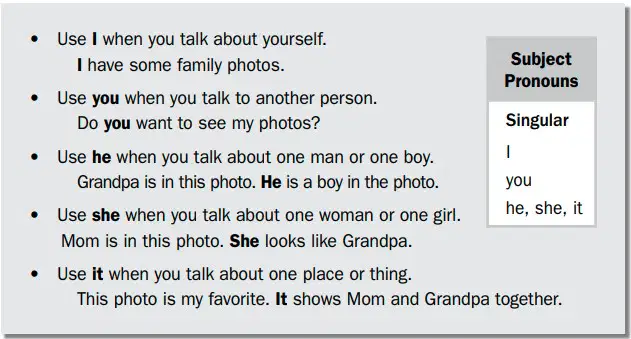
Complete the sentence. Use a subject pronoun from the chart.
My name is Henry. (a) have a brother and a sister.
"El pronombre sujeto correcto para completar la oración es 'I'. Se refiere al hablante, Henry, indicando que tiene un hermano y una hermana."
Complete the sentence. Use a subject pronoun from the chart.
Zac is my brother. (a) looks like my dad.
"El pronombre sujeto correcto para completar la oración es 'He'. Se refiere a Zac, quien es el hermano mencionado, e indica que se parece a su papá."
Complete the sentence. Use a subject pronoun from the chart.
Sara is my sister. (a) looks like my mom.
"El pronombre sujeto correcto para completar la oración es 'She'. Se refiere a Sara, quien es mi hermana, e indica que se parece a mi mamá."
Complete the sentence. Use a subject pronoun from the chart.
Do (a) think I look like my mom or my dad?

