
Font size
 Worksheets
7th Grade STAAR TEKS Review
Total questions: 58
Worksheet time: 1hrs 18mins
Fill in the blank: To calculate speed, you divide the total ______ by the total time.
Distance
Speed
Time
Acceleration
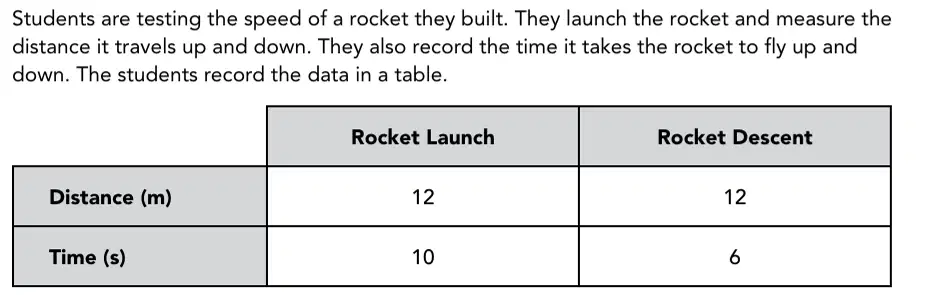
What is the average speed of the rocket for the entire flight?
0.7 m/s
1.2 m/s
1.5 m/s
2.0 m/s
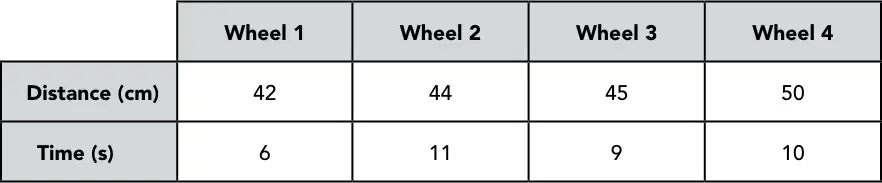
Which wheel had the fastest speed?
Wheel 1
Wheel 2
Wheel 3
Wheel 4

Fill in the blank: The wheel with the slowest speed is ____.
Wheel 1
Wheel 2
Wheel 3
Wheel 4
What is the difference between speed and velocity?
A) Speed includes direction, velocity does not.
B) Velocity includes direction, speed does not.
C) Both include direction.
D) Neither include direction.
Fill in the blank: If a car is driving 35 miles per hour west, then the speed is 35 mph, and the velocity is 35 mph ____.
north
south
east
west
Two airplanes take off from the same airport. One airplane is flying northwest and the other airplane is flying south. Both planes fly a total distance of 1437 miles in 3 hours and 16 minutes. Which of the following magnitudes is different for the two flights?
Speed
Velocity
Time
Distance

Fill in the blank: As the roller coaster moves from position 1 to position 2, the ______ of the roller coaster car changes.
A) gravity
B) velocity
C) height
D) direction
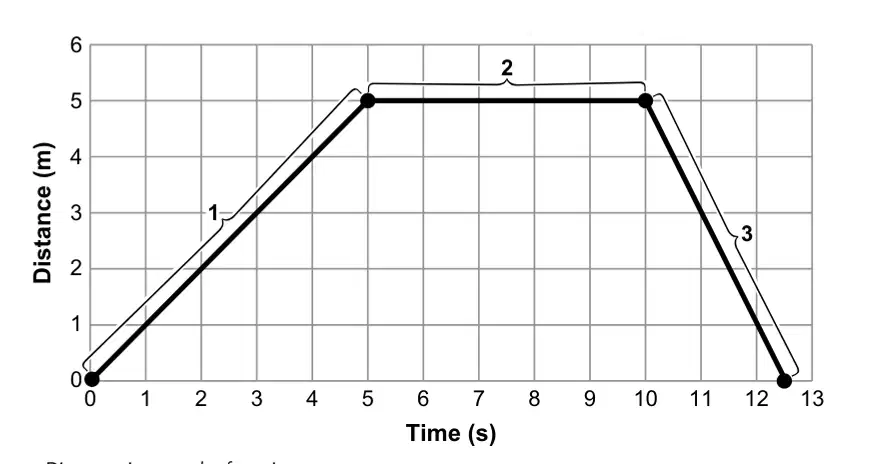
What does a positive slope in a distance-time graph indicate about an object's motion?
The object is moving away from the starting point.
The object is stationary.
The object is moving back to the starting point.
The object is moving in a circular path.

Fill in the blank: In the distance-time graph, Line 2 represents a period where the swimmer was ______.
A) moving away from the wall
B) stationary
C) moving back to the wall
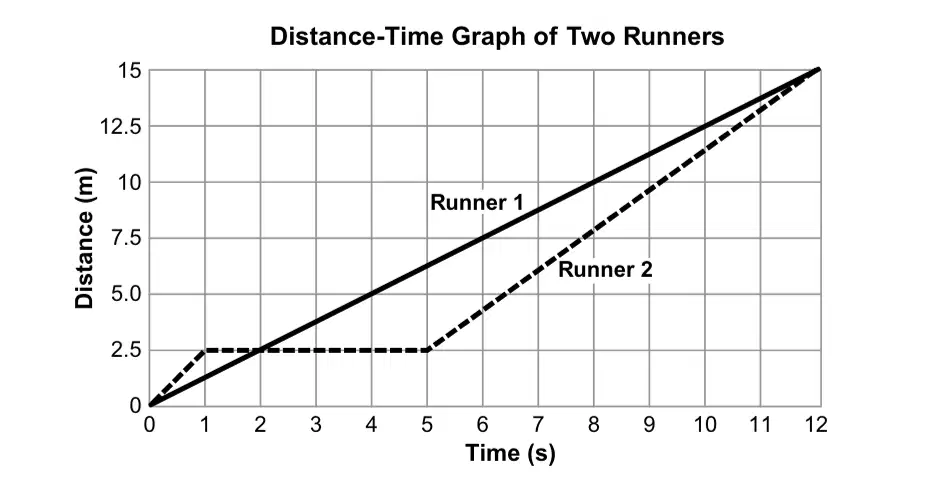
Fill in the blank: According to the graph, Runner 1 maintained a constant speed of ___ m/s.
1.0
1.25
1.5
2.0

What part of the graph MOST LIKELY represents the period of time when the two park rangers took a break?
Between points A and B because the slope is negative
Between points B and C because the slope is zero
Between points B and D because the slope is positive
Between points A and C because the slope is zero

Fill in the blank: The slope of a distance-time graph indicates the speed of the object. A horizontal line on the graph indicates that the speed is ____.
increasing
decreasing
constant
zero

Which runner had the fastest start in the first 6 seconds of the race?
Runner A
Runner B
Runner C
All runners had the same speed.

Fill in the blank: The runner who won the race is ____.
A) Runner A
B) Runner B
C) Runner C
What does Newton's First Law of Motion state?
A) A body at rest will stay at rest unless acted upon by an unbalanced force.
B) A body in motion will stay in motion unless acted upon by a balanced force.
C) A body at rest will stay at rest unless acted upon by a balanced force.
D) A body in motion will stay at rest unless acted upon by an unbalanced force.
Fill in the blank: According to Newton's First Law of Motion, balanced forces act on stationary objects and objects moving at constant velocities. It takes an _______ force to change this.
balanced
unbalanced
equal
opposite
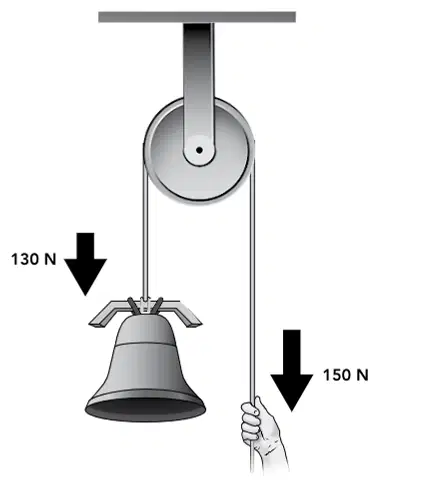
A heavy bell attached to a rope and a pulley system is being lifted. Which statement BEST describes the forces acting on the bell according to Newton’s first law of motion?
The forces are unbalanced so the bell will not move.
The forces are unbalanced so the bell will move.
The forces are balanced so the bell will not move.
The forces are balanced so the bell will move.
A ball is sitting at rest on a field and then it is kicked. Which statement BEST describes the forces acting on the ball?
The forces are unbalanced when the ball is sitting on the field because it is not moving; the forces are balanced when the ball is kicked because the ball is in motion.
The forces are balanced when the ball is sitting on the field because gravity is pulling it; the forces are unbalanced when the ball is kicked because gravity is not pulling it.
The forces are balanced when the ball is sitting on the field because it is not moving; the forces are unbalanced when the ball is kicked because the ball is in motion.
The forces are unbalanced when the ball is sitting on the field because gravity is pulling it; the forces are unbalanced when the ball is kicked because gravity is not pulling it.

In a game of tug-of-war, for one team to win, the forces must be ______.
A) balanced
B) unbalanced
C) equal
D) opposite

Which of the following is the largest and most massive object in the solar system?
Earth
Jupiter
The Sun
Saturn
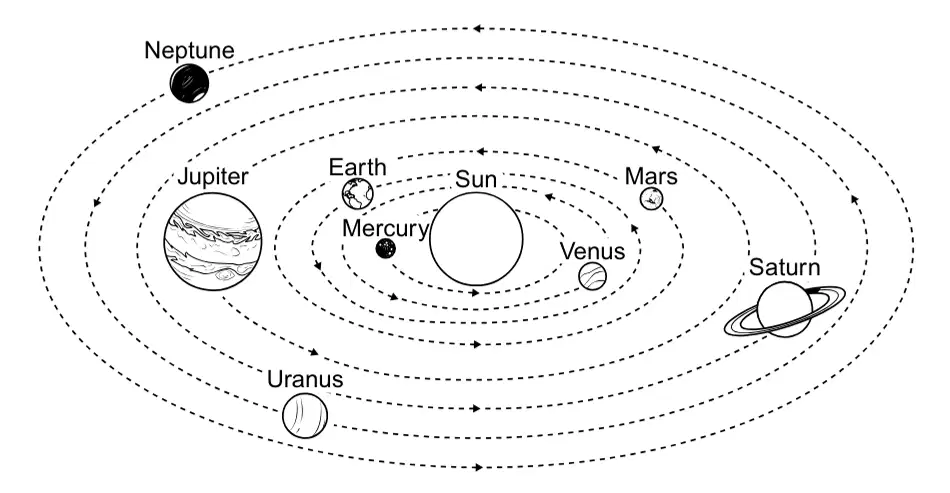
A planet is an object that _______ around the sun.
floats
orbits
stands still
disappears
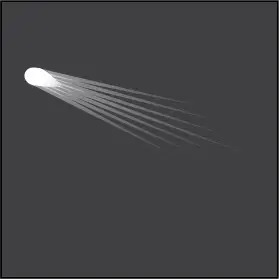
A student is watching objects in the night sky and sees the object shown in the image. What is this object?
It is an asteroid because it is rounded.
It is an asteroid because it has a tail.
It is a comet because it is rounded.
It is a comet because it has a tail.
Which of the following is ALWAYS a property of planets?
Planets always orbit the sun.
Planets always have at least one moon orbiting them.
Planets are always found in every belt in the solar system.
Planets always have a solid surface and contain metals.
What is the theory that explains how continents have changed and moved over millions of years?
Plate Tectonics
Continental Drift
Superposition
Fossil Evidence
The law of _______ states that in undisturbed sedimentary layers, the oldest layer is at the bottom and the youngest layer is at the top.
Plate Tectonics
Continental Drift
Superposition
Fossil Evidence
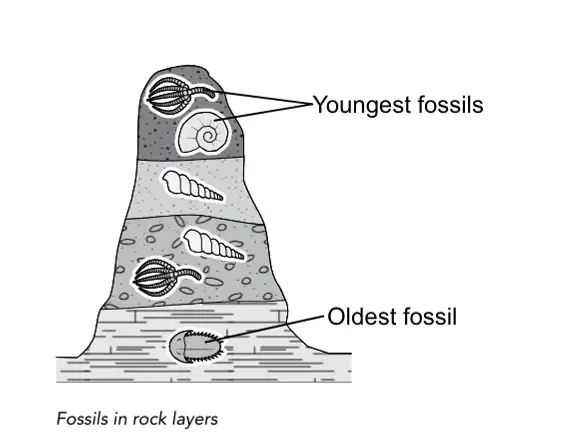
Which of the following statements is true about fossils in rock layers?
The youngest fossils are found at the bottom layers.
The oldest fossils are found at the top layers.
The youngest fossils are found at the top layers.
Fossils do not indicate the age of rock layers.

Why would the desert have these fossils?
Wind patterns blew aquatic fossils into the desert.
The desert was once covered with water.
The land slowly shifted, bringing fossils from their original location.
Ancient desert animals used to look like aquatic animals.

In Location 1, the most recent fossils found were ______.
Gastropods
Ammonites
Corals
Ferns


Respiratory System


Subduction means.....
one plate goes under another plate
two plates slide past each other
two plate collide and form folded mountains

Sea-floor spreading explains how.....
new crust is created at a divergent boundary
volcanoes are formed on continents
deep sea trenches are formed

When plates collide we get ________.
crumbles
volcanos
trenches
mountain ranges

What definition BEST describes a watershed?
An area where water infiltrates the soil
An area where aquatic plants and animals thrive
An area where snow melts and changes into liquid water
An area that collects precipitation and drains it to the lowest point
All water below the surface of land is called__________.
water table
watershed
groundwater
runoff
The process where water or irrigation runs over land and seeps into the ground, or flows into streams or oceans.
water cycle
runoff
precipitation
evaporation

The picture illustrates nonpoint source pollution.
True
False

The picture shown is an example of______
runoff
point source water pollution
nonpoint source water pollution
ground water
How does the supervolcano release pressure on a daily basis?
by spewing lava and hot ash
through geysers and hot springs
What is the force inside the mantle that causes the Earth's Plates to move ?
subduction
radiation
conduction
convection
What geologic feature will occur at a hot spot ?
volcano
folded mountain
deep sea trench
crevasse
A prime example of an area over a hot spot is :
Japan
the Andes Mountains
the East African Rift
the Hawaiian Islands
What area of the continental United States is over a hot spot ?
the Florida Everglades
the Grand Canyon
Yellowstone National Park
New York City



