Wayground logo

Free Printable Worksheets

Font size

S
M
L
XL
Worksheets

Q3 Geometry Review

Total questions: 79

Worksheet time: 3hrs 38mins

Name
Class
Date
1.

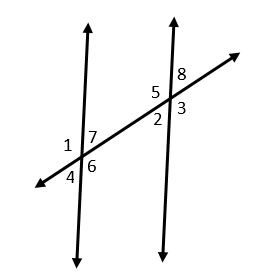
∠8\angle8  and  ∠6\angle6   are __.  

a)

Alternate Interior Angles

b)

Alternate Exterior Angles

c)

Same-side Interior Angles

d)

Corresponding Angles

e)

None of these

2.

∠1 \angle1\ and  ∠2\angle2    are __.

a)

Alternate Interior Angles

b)

Alternate Exterior Angles

c)

Same-side Interior Angles

d)

Corresponding Angles

e)

None of these

3.

∠3\angle3  and  ∠7\angle7  are ___.  

a)

Alternate Interior Angles

b)

Alternate Exterior Angles

c)

Same-side Interior Angles

d)

Corresponding Angles

e)

None of these

4.

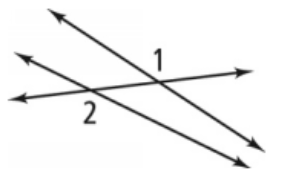
How are these angles related?

a)

Corresponding angles

b)

Alternate interior angles

c)

Alternate exterior angles

d)

Same side interior angles

5.

How are these angles related?

a)

Corresponding angles

b)

Alternate interior angles

c)

Alternate exterior angles

d)

Same side interior angles

6.

Given the following two parallel lines cut by a transversal.


Which pair of angles represents alternate exterior angles?

a)

∠3\angle3  and ∠8\angle8  

b)

∠7\angle7  and ∠2\angle2  

c)

∠7\angle7  and ∠8\angle8  

d)

∠4\angle4  and ∠8\angle8  

7.
Solve for y.
a)
y = 20
b)
y = 120
c)
y = 60
d)
y = 10
8.
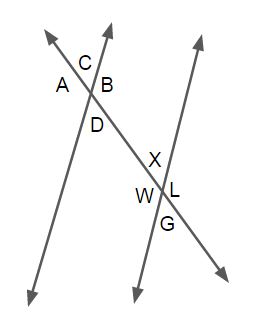
Which pair of angles are congruent?
a)
A and C
b)
C and L
c)
B and W
d)
D and W
9.
Which pair of angles add up to 180 degrees?
a)
A and W
b)
C and X
c)
D and X
d)
A and G
10.
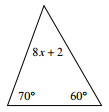
What is the value of x?
a)
22
b)
26
c)
24
d)
23
11.

Solve for x.

a)

180

b)

12

c)

8

d)

16.7

12.

Solve for x.

a)

23

b)

-20

c)

32

d)

20

13.

What is the vertical angle of angle 4?

a)

1

b)

2

c)

3

d)

4

14.

Are angles 1 and 3 congruent to each other?

a)

No, because they are supplementary.

b)

No, because they are vertical.

c)

Yes, because they are next to each other.

d)

Yes, because they are on the same line.

15.

If two lines are parallel, what can you say about their consecutive interior angles?

a)

Complementary

b)

Congruent

c)

Vertical

d)

Supplementary

16.

What is the equation for finding slope?

a)

m = y2 − y1x2 − x1m\ =\ \frac{y2\ -\ y1}{x2\ -\ x1}

b)

m = y2 + y1x2 + x1m\ =\ \frac{y2\ +\ y1}{x2\ +\ x1}

c)

m = x2 − x1y2 − y1m\ =\ \frac{x2\ -\ x1}{y2\ -\ y1}

d)

m = x2 + x1y2 + y1m\ =\ \frac{x2\ +\ x1}{y2\ +\ y1}

17.
Which of these represents slope-intercept form?
a)
y - y1 = m(x-x1)
b)
Ax + By = C
c)
y = mx + b
18.

If m=3 and b=6, what is the correct slope intercept equation?

a)

y=3-6

b)

y=3x-6

c)

y=3x+6

d)

y=6x+3

19.

Two lines that are parallel will have ...

a)

Slope that is opposite reciprocals

b)

No slope

c)

Slope that is the same

d)

none of the above

20.

Two lines that are perpendicular lines have ...

a)

Slope that is opposite reciprocals

b)

No Slope

c)

Slope that is the same

d)

none of the above

21.

Write the equation of a line PARALLEL to y = 2x + 3 that passes through the point (3, 1).

a)

y=2x −3y=2x\ -3

b)

y=2x−5y=2x-5

c)

y=2x + 1y=2x\ +\ 1

d)

y=−12x+52y=-\frac{1}{2}x+\frac{5}{2}

22.

Write the equation of a line PERPENDICULAR to y = -2x + 1 that passes through the point (2, 3).

a)

y=−12x+12y=-\frac{1}{2}x+\frac{1}{2}

b)

y=12x+2y=\frac{1}{2}x+2

c)

y=−2x+7y=-2x+7

d)

y=−2x+8y=-2x+8

23.

Write the equation of a line PERPENDICULAR to y=13x−9y=\frac{1}{3}x-9  that passes through the point (-6, 10).

a)

y=13x−9y=\frac{1}{3}x-9

b)

y=13x+10y=\frac{1}{3}x+10

c)

y=−3x+6y=-3x+6

d)

y=−3x−8y=-3x-8

24.

Select the two lines that are parallel.

a)

y=4x−2y=4x-2

b)

y=−14xy=-\frac{1}{4}x

c)

y=−4x+1y=-4x+1

d)

None are parallel.

25.

Select the two lines that are perpendicular.

a)

y=4x−2y=4x-2

b)

y=−14xy=-\frac{1}{4}x

c)

y=−4x+1y=-4x+1

d)

None are perpendicular.

26.
In a translation, the preimage and image are ___________.
a)
congruent
b)
similar
c)
different
d)
red
27.
What does a translation do to an image?
a)
Turns it 90* clockwise
b)
Mirrors it
c)
Shrinks it
d)
Slides it
28.
When you translate, you ______ a number to x and y.
a)
Add or subtract
b)
Multiply or divide
c)
Add or multiply
d)
Subtract or divide
29.

Translate the points using the rule (x, y) --> (x + 3, y + 2)

30.

What vector transformation would be the same as the translation rule (x, y) --> (x + 2, y - 5) ?

a)

< 2, -5 >

b)

(2, 5)

c)

(-2, -5)

d)

< -2, 5 >

31.
Write a rule for the translation.
a)

(x, y) --> (x -1, y  + 2)

b)

(x, y) --> (x -2, y  + 1)

c)

(x, y) --> (x +2, y  - 1)

d)

(x, y) --> (x +1, y  -  2)

32.
Triangle ABC is going to be translated. Where would  A' position be at, if the translation was be (x,y) --> (x+3, y-2)?
a)
(-1,3)
b)
(5,3)
c)
(5,8)
d)
(3,5)
33.
Determine how to translate triangle A'B'C' to triangle ABC.
a)
right two, down five
b)
right two, down 9
c)
left two, down 9
d)
left two, down 5
34.

Determine where X' would be if you translated X using the vector <-3, -9>

a)
(-4, 4)
b)
(-10, 2)
c)
(-4, -5)
d)
(-1, 5)
35.

Given the translation rule (x, y) → (x - 3, y + 4), what is the preimage of  C' (2, 9).

a)

(5, 5)

b)

(-1, 13)

c)

(6, 6)

d)

(1, 11)

36.
What is a reflection?
a)
When you turn an object around a point.
b)
When you slide an object form one place to another.
c)
When you flip or mirror an object across a line.
d)
When you resize an object.
37.
State the line of reflection.
a)
Reflection across y-axis
b)
Reflection across x-axis
c)
Reflection across x = 1
d)
Reflection across y = 1
38.

Describe the reflection.

a)

Reflection over x = -1

b)

Reflection over x = 1

c)

Reflection over y = -1

d)

Reflection over y = 1

39.
A line that acts as a mirror so that corresponding points are the same distance from the mirror.
a)
line of rotation
b)
line of reflection
c)
line of dilation
d)
line of translation
40.

What is the mirror line for this reflection?

a)

y=4

b)

x=-3

c)

y=x

d)

y= -x

41.
The point ( -2,5) is reflected over the line x = 1.  Find its image.
a)
(  4,  5)
b)
( -2  , -5)
c)
( 2  ,  5)
d)
(2   , -5)
42.

If A(2,5) was reflected over the Y-AXIS, what would the coordinated of A' be?

a)

A'(2,-5)

b)

A'(-2,5)

c)

A'(5,2)

d)

A'(5,-2)

43.
Which answer shows a reflection across the x-axis?
a)
d
b)
c
c)
b
d)
a
44.
If you were to rotate ABCD 180°  about the origin, what would the coordinate of A' be?
a)
(-5, 5)
b)
(-3, -5)
c)
(-5, 3)
d)
(-3, 3)
45.
If you were to rotate ABCD 90° counterclockwise about the origin, what would the coordinate of A' be?
a)
(-5, 5)
b)
(-3, 5)
c)
(-5, 3)
d)
(-3, 3)
46.
What is the angle of rotation for this counterclockwise rotation about the origin?
a)
90°
b)
180°
c)
270°
d)
360°
47.
Rotate the point (7,8) around the origin 90 degrees counterclockwise.
State the image of the point.
a)
(-7,-8)
b)
(8,-7)
c)
(-8,7)
d)
(8,7)
48.
Rotate the point (-3,-4) around the origin 180 degrees clockwise. State the image of the point.
a)
(-4,-3)
b)
(-4,3)
c)
(4,-3)
d)
(3,4)
49.
Triangle ABC will be dilated by a scale factor of 1/2.  What will be the coordinates of C'?
a)
(-1, -2.5)
b)
(12, 6)
c)
(3, -1.5)
d)
(0, 1.5)
50.
Enlargement or reduction?  Find the scale factor!
a)
It's a reduction; the scale factor is 2.
b)
It's an enlargement; the scale factor is 2.
c)
It's an enlargement; the scale factor is 1/2.
d)
It's a reduction; the scale factor is 1/2.
51.
If the scale factor is less than 1, the dilation is...
a)
an enlargement
b)
a translation
c)
a rotation
d)
a reduction
52.
The algebraic expression for an enlargement by a scale factor of 3 is...
a)
(x, y)→(3x, 3y)
b)
(x, y)→(3, 3)
c)
(3x, y)→(x, y)
d)
(x, y)→(3x)
53.
Triangle ABC will be dilated using the rule (x, y)→(2x, 2y).  What will be the coordinates of C'?
a)
(12, -3)
b)
(12, -6)
c)
(3, -1.5)
d)
(8, -5)
54.
Enlargement or reduction?  Find the scale factor!
a)
It's an enlargement; the scale factor is 2.
b)
It's a reduction; the scale factor is 2/3.
c)
It's an enlargement; the scale factor is 3/2.
d)
It's a reduction; the scale factor is 3.
55.

Classify the triangle by its sides.

a)

equilateral

b)

scalene

c)

isosceles

56.

Classify the triangle by its angles.

a)

acute

b)

obtuse

c)

equiangular

d)

right

57.

Classify the triangle by its angles.

a)

acute

b)

obtuse

c)

equiangular

d)

right

58.

Classify the triangle by its angles.

a)

acute

b)

obtuse

c)

equiangular

d)

right

59.
Classify the triangle.
a)
acute
b)
equilateral
c)
scalene
d)
obtuse
60.
Classify the triangle.
a)
acute
b)
equilateral
c)
equiangular
d)
obtuse
61.

Match the following triangles with their correct definition.

a)

1.

all sides are the same length.

b)

2.

Has at least 2 equal sides.

c)

3.

Has no equal sides.

d)

4.

Has one right angle

e)

5.

Has 3 acute angles

62.
Classify the triangle by angles and sides.
a)
Right Scalene
b)
Right Isosceles
c)
Acute Isosceles
d)
Right Obtuse
63.
Classify the triangle by angles and sides.
a)
Obtuse Scalene
b)
Obtuse Isosceles
c)
Right Scalene
d)
Acute Isosceles
64.
Which of the following terms best describes Angle d? (remember that it's outside)
a)
Remote interior angle
b)
Corresponding angle
c)
Exterior angle
d)
Interior angle
65.

What is the measure of angle b?

a)

56o

b)

36o

c)

63o

d)

117o

66.

Solve for x.

a)

8

b)

6

c)

15

d)

13

67.
Find the value of x.
a)
A
b)
B
c)
C
d)
D
68.
Find the measure of angle D.
a)
140 degrees
b)
16 degrees
c)
40 degrees
d)
90 degrees
69.
Solve for x.
a)
16
b)
11
c)
50
d)
6
70.
Solve for x.
a)
6
b)
-10
c)
7
d)
-9
71.

Find the angle labeled with the question mark.

a)

97 degrees

b)

33 degrees

c)

83 degrees

d)

47 degrees

72.

In the figure, ABCD≅EFGHABCD\cong EFGH . Identify all pairs of congruent corresponding parts. Then write another congruence statement.

∠A≅\angle A\cong ​ (a)  

∠B≅\angle B\cong ​ (b)  

∠C≅\angle C\cong ​ (c)  

∠D≅\angle D\cong ​ (d)  
BCDA≅BCDA\cong ​ (e)  

Choose from the below words

∠E\angle E  

∠F\angle F  

∠G\angle G  

∠H\angle H  

FGHEFGHE  

GHEFGHEF
FGEHFGEH
HFGEHFGE
73.

Find m∠Tm\angle T .

74.
If ∆LMK ≅ ∆LMT, then
∠K ≅ ____
a)
T
b)
∠T
c)
∠M
d)
∠L
75.
Matching sides are called
a)
Corresponding Sides
b)
Corresponding Angles
c)
The Same
d)
Congruent Sides
76.
How can you tell which Angles are congruent from ∆DEF ≅ ∆ZXY?
a)
I can not tell without a diagram.
b)
I can not tell without measurements given.
c)
I looked at the letters in corresponding positions.
d)
The letters closer to the beginning of the alphabet match and the letters closer to the end of the alphabet match.
77.

△DEF ≅ △QRS. What is the value of y?

a)

6.2

b)

8

c)

9

d)

7

78.

a)

A

b)

B

c)

C

d)

D

79.

a)

A

b)

B

c)

C

d)

D