
 Worksheets
CONTINENTAL DRIFT AND PLATE TECTONICS
Total questions: 80
Worksheet time: 40mins
Alfred Wegener is best known for what hypothesis?
seafloor spreading
plate tectonics
continental drift
subduction
Which scientist was credited with first seriously proposing that all continents were joined together as a single landmass?
Harry Hess
Alfred Wegener
Charles Darwin
Albert Einstein
What is the name of the ancient supercontinent that broke apart about 200 million years ago?
Gondwana
Eurasia
Pangaea
Panthalassa
Fossils of the Mesosaurus, a prehistoric freshwater animal, have been found on the continents of South America and Africa. The distribution of these fossils suggest that these areas were once…
made of similar chemical elements
covered by oceanic crust
connected to one another
frozen
If the continents were once joined together, rocks and mountain ranges on the margins of each…
should have similar chemical properties.
should have formed at the same time.
should have formed under the same conditions.
all of the above
What was the principal reason why Wegener’s hypothesis of continental drift was rejected?
He could only provide the evidence that the coastlines of continents appeared to fit together.
He could only provide fossil evidence from marine species.
He’s hypothesis lacked evidence of glacial striations on connecting continents.
His hypothesis lacked a geological mechanism to explain how the continents drifted apart.
What does the word Pangaea mean in Latin?
all land
all coastlines
all planets
seven continents
Which of the following is NOT evidence of continental drift?
a. a land bridge once connected different continents
b. similar rock types on different continents
c. similar fossils on different continents
d. similar glacial striations and till on different continents
Which scientist first backed up the hypothesis of continental drift with evidence, but was unable to prove his hypothesis because he could not identify the mechanism behind the drifting of continents?
Harry Hess
Alfred Wegner
Marie Tharp
Alfred Einstein
Approximately when did the supercontinent Pangaea begin to break apart?
about 450,000 years ago
about 200 billion years ago
about 4.5 million years ago
about 200 million years ago
To develop the theory of plate tectonics, scientists first had to accept the idea that…
Earth’s core consists of molten rock.
Some organisms have the ability to cross vast oceans.
Earth’s continents have the ability to move.
Some plants’ seeds can be dispersed by the wind hundreds of thousands of kilometers away.
When did Alfred Wegener first propose his theory of continental drift?
early 1900s
early 1800s
late 1700s
late 1900s
What was Wegener’s role in the development of the theory of plate tectonics?
He identified evidence of paleomagnetism near mid-ocean ridges.
He provided evidence of seafloor spreading.
He identified evidence of intraplate volcanism.
He proposed evidence that the continents have were once joined together in a single landmass.
Which of the following predictions is MOST correct?
The Earth will go flat.
The solar system will arrange itself into perfect alignment.
Another supercontinent will form.
All oceanic crust will disappear.
When Pangaea existed, the South American continent was attached to present-day…
India
Australia
Eurasia
Africa
What is the name of the outermost, ridged layer of the Earth?
lithosphere
asthenosphere
mesosphere
troposphere
Which layer of the Earth is composed of tectonic plates?
mesosphere
lithosphere
asthenosphere
exosphere
What layer of the Earth does the lithosphere float on top of?
mesosphere
outer core
asthenosphere
troposphere
One of the most general conclusions to be drawn from the theory of plate tectonics is that the Earth…
is slowly expanding
is slowly shrinking
is continuously losing heat
is slowly changing its geography
Which scientist was the first to use SONAR to discover and hypothesize the process of seafloor spreading?
Harry Hess
Alfred Wegener
Marie Tharp
Isaac Newton
Where does seafloor spreading take place?
continental rift alleys
hot spots
volcanic island arcs
mid-ocean ridges
Which of the following processes is most likely to cause the movement of Earth’s tectonic plates?
energy produced from volcanic eruptions
magnetic pole reversals
faulting of mountain ranges
convection currents below the lithosphere
Where do convection currents take place?
crust
mantle
outer core
inner core
What type of plate boundary exists at a mid-ocean ridge?
convergent plate boundary
divergent plate boundary
subduction plate boundary
transform plate boundary
What type of plate boundary are subduction zones associated with?
convergent plate boundary
divergent plate boundary
volcanic plate boundary
transform plate boundary
What type of boundary exists at the San Andreas Fault?
convergent plate boundary
divergent plate boundary
volcanic plate boundary
transform plate boundary
What type of tectonic plate boundary involves a collision between two plates?
convergent plate boundary
divergent plate boundary
subduction plate boundary
transform plate boundary
What type of tectonic plate boundary involves two plates moving away from one another in opposite directions?
convergent plate boundary
divergent plate boundary
volcanic plate boundary
transform plate boundary
What type of tectonic plate boundary involves two plates sliding and grinding past one another horizontally without destroying any crust?
convergent plate boundary
divergent plate boundary
subduction plate boundary
transform plate boundary
At a transform plate boundary…
new lithosphere is formed
lithosphere is neither destroyed nor produced
lithosphere is subducted and destroyed
new continental crust is formed
Which type of plate boundary is MOST associated with earthquakes?
transform plate boundary
divergent plate boundary
rigid plate boundary
convergent plate boundary
Which of the following is NOT evidence of seafloor spreading?
magnetic pole reversals
age of rocks on ocean floor
mantle plumes in hot spots
molten material at mid-ocean ridges
Which of the following does NOT occur at convergent plate boundaries?
volcanic island arcs
continental volcanic mountain arcs
ocean trenches
rift valleys
Which of the following is caused by continental divergent plate boundaries?
volcanic island arcs
rift valleys
continental mountains
deep ocean trenches
Volcanic arcs are associated with…
divergent boundaries
convergent boundaries
transform boundaries
all of the above
Which of the following increases with distance from a mid-ocean ridge?
depth of seafloor
thickness of oceanic lithosphere
age of oceanic lithosphere
all of the above
What are hot spots caused by?
mantle plumes
earthquakes
continental volcanic mountain arcs
seafloor spreading
What can be created at a convergent boundary between a continental crust and another continental crust?
volcanic island arc
continental mountain range
continental volcanic mountain arc
rift valley
Which type of crust is the densest?
continental crust
oceanic crust
asthenospheric crust
mesospheric crust
Which type of crust is the thickest?
continental crust
oceanic crust
asthenospheric crust
mesospheric crust
What type of rock mainly makes up continental crust?
basalt
obsidian
granite
pumice
What type of rock mainly makes up oceanic crust?
basalt
quartz
granite
obsidian
Which type of crust generally subducts under the other?
continental crust
volcanic crust
transform crust
oceanic crust
What is the name of the deepest trench on Earth?
Puerto Rico Trench
Mariana Trench
Great Australian Trench
Red Sea Trench
The rate of plate movement can best be measured in…
millimeters per year
centimeters per year
meters per year
micrometers per year
Which of the following is a destructive plate boundary?
transform plate boundary
convergent plate boundary
subduction plate boundary
divergent plate boundary
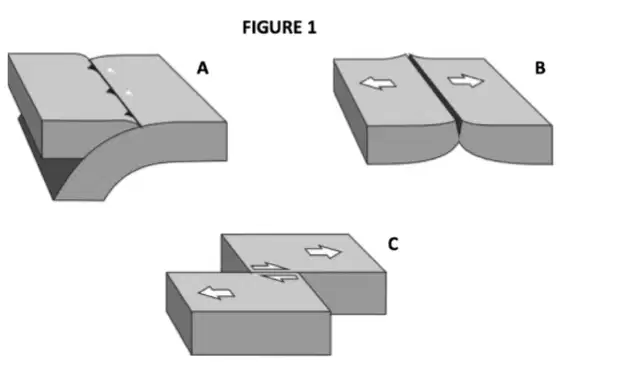
Observe Figure 1 (above). Which diagram(s) shows a transform plate boundary?
Diagram A
Diagram B
Diagram C
All of the above

Observe Figure 1 (above). Which diagram(s) shows a divergent plate boundary?
Diagram A
Diagram B
Diagram C
All of the above
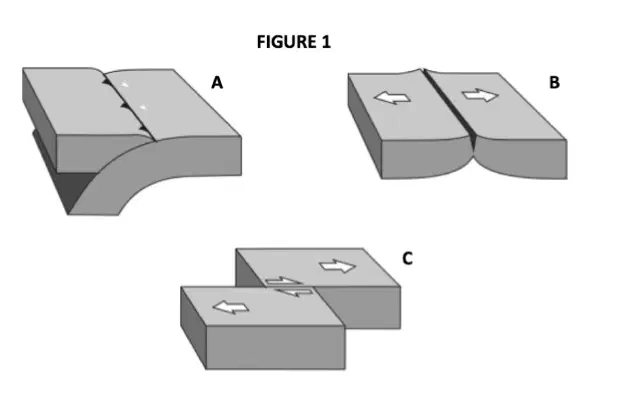
Observe Figure 1 (above). Which diagram(s) shows a subduction?
Diagram A
Diagram B
Diagram C
All of the above
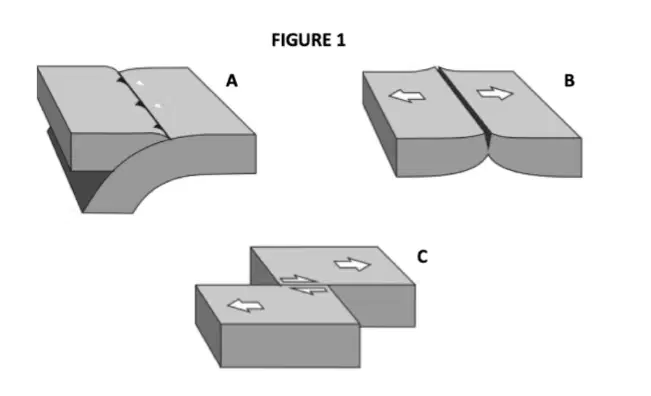
Observe Figure 1 (above). Which diagram(s) shows a convergent plate boundary?
Diagram A
Diagram B
Diagram C
All of the above
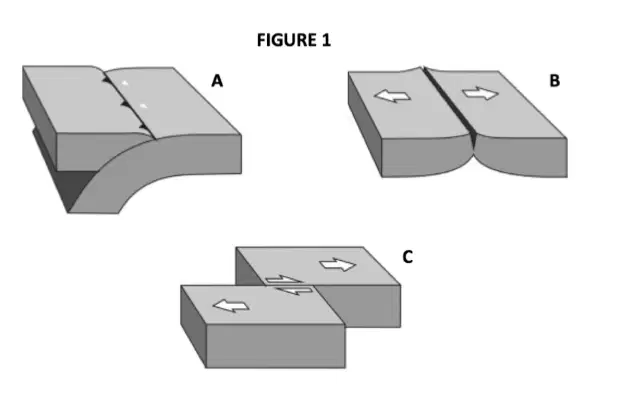
In which diagram(s) can an earthquake occur?
Diagram A
Diagram B
Diagram C
All of the above
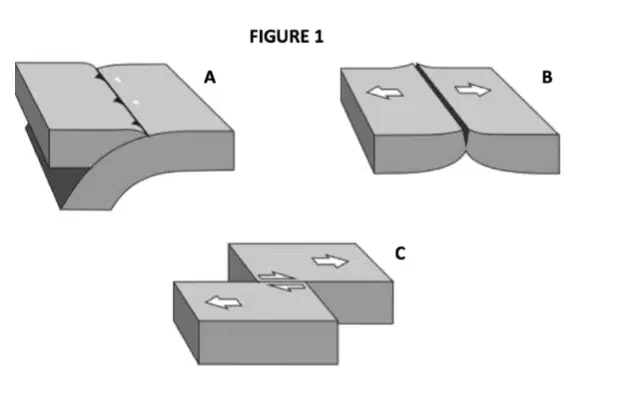
In which diagram(s) is a volcano most likely to occur?
Diagram A
Diagram B
Diagram C
All of the above
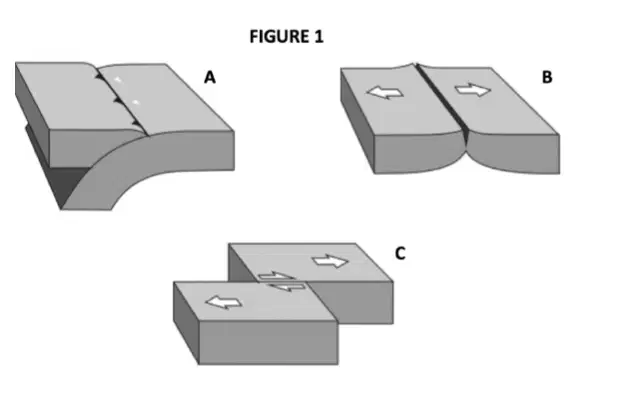
In which diagram is a rift valley most likely to occur?
Diagram A
Diagram B
Diagram C
None of the above
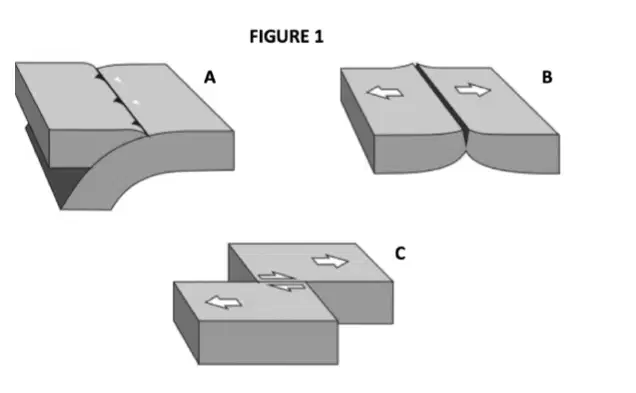
In which diagram is an ocean trench most likely to occur?
Diagram A
Diagram B
Diagram C
None of the above
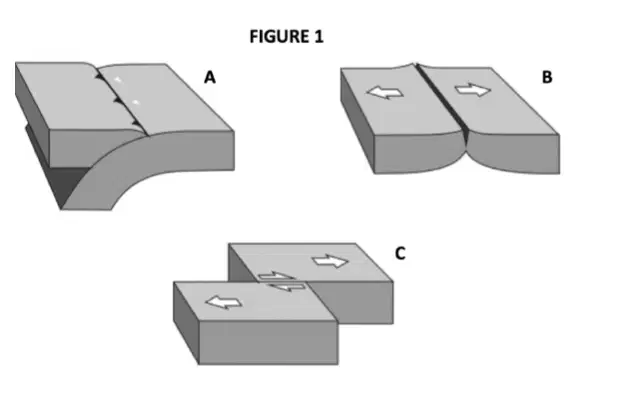
In which diagram is a mid-ocean ridge most likely to occur?
Diagram A
Diagram B
Diagram C
None of the above

In which diagram is hot spot most likely to occur?
Diagram A
Diagram B
Diagram C
None of the above
_______ states that continents can drift apart from one another and have done so in the past.
Continental drift
Plate tectonics
Seafloor spreading
Pangaea
_______ is the theory that the Earth’s lithosphere is divided into tectonic plates that float and move above the asthenosphere.
Plate tectonics
Continental drift
Subduction zones
Seafloor spreading
Wegner’s _______ of continental drift suggested that there was once one single supercontinent on Earth.
hypothesis
theory
concept
idea
By studying _______ , Wegener found evidence for dramatic climate changes to support his ideas.
glacial deposits
fossil records
tree rings
sedimentary layers
The main objection to Wegener’s hypothesis was he could not describe a _______ capable of moving the continents.
mechanism
evidence
phenomenon
theory
When Wegner first introduced continental drift, many scientists believed that there were _______ connecting the continents.
land bridges
oceanic ridges
volcanic arches
submerged valleys
Continental crust is composed of _______ rock.
granite
basalt
rhyolite
andesite
The continents were once joined to form a single supercontinent called _______.
Pangaea
Gondwana
Laurasia
Euramerica
Oceanic crust is composed of _______ rock.
basalt
granite
gabbro
peridotite
Oceanic plates are _______ than continental plates.
denser
thicker
lighter
younger
The youngest material of the ocean floor is found at _______.
mid-ocean ridges
continental margins
subduction zones
ocean trenches
While studying the ocean floor, scientists found _______ bands of magnetism.
alternating
uniform
continuous
steady
The boundary between two plates that are moving apart is a _______ boundary.
divergent
convergent
transform
collisional
Mountain ranges are caused by a _______ boundary between two continental plates.
convergent
divergent
transform
rift
The San Andreas Fault is located at a _______ boundary.
transform
convergent
divergent
compressional
The process of _______ creates new oceanic lithosphere as older materials are pulled away.
seafloor spreading
continental drift
subduction
volcanism
The largest mid-ocean ridge is located in the _______ ocean.
Atlantic
Indian
Pacific
Arctic
The divergence of two continental crusts may result in a _______.
rift valley
transform fault
subduction zone
volcanic island arc
_______ in the mantle moves tectonic plates.
Convection
Subduction
Slab pull
Rifting
Alfred Wegener was NOT the first to suggest that continents once had been connected in one supercontinent, however, he was the first to present extensive evidence that they once were.
True
False
Earth has always had seven continents.
True
False
Alfred Wegener proved the theory of continental drift on the basis of his evidence.
True
False
Tropical climates once existed in the past on continents which are now located in polar areas.
True
False
Supercontinents will never again form in the Earth’s future.
True
False

