
 Worksheets
EASE 3 Prep G8 2025
Total questions: 61
Worksheet time: 2hrs 3mins

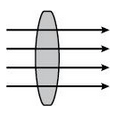
The above lens is a type of ___.
diverging lens
converging lens
divergent lens
convergent lens
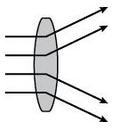
Which lens represents the path light takes through a diverging lens?


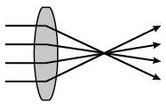
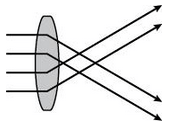
Which figure represents the path light takes through a converging lens?

What type of lens creates the image seen in the eyeglasses?
convex
concave
reflection
plane
A lens that is thicker in the middle than on the outside is called ___.
diverging
concave
convex
achromatic
A lens that is thinner in the middle than on the outside is called ___.
diverging
concave
convex
achromatic

What type of lens is used in the shown instrument?
concave lens
convex lens
reflection lens
reduction lens
if the object is beyond C (2F)
image is real, smaller and upright
image is real, smaller and upside down
image is virtual, smaller and upside down
image is real, bigger and upright

Is a convex lens thicker or thinner in the middle?
Thicker
Thinner
A converging lens is also known as a ____ lens.
convex
concave
double
refracted
A real image...
is produced by virtual rays and can be projected on a screen
is produced by real rays and cannot be projected on a screen
is produced by virtual images and cannot be projected on a screen
is produced by real rays and can be projected on a screen

An object is placed in front of a converging lens. The lens has a focal length f. The lens produces a real, enlarged image of the object. In which labelled position is the object placed?
A
B
C
D
When an object is placed between the focus and the convex lens, the image produced is ___.
real, diminished, and inverted
real, magnified, and inverted
virtual, magnified, and upright
virtual, diminished, and upright
A virtual image is formed by...
the actual intersection of light rays, cannot be formed on a screen
the apparent intersection of light rays, cannot be formed on a screen
the actual intersection of light rays, can be formed on a screen
the apparent intersection of light rays, can be formed on a screen

In the thin lens equation, do represents
Distance of the object from the lens
Distance of the image from the lens
The focal point

In the thin lens equation, f represents
Distance of the object from the lens
Distance of the image from the lens
focal length
focal point
A tree is located 40 m from the converging lens of focal length 0.08 m. What does the 0.08 m represent?
do
di
f
1/f
A normal human eye has a focal length of about 0.023 m. The tip of a pencil is 0.553 m from your eye. What does the 0.553 m represent?
do
di
f
1/f
The focal length of the lens in your eye is about 0.015 m. The object is 1 m from your eye. What does the 0.015m represent?
do
di
f
1/f
The above lens is a type of ___.
diverging lens
converging lens
divergent lens
convergent lens
Which lens represents the path light takes through a diverging lens?
A lens that is thicker in the middle than on the outside is called ___.
diverging
concave
convex
achromatic
When an object is placed on the focal point in front of a converging lens, the image produced is ___.
real, reduced, and inverted
real, enlarged, and inverted
real, true, and inverted
There is no image
When an object is placed between the focus and the converging lens, the image produced is ___.
real, diminished, and inverted
real, magnified, and inverted
virtual, magnified, and upright
virtual, diminished, and upright
The bouncing back of light ray
Refraction
Reflection
Diffusion
Dispersion
The ray of light which leaves the mirror
incident ray
reflected ray
x-ray
UV ray
A mirror with a flat reflective surface is called
convex mirror
concave mirror
plane mirror
side mirror
If the angle of incidence is 25 degrees, the angle of reflection is
20 degrees
25 degrees
50 degrees
90 degrees
If a 2.5 m object is placed in front of a plane mirror, the height of its image is
less than 2.5 m
2.5 m
more than 2.5 m
0
A plane mirror always produce ________images.
virtual
real
ideal
refracted
What is the distance of your image from you if you stand 1.5 m in front of a plane mirror?
1.5 m
2.0 m
3.0 m
4.5 m
In order to see a picture it must
produce light
reflect light
absorb light
To get the best reflection from a mirror you need
a very shiny surface to reflect lots of light
to stand right in front of it
to shine a bright light on it
it to produce light

In the diagram, which letter represents the angle of incidence?
A
B
C
D
what we call the phenomenon when a light ray changes its direction when passing from one transparent medium to another transparent medium?
Reflection of light
Refraction of light
Dispersion of light
None of these
What is the phenomenon of Dispersion?
Splitting of a white light into spectrum
Scattering of white light
Distribution of a spectrum
Light maintaining its properties
What is a Spectrum?
A band of 7 colors
A group of 10 colors
A band of 10 colors
A mixture of 7 colors
Which color is refracted the most in a rainbow?
Red
Violet
Indigo
Blue
Yellow
Which color refracts the least from the 7 colors of the rainbow?
Red
Yellow
Green
Black
Why is the component of colour in a rainbow can be seen when light passes through a glass prism?
phenomena of scattering of light
phenomena of dispersion of light
phenomena of reflection of light
phenomena of diffraction of light
Rainbow is formed due to
Natural dispersion
Sunlight passing through raindrops
Refraction of light
All of the above

A student placed a pencil in a cup of water. The pencil appears broken because light
always travels in a straight line.
bends when it passes through water.
makes the water in the glass evaporate.
reflects the pencil on the water's surface.
When light passes at an angle to the normal from one medium into another in which its speed is higher
it is bent toward the normal.
it always lies along the normal.
it is unaffected.
it is bent away from the normal.
When light passes at an angle to the normal from one medium into another in which its speed is lower
it is bent towards the normal.
it always lies along the normal.
it is unaffected.
it is bent away from the normal.
flint glass n=1.70
barium glass n=1.60
crown glass n=1.523
water n=1.33
diamond n=2.45

flint glass n=1.70
barium glass n=1.60
crown glass n=1.523
water n=1.33
diamond n=2.45
If all other variables are held constant, what happens to the angle of refraction if the angle of incidence increases?
the angle of refraction stays the same
the angle of refraction decreases
the angle of refraction increases
cannot be determined from the information provided

Based on the image, which medium has a larger index of refraction?
Medium 1 has a larger index of refraction.
Medium 2 has a larger index of refraction.
Both mediums have the same index of refraction.
Cannot be determined.
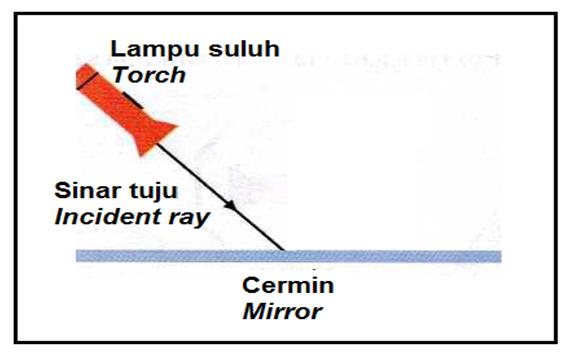
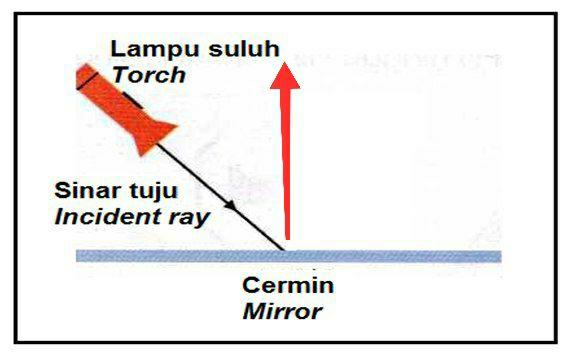
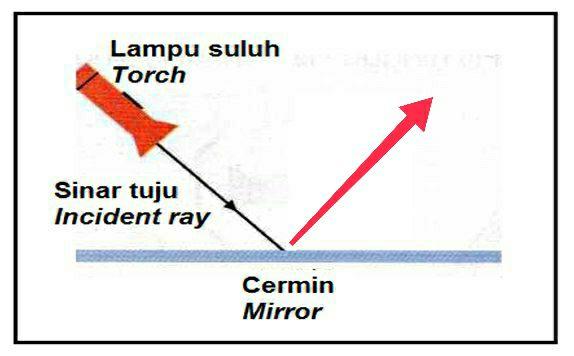
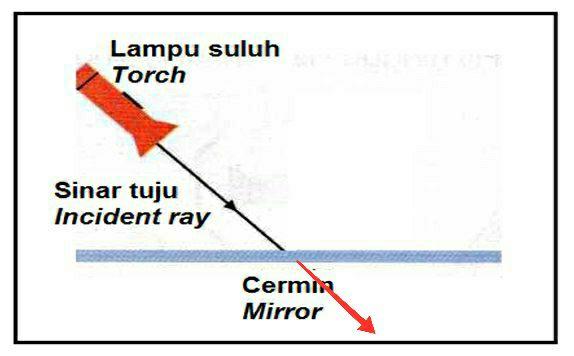
The following diagram shows the ray diagram when a torch light is torched towards a mirror. Which of the following is the correct reflected ray?
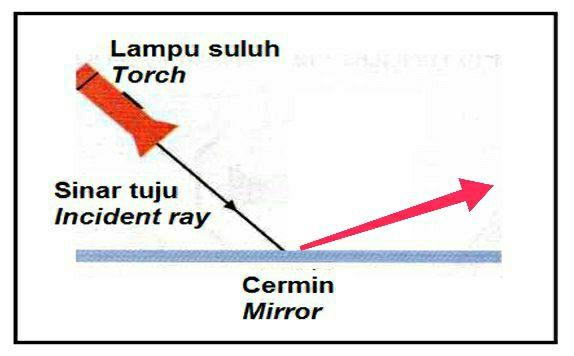

What is the conclusion from your observation in this picture?
Light travels in a straight line
Light can be refracted
Light can be reflected
Light can pass through a transparent material
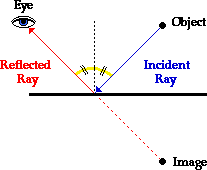
What is the angle of reflection equal to?
The angle of refraction
The angle of incidence
The angle of absorption
The angle of light


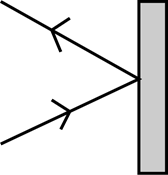
In the illustration, the light ray striking the object is-

On the diagram, E is:
The angle of incidence
The normal
The angle of reflection
The angle of refraction

What happens to light during total internal reflection?
The angle of incidence is greater than the critical angle.
The angle of reflection is the same as the critical angle.
The angle of refraction is less than the critical angle.
The angle of incidence is zero.
When angle of incident (i) equals to critical angle (c) if light is traveled from a denser medium to a less dense medium,
total internal reflection occurs.
angle of refraction is equal to 90 degree.
light is refracted out
light travel in straight line

Light travels through a glass block as shown. Which angle is the critical angle for light in the glass?
A
B
C
D

