wayground logo

Free Printable Worksheets

Font size

S
M
L
XL
Worksheets

Atoms, Matter, PT, & Interactions (PS.2-PS.4) Pt 1 SOL Review

Total questions: 64

Worksheet time: 54mins

Name
Class
Date
1.
A state of matter that has a definite volume and shape.
a)
solid
b)
liquid
c)
gas
d)
matter
2.
The amount of space something takes up
a)
density
b)
volume
c)
mass
d)
matter
3.
Shape is a ____ that helps identify an object.
a)
physical property
b)
chemical property
c)
mass
d)
matter
4.
Solubility is
a)
an items ability to dissolve
b)
an items ability to melt
c)
an items ability to freeze
d)
an items ability to boil 
5.
Which of the following is NOT an example of matter?
a)
Rocks
b)
Minerals 
c)
Oxygen
d)
Sound 
6.

At higher temperatures

a)

particles in an object have less energy

b)

particles in an object move faster

c)

a gas contracts

7.

The state of matter that has no definite volume or shape is

a)

Solid

b)

Liquid

c)

Gas

8.

Particles of a liquid

a)

are tightly packed together and stay in a fixed position.

b)

can move and flow but are still relatively close to each other

c)

move rapidly and spread far apart from each other

d)

move at very high speeds and are electrically charged
9.

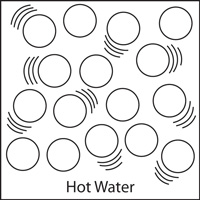
The speed of the molecules is affected by its _____.

a)

volume

b)

density

c)

pressure

d)

temperature

10.

Which of the following are physical properties? SELECT ALL THAT APPLY

a)

density

b)

boiling point

c)

combustibility

d)

reactivity with water

e)

color

11.

Which of the following are chemical properties? SELECT ALL THAT APPLY

a)

solubility

b)

acidity/basicity

c)

combustibility

d)

reactivity with water

e)

color

12.
Change of state from a solid to a liquid.
a)
sublimation
b)
deposition
c)
freezing
d)
melting
13.
What happens when my glass of water is sitting in the sun and disappears into a gas?
a)
evaporation
b)
burning
c)
melting
d)
freezing
14.
Molecules are closest together in a 
a)
Solid
b)
Liquid
c)
Gas
d)
plasma
15.

Condensation is ________.

a)

liquid freezing

b)

gas changing to liquid

c)

gas changing to solid

d)

solid changing to gas

16.

Dissolving sugar into a glass of iced tea is an example of making ___________.

a)

a solution

b)

a chemical change

c)

a compound

d)

an element

17.

What type of change happens when you crumple a piece of paper?

a)

chemical change

b)

physical change

18.

Which is an example of a chemical change?

a)

wood burning and turning into ashes

b)

a vase breaking

c)

sugar dissolving in water

d)

graham crackers breaking

19.
Gas created when water boils is an example of a:
a)
Physical change
b)
Chemical change
20.
What type of substance is shown in the picture? 
a)
element
b)
compound
c)
mixture 
21.
What type of substance is shown in the picture below? 
a)
compound 
b)
mixture 
c)
element 
22.
A change in the appearance of matter without changing the type of matter is called a __________. 
a)
chemical change 
b)
physical change 
23.
What change happens when a metal fork rusts? 
a)
physical change
b)
chemical change 
24.
Contains only one kind of atom.
a)
Element
b)
Compund
c)
Mixture
25.
The air is a _________. 
a)
element 
b)
mixture 
c)
compound 
d)
energy 
26.
Elements can be broken down into simpler substances. 
a)
false 
b)
true 
c)
sometimes 
27.
Examples are milk and gasoline.
a)
elements
b)
mixtures
c)
compounds
28.

Examples are diamonds (C) and Uranium (U)

a)

elements

b)

mixtures

c)

compounds

29.
Is sugar (C12H22O11) an element or a compound?
a)
Element
b)
Compound
30.
What is H2SO4 
 made up of?
a)
2 hydrogen, 1 sulfur, 4 oxygen
b)
1 hydrogen, 2 sulfur, 4 oxygen
c)
2 hydrogen & 4 sodium
d)
1 hydrogen & 6 sodium
31.
An element is made up of only one kind of _____.
a)
isotope
b)
plastic
c)
atom
d)
metal
32.
What is salad?
a)
element
b)
compound
c)
mixture
33.
When materials combine to form a mixture , they keep their original properties. 
a)
True
b)
False
34.
How is a compound different from a mixture? 
a)
Compounds have 2/more components.
b)
Each substance in a compound loses its original properties. 
c)
Compounds are commonly found in nature.
d)
Solids, liquids, and gases can form compounds.
35.
This picture represents which of the following?
a)
element
b)
compound
c)
mixture
36.

The sun and stars are in what state of matter?

a)

solid

b)

liquid

c)

gas

d)

plasma

37.

Neutral solutions have a pH of:

a)

0

b)

1

c)

7

d)

14

38.

True or false: a neutral solution has equal amounts of H+ and OH-.

a)

True

b)

False

39.

NaOH may be found in drain cleaners and as a component of soaps. Is NaOH an acid or a base?

a)

Acid

b)

Base

c)

Neither (Neutral)

40.

Taste Sour; Litmus paper - Red; Corrosive to Metals

a)

Acids

b)

Bases

c)

Neutral

41.

Taste Bitter; Litmus paper Blue; Feels Slippery

a)

Acids

b)

Bases

c)

Neutral

42.

Which is an acid?

a)

Lemon Juice pOH 11

b)

Baking Soda pOH 6

c)

Soy milk pOH of 7

43.
Which of the following is a sign that a chemical reaction has occurred?
a)
change in shape
b)
melting
c)
formation of a gas
d)
dissolving
44.
Photosynthesis is an example of a
a)
physical change
b)
chemical change
45.
Which of the following models best demonstrates a balanced chemical equation?
a)
F
b)
G
c)
H
d)
J
46.

How many atoms in all are in a molecule of serotonin?

C10H12N2O

a)
22
b)
24
c)
25
d)
4
47.

The Law of Conservation of Mass states

a)

that matter exists in all states and reacts the same

b)

that matter can only be changed into new substances by introducing a catalyst

c)

that matter exists in the same state throughout any chemical change

d)

that matter cannot be created or destroyed and that the mass of the products must equal the mass of the reactants

48.

During photosynthesis energy is absorbed (in the form of sunlight). What kind of reaction is it?

a)

Endothermic

b)

Exothermic

49.

In cellular respiration, glucose and oxygen are broken down and in the process, energy is released. What type of reaction is this?

a)

Endothermic

b)

Exothermic

50.

How many oxygen (O) atoms are there in this formula?

a)

1

b)

3

c)

4

d)

12

51.

What is the correct coefficient to balance this chemical equation?

a)

do not add a coefficient-it is already balanced

b)

2

c)

4

d)

you can not add coefficients

52.

The coefficients (large numbers at the front of the chemicals) tell you the number of what?

a)

atoms

b)

molecules

c)

cations

d)

pH levels

53.

The subscripts (small numbers after element symbols) tell you the number of what?

a)

atoms

b)

molecules

c)

cations

d)

pH levels

54.

Which of the following chemical equations is balanced?

a)

CH₄+O₂------CO₂+2H₂O

b)

H₂+O₂-----2H₂O₄

c)

4Al+3O₂-----2Al₂O₃

55.
Bob puts 200 grams of ice into a pitcher with 900 grams of water. He gets distracted and comes back later to find that the ice has melted in the water. How many grams of water does Bob now have in the pitcher?
a)
200 g
b)
700 g
c)
1,100 g
56.
24 g of magnesium reacts with 38 g of fluorine to produce _____ g magnesium fluoride
a)
62 
b)
38
c)
24
d)
14
57.

When an atom loses an electron, it becomes a

a)

positive ion

b)

negative ion

c)

neutral ion

d)

neutral atom

58.

Which of the following terms means that metals can be rolled into thin sheets, as in aluminum foil, or beaten into complex shapes

a)

polar

b)

alloy

c)

ductile

d)

malleable

59.

Solid metals are good conductors of heat and _________

a)

cold

b)

electricity

c)

ions

d)

atoms

60.
Covalent bonds are between...
a)
Metal and Non-metal
b)
Non-metal and Non-metal
c)
Metal and Metal
61.
Ionic bonds are between...
a)
Metal and Non-metal
b)
Non-metal and Non-metal
c)
Metal and Metal
62.

What kind of bond does this show?

a)

ionic

b)

covalent

63.
Ionic or covalent?
H2O
a)
Ionic
b)
Covalent
64.
This picture shows a...
a)
Ionic Bond
b)
Covalent Bond
c)
Both bonds
d)
Neither bond