wayground logo

Free Printable Worksheets

NEW

Font size

S
M
L
XL
Worksheets

Test Review-Cells, Traits, & Adaptations

Total questions: 46

Worksheet time: 4hrs 50mins

Name
Class
Date
1.

Small grain-shaped organelles that produce proteins for the cell

a)

Cytoplasm

b)

Ribosomes

c)

Lysosomes

d)

Mitochondria

2.

Rigid layer that surrounds the cell of plants and some other organisms such as fungi

a)

Cell Wall

b)

Golgi Apparatus

c)

Chloroplast

d)

Cell Membrane

3.

Large oval structure that acts as the control center of the cell, directing all of the cells’ activities

a)

Vacuole

b)

Ribosome

c)

Golgi Apparatus

d)

Nucleus

4.

Thick, clear, gel-like fluid that fills the region between the cell membrane and the nucleus

a)

Mitochondria

b)

Cytoplasm

c)

Chloroplast

d)

Nucleus

5.

Rod-shaped organelles that convert energy in food molecules to energy the cell can use to carry out its functions

a)

Mitochondria

b)

Golgi Apparatus

c)

Ribosomes

d)

Endoplasmic Reticulum

6.

Semipermeable membrane, surrounding a cell that controls what goes into and out of the cell

a)

Cell Wall

b)

Lysosome

c)

Nucleus

d)

Cell Membrane

7.

Organelle in the cells of plants and some other organisms that captures energy from sunlight and changes it to an energy form that cells can use in making food

a)

Cell Wall

b)

Chloroplast

8.

What is the function of the cell membrane?

a)

To control what comes in and out of the cell

b)

To break down food inside the cell

c)

to serve as a barrier

d)

to eat the cells food

9.

What is the function of the Vacuoles

a)

Store food, water and waste

b)

Receive proteins

c)

Assembles amino acids

d)

Found inside the nucleus

10.

Which cell contains Chloroplasts?

a)

Animal

b)

Plant

11.

Which organelle contains genetic material?

a)

Endoplasmic Reticulum

b)

Golgi Complex

c)

Nucleolus

d)

Nucleus

12.
Where does photosynthesis occur?
a)
mitochondria
b)
stomata
c)
xylem
d)
chloroplast
13.
What can only be found in plant cells?
a)
Cell membrane
b)
Vacuole
c)
Chloroplast
d)
Mitochondrion
14.
What cell part is NOT found in all cells?
a)
Cell Wall
b)
Cell Membrane
c)
Cytoplasm
d)
Genetic Material
15.

How does all of our DNA fit into our cells

a)

Packaged into astrosomes

b)

Packaged into centromeres

c)

Packaged into chromosomes

d)

It is just floating everywhere inside of the cell

16.

What is labeled "A"

a)

Chromosome

b)

Gene

c)

DNA

d)

Nucleus

17.

What is labeled "B"

a)

Cell

b)

Chromosome

c)

Nucleus

d)

DNA

18.

The passing of traits from parent to offspring is called what?

a)

Heredity

b)

Genetics

c)

Allele

d)

Genes

19.

A threadlike structure made of DNA molecules that contain the genes

a)

Deoxyribonucleic Acid

b)

Ribonucleic Acid

c)

Chromosomes

d)

DNA

20.
Which is the best definition of DNA?
a)
a spiral ladder
b)
something in your cells
c)
the recipe for making an organism
21.
DNA is inside your cells. What part of the cell is the DNA inside of?
a)
cell membrane
b)
cytoplasm
c)
nucleus
22.
What is a gene?
a)
A bundle (like a hot dog bun) that the DNA is packed into
b)
something inside the nucleus
c)
a piece of DNA
d)
all of your DNA
23.

A chromosome is made of coiled up ___________.

a)

cells

b)

nuclei

c)

DNA

24.

Eye color, hair color, having freckles, etc. are examples of:

a)

DNA

b)

Chromosomes

c)

Genes

d)

Traits

25.

A segment of DNA that codes for a trait

a)

gene

b)

centromere

c)

chromosome

d)

chromatid

26.
What is a characteristic, or feature of a plant or animal called?
a)
trait
b)
survive
c)
adaptation
d)
reproduce
27.
This word means to stay alive.
a)
trait
b)
reproduce
c)
adaptation
d)
survive
28.
Which Adaptation helped the frog blend in with the souroundings?
a)
Mimicry
b)
Scent
c)
Hibernation
d)
Camouflage
29.
Why Do aniamals Adapt?
a)
To make their life better
b)
To Survive in their envorment.
c)
To make people happy
d)
ALL of the above
30.
This word means to move from one place to another and back again.
a)
migrate
b)
hibernate
31.

Chameleons are reptiles that have the ability to hide from predators and prey by blending in with their environment. They can change the pattern and/or color of their skin. This ability is known as --

a)

natural selection

b)

imitations

c)

mimicry

d)

camouflage

32.

An example of a physical/structural adaptation is...

a)

a turtle hiding inside its shell

b)

The spikes on a porcupine fish

c)

a rabbit burrowing underground

d)

a viper biting when threatened

33.
An example of a behavioral adaptation is
a)
The long neck of a giraffe
b)
Penguins huddling together for warmth
c)
A camel's hump used to store water
d)
A polar bear's white fur used for camouflage
34.
The slight differences in stripe patterns in a zebra population is known as 
a)
Adaptation
b)
Variation
35.
What are adaptations?
a)
traits that help an organism to survive and reproduce
b)
traits that help an organism hide
c)
traits that help an organism to seek protection
d)
traits that help an organism to see.
36.
Why might some plants have thorns?
a)
to stay safe from animals that want to eat the plant
b)
to attract insects that spread pollen to other plants
c)
to take in nutrients from the air
d)
to provide shade for the plant
37.
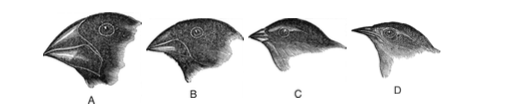
Base your answer(s) to question(s) on the diagram below and on your knowledge of biology. The diagram shows the heads of four different species of Galapagos Islands finches. 
The four different types of beaks shown are most likely the result of 
a)
gene manipulation 
b)
natural selection 
c)
unchanging environmental conditions 
d)
patterns of behavior learned from parents 
38.
Which characteristic is necessary for natural selection to occur in a species? 
a)
stability 
b)
variation 
c)
complex cellular organization 
d)
a very low mutation rate 
39.
The different tools used during the beaks of finches lab represented 
a)
feeding adaptations in finches 
b)
nest construction adaptations 
c)
variations in seed size 
d)
variations in ecosystems 
40.
"Survival of the Fittest" describes which theory
a)
a) natural selection
b)
b) gravity
c)
c) heredity
d)
d) string theory
41.
What is the advantage of having different shaped beaks?
a)
To look different from other species.
b)
To be able to eat the food readily available in the environment.
c)
To protect itself against predators.
d)
To protect itself against prey.
42.
Why are advantageous traits more likely to be passed onto offspring?
a)
Because they are more likely to survive and reproduce.
b)
Because they come from dominant alleles.
c)
Because they come from recessive alleles.
d)
Because the trait is an acquired phenotype.
43.
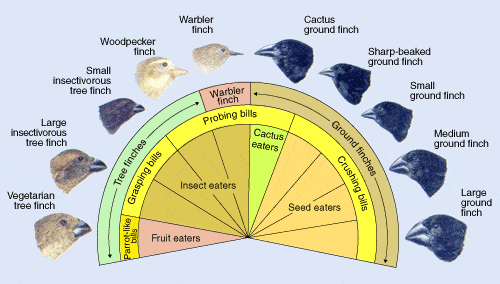
All of these finches have different shaped beaks, they are an adaptation to gain access of 
a)
Water
b)
Food
c)
Shelter
44.
What do we call traits that increase an individual's chance to survive and reproduce?
a)
Maladaptations
b)
Adaption
c)
Variations
d)
Adaptations
45.
Which trait does a puppy inherit from its parents?
a)
fur color and pattern
b)
obedience to commands
c)
food brand preference
d)
affection for a specific home
46.
Which best describes an inherited trait?
a)
a characteristic one chooses to express
b)
a characteristic one receives from the food one eats
c)
a characteristic that is passed on from one's parents
d)
a characteristic that is influenced by one's surroundings