
Font size
 Worksheets
AP Chemistry Unit 8.4- Titration Quiz
Total questions: 21
Worksheet time: 29mins
Ca(OH)2 + H2CO3 -->
3 LiOH + H3PO4 →
Hint: Primary standards (like oxalic acid, here) incude water in their formula. As a result, they do not absorb atmospheric water. Oxalic acid has the chemcial formula: H2C2O4⋅2H2O (so be sure to include the 2 extra water molecules).
The name of the apparatus used for holding the titrant is__________
Conical flask
Burette
Pipette
Volumetric flask
The tirant is also known as_________
Standard solution
Saturated solution
Concentrated solution
Super solution
In the titration equation, M1V1 = M2V2, what is M?
Molarity
Concentration
Amount of solution
Mass of mixture
Choose the indicator solutions used for acid-base titration
Phenolphtalein solution
Methyl red solution
Methyl orange solution
Fluoresceine solution

A 50.0 mL sample of an acid, HA, of unknown molarity is titrated, and the pH of the resulting solution is measured with a pH meter and graphed as a function of the volume of 0.100 M NaOH added.
At point R in the titration, which of the following species has the highest concentration?
HA
A-
H3O+
OH-

A solution of a weak monoprotic acid is titrated with a solution of a strong base, KOH. Consider the points labeled (A) through (E) on the titration curve
that results, as shown below.
The point at which the concentrations of the weak acid and its conjugate base are approximately equal is
A
B
C
D
E

A student performs an acid-base titration and plots the experimental results in the graph above. Which of the following statements best explains the experimental findings?
A strong acid was titrated with a strong base, as evidenced by the equivalence point at pH = 7.
A strong acid was titrated with a strong base, as evidenced by the equivalence point at pH > 7.
A weak acid was titrated with a strong base, as evidenced by the equivalence point at pH > 7.
A weak acid was titrated with a weak base, as evidenced by the equivalence point at pH approximately 7.
A 50.0 mL sample of an acid, HA, of unknown molarity is titrated, and the pH of the resulting solution is measured with a pH meter and graphed as a function of the volume of 0.100 M NaOH added.
Which of the following is the best particulate representation of the species (other than H2O) that are present in significant concentrations in the solution at point U in the titration?


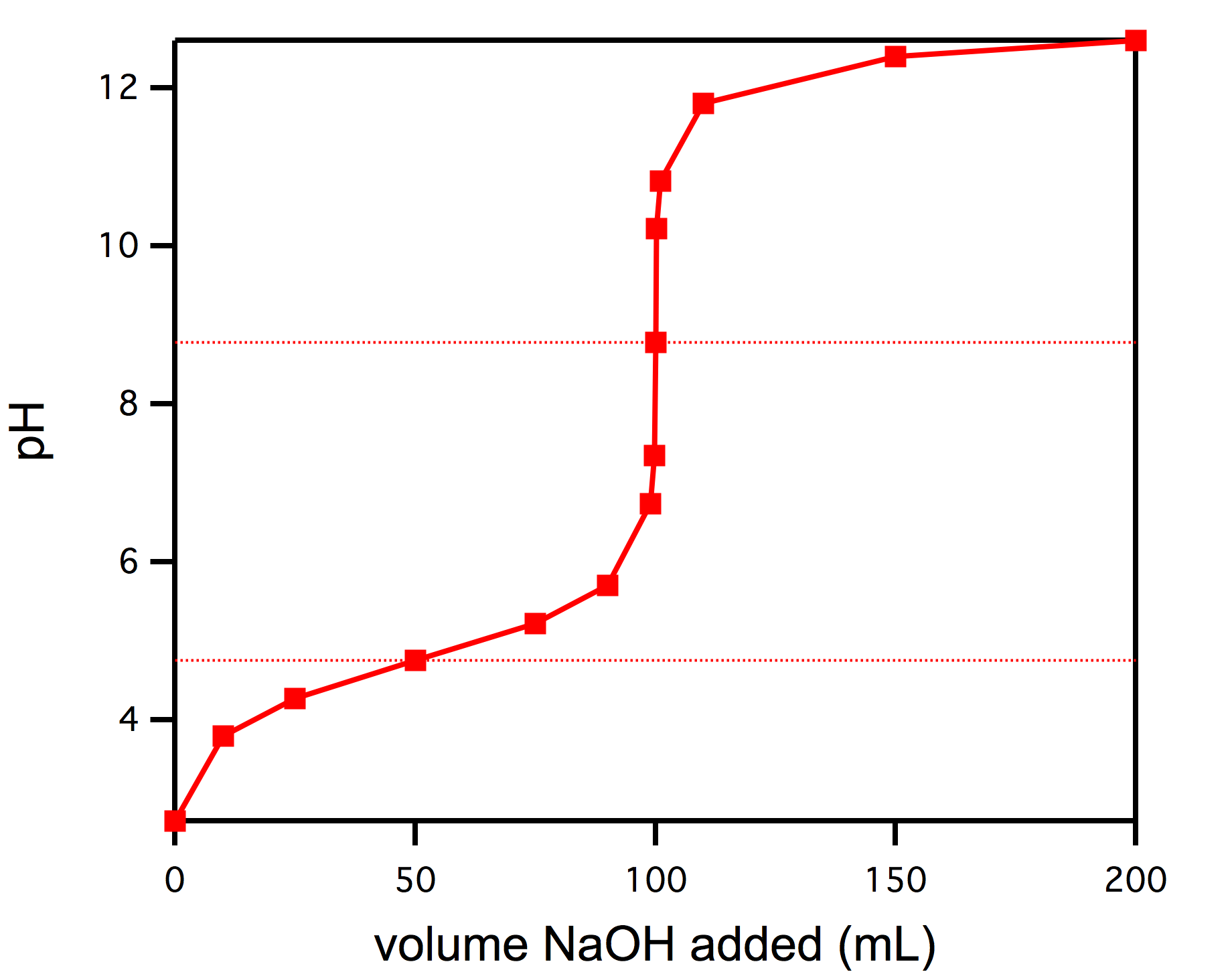
What is the pH at the equivalence point.
The pH is approximately 5
The pH is approximately 6
The pH is approximately 8
The pH is approximately 9
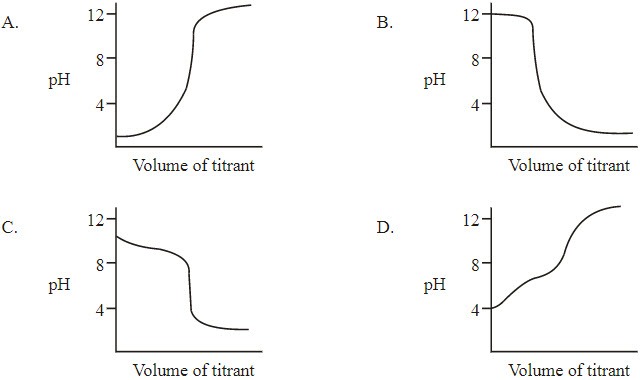
Which curve is produced by the addition of a 0.1 molL-1 strong acid to a 0.1 molL-1 weak base?
A
B
C
D

