
 Worksheets
Copy of Unit 4 Topic 2 Test
Total questions: 14
Worksheet time: 7mins
Name
Class
Date
1.
What is Mrs. Rivette's favorite holiday
a)
Easter
b)
Halloween
c)
Christmas
d)
Thanksgiving
2.
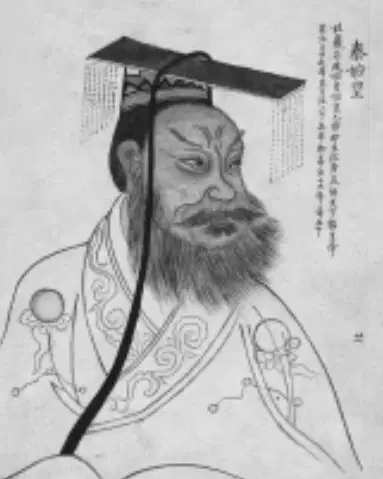
What is this emperor known for? (4.18.d)
a)
unifying China
b)
dividing China
c)
following Confucianism
d)
creating Legalism
3.
What philosophy did Qin Shi Huangdi follow, which believed in controlling people through harsh punishments and strict laws? (4.18.d)
a)
Legalism
b)
Confucianism
c)
Daoism
d)
Buddhism
4.
What surrounded Qin Shi Huangdi in his tomb? Select the TWO correct answers. (4.18.d)
a)
statues of angels
b)
statues of horses
c)
statues of soldiers
d)
statues of dragons
e)
statues of his children
5.
Why was the Great Wall built? (4.18.e)
a)
to divide China into east and west
b)
to keep out nomads called the Xiongnu
c)
to stop trade between Japan and Rome
d)
to commemorate historical events
6.
What did Emperor Wudi of the Han dynasty order an official to travel into the wilderness to find? (4.18.f)
a)
people willing to help China defend itself
b)
potions that would make him live forever
c)
a country willing to buy China’s silk
d)
a trade route to foreign empires
7.
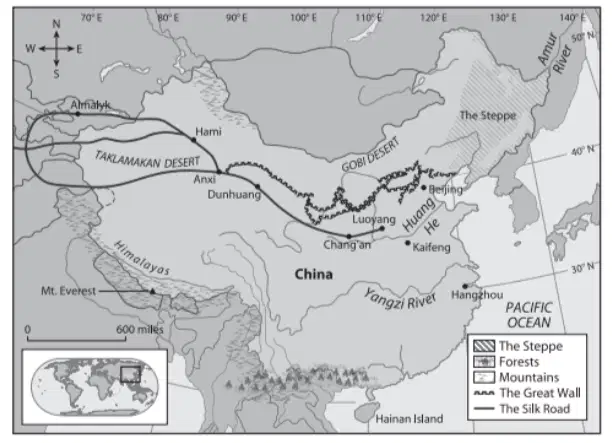
Which conclusion is supported by this map? (4.18.g)
a)
The Silk Road weakened China’s borders.
b)
The Silk Road ended attacks by the Xiongnu.
c)
The Silk Road took thousands of people to build.
d)
The Silk Road connected China to other kingdoms.
8.
Use this passage from The Writings of Master Han Fei to answer the following question.
A state under an enlightened sovereign [ruler] does not provide for trivial [unimportant] documents but promulgates [puts into effect] a code of laws for the guidance of the people; nor does it follow the ways of the early kings but makes the governing officials the people’s masters; nor does it tolerate private feuds [conflicts] but gets the people to die fighting in wars. In such a state, everyone abides by the law, works hard for the state, and delights in fighting.
According to this passage, what did Han Fei think about war? (4.2, 4.2.a, 4.18.c)
a)
War can be avoided by having a code of laws.
b)
War makes it difficult for officials to do their jobs.
c)
War weakens the state because many people die.
d)
War prevents people in the same country from feuding.
9.
What was the main product traded along the Silk Road from China? (4.18.g)
a)
Gold
b)
Spices
c)
Silk
d)
Timber
10.
What was invented in China a thousand years before it was widely used in Europe? (4.18.f)
a)
irrigation
b)
brick
c)
paper
d)
porcelain
11.
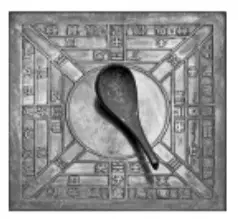
What was special about the spoon-shaped object in this image? (4.18.f)
a)
It protected a person from poison.
b)
It was used to measure liquids.
c)
It moved to point north.
d)
It was found in the sea.
12.
Use this passage from The Writings of Master Han Fei to answer the following question.
A state cannot be strong forever, nor can it remain weak. When its laws are strictly administered [enforced], the state is strong. When its laws are loosely administered, the state is weak.
Which emperor followed this philosophy by enforcing laws very strictly? (4.18.d)
a)
Qin Shi Huangdi
b)
Liu Bang
c)
Wu Zhao
d)
Wudi
13.
Use this passage from The Writings of Master Han Fei to answer the following question.
One gives and receives for his own selfish purpose. If there is common interest, men, even though they are strangers, will live in harmony. Conversely, if their interests conflict with one another, even they be father and son, they will strive [fight] against one another.
According to Han Fei, what makes strangers live in harmony? (4.2, 4.2.a, 4.18.c)
a)
equal wealth
b)
similar jobs
c)
living in the same house
d)
shared responsibilities
14.
Which dynasty invented paper, the magnetic compass, woodblock printing, silk, and porcelain? (4.18.f)
a)
Han dynasty
b)
Qin dynasty
c)
Tang dynasty
d)
Xia dynasty
100 %

