
 Worksheets
Mega Review
Total questions: 80
Worksheet time: 1hrs 12mins
Producers absolutely, positively have to have...
Sunlight, water, and carbon dioxide
Sunlight, water, and oxygen
Soil, carbon dioxide, and water
Planes, trains, and automobiles
Which part of the producer is responsible for absorbing the energy from the sun?
The roots
The leaves
The flower
In a food chain or food web, which kind of organism must get it's energy directly from the sun?
Decomposer
Consumer
Producer
Herbivore
What is an apex predator?
An organism that gets its energy from the sun
An organism that eats only plants
An organism that uses photosynthesis to make its own food
An organism that is a consumer that is not prey for another consumer
In a food web, both mice and frogs are eaten by snakes. If the snakes went extinct, what would most likely happen to the populations of both the mice and the frogs?
They would increase
They would decrease
Photosynthesis produces (a) for the producer.
Why are rotting/decaying leaves important in an ecosystem?
The leaves are used by other organisms for shelter
The leaves release carbon dioxide into the soil as they rot, which is useful to other producers
The leaves put useful nutrients into the soil as they rot, which is useful to other producers
A lizard dies and is buried under many layers of sediment. What might scientists find when they dig up the area later?
A hole where the lizard used to be
A fossil of lizard
A small house that was built by the lizard
What can scientists learn from fossils?
The total number of hurricanes that happened in the area in the past
How to build lizard houses
What the diet of an organism might have been

This fossil was found in a very dry, sandy area.
What information can this fossil give to us?
The area probably used to have more bodies of water, like rivers or lakes
Fish used to have feet and walk on land
This area used to be a very dense forest
Which example is similar to how a fossil can form?
A plant being watered in a garden
Wood being smoothed down by sandpaper
A star-shaped mold being pushed in to clay
Wax crayons melting in the sun
Which three situations could result in the formation of fossils?
A shell tumbles in ocean waves
An animal dies and is quickly covered in dirt
A dead fish is pressed between layers of sediment that turns into rock
A leaf is ripped apart by ants
An animal is trapped in the ice of a glacier
All of the following can become fossils except...
Bones
Shells
Teeth
Rocks
All of the following can become fossils except...
Bones
Shells
Teeth
Rocks
What type of resources will we never run out of?
Renewable resources
Nonrenewable resources
What type of resources will we run out of eventually because they do not reform quickly enough?
Renewable resources
Nonrenewable resources
Please select all of the resources that are nonrenewable
Oil
Nuclear
Natural gas
Wind
Please select all of the resources that are nonrenewable
Coal
Water
Oil
All fossil fuels
Please select all of the resources that are renewable
Wind
Water
Bioenergy from plants
All fossil fuels
Please select all of the resources that are renewable
Solar
Nuclear
Hydroelectric
Geothermal
What is it called when humans do their best to use less of a resource or use it in a more efficient way so that it can be used for a longer period of time?
Conservation
Condensation
Perspiration
Which layer is solid and forms the center of Earth?
Inner core
Outer core
Mantle
Crust
Which best describes the composition of Earth’s inner core?
Gaseous
Liquid metal
Solid metal

Which two words will you need to label this diagram?
Mantle
Outer core
Crust
Inner core
Which layer of Earth is the thinnest?
Crust
Mantle
Outer core
Inner core
Which layer of Earth is the thickest?
Crust
Mantle
Outer core
Inner core
Which layer of Earth is mostly made of iron in a liquid state?
Crust
Mantle
Outer core
Inner core
Which of these are considered renewable resources?
Trees
Water
Wind
Geothermal
Which of these are considered renewable resources?
Solar
Hydroelectric
Oil
Nuclear
Which of these are considered nonrenewable resources?
Oil
Coal
Natural gas
Nuclear
Metals
Planting trees and shrubs most likely helps protect the soil from ________
Weathering
Erosion
Deposition
Which of these things is true about water?
Usable water is everywhere
New freshwater is easy to create
Fresh water on earth is limited
Why does recycling help the environment?
Recycling creates new natural resources
Recycling conserves natural resources
Recycling helps to create new landfills
Which process most likely forms a sand dune?
Deposition by the wind
Erosion by water
Erosion by ice
What causes the most soil and rock erosion?
Wind
Sun
Water
Gravity
Which process is most directly related to constructing new land?
Erosion
Deposition
Weathering

Which processes formed this canyon?
Deposition and weathering
Earthquakes and erosion
Weathering and erosion

The pictures show the same beach at two different times.
Which is the most likely cause of the beach getting smaller?
Erosion of sand by waves
Gravity pulling sand away from the beach
Sand dissolving in the water
Which land feature is formed directly from the deposition of sediment?


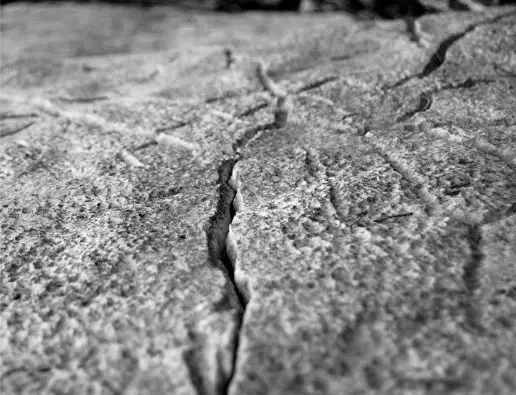
Look at the picture of cracks in a rock.
Which term describes the natural process that most likely caused the cracks?
Deposition
Abrasion
Wedging
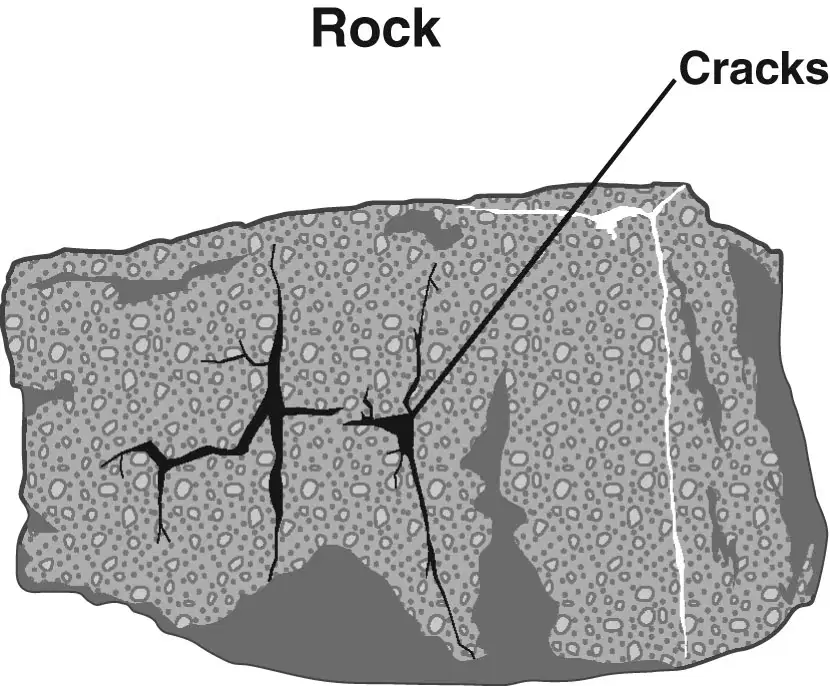
In a climate with cold winters, a rock cracks and breaks.
What substance froze inside the rock causing it to break?
Oil
Water
Oxygen
Which process turns a large rock into a pile of smaller stones?
Deposition
Weathering
Fossilization
What event occurs because of the 24-hour rotation cycle of Earth?
Tides
Changes in the weather
Night and day
Two children were playing outside at sunset. They had to go inside their homes when it became dark. Which best explains why the day became night?
The Sun stops producing light each night
The Moon blocks light from the Sun at night
Part of Earth faces away from the Sun at night

What is the time of day at the location marked X?
6 a.m.
12:00 a.m.
12:00 p.m.

Which ocean landform resembles the landform shown?
Abyssal plain
Rift
Trench

Which number represents a continental slope?
1
2
3
4
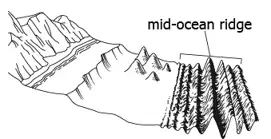
What is the correct sequence of the ocean floor features moving from the shoreline toward the mid-ocean ridge?
abyssal plain → continental shelf → continental slope
abyssal plain → continental slope → continental shelf
continental shelf → continental slope → abyssal plain
During photosynthesis, plants produce oxygen and _________, which is also known as glucose.
Carbon dioxide
Sugar
Water
Chlorophyll
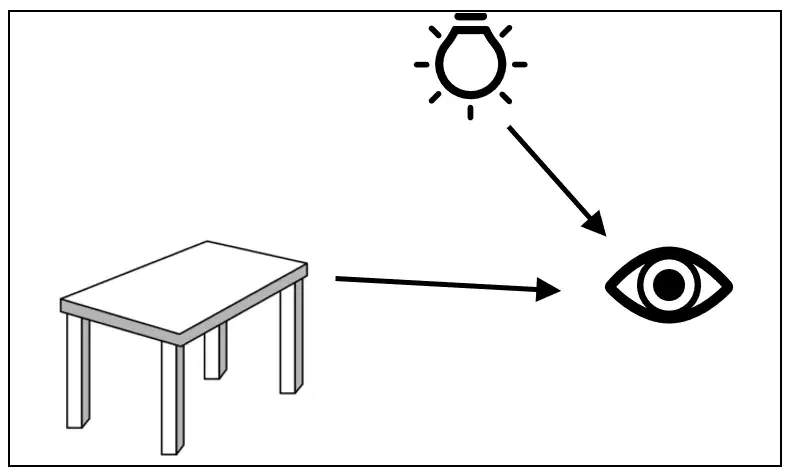
Which diagram shows how the person is able to see the table when a light is turned on?
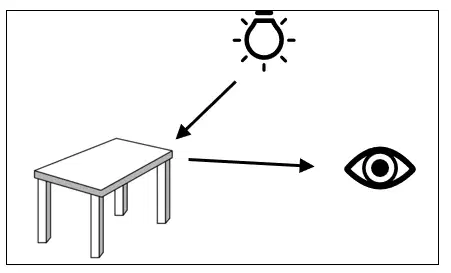
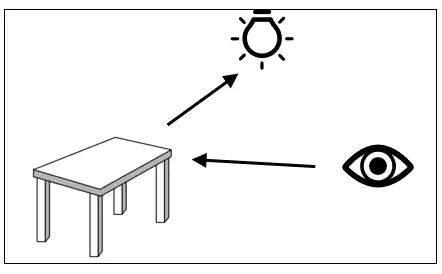

A student shines a beam of white light through a prism.
What happens to the light that comes out from the other side of the prism?
It remains the same.
It appears to be dimmer
It splits into different colors
Which process causes light to bend and form a rainbow?
Refraction
Frequency
Reflection
When light is bounced off a mirror, the light is...
Absorbed
Reflected
Refracted
A class made a solar cooker out of a large can. What color should they paint the can in order to collect the most heat?
Blue
Pink
Black
White
Which of the following best describes what happens when a student looks in a mirror?
The mirror acts as a light source that lights the student’s face
The student’s eyes see light waves reflecting off the mirror as solid matter
Light waves bouncing off the student’s face reflect off the mirror
Choose all of the materials that are transparent.
White plastic milk bottle
Clear glass juice bottle
Plastic food wrap
Air in the refrigerator
Aluminum foil wrap

A student puts a pencil in a glass of water and notices that the pencil looks like it is broken.
Why does the pencil look broken?
Light bends when moving from air to water
Light is made of different colors
Light travels in a straight line
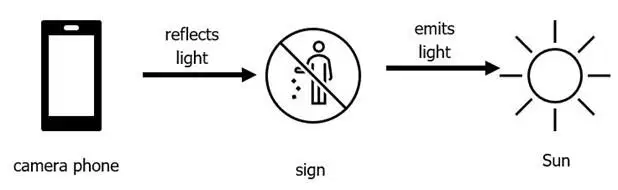
A child uses a camera phone to take a picture of a sign. Which model best shows how the camera phone sees the sign?
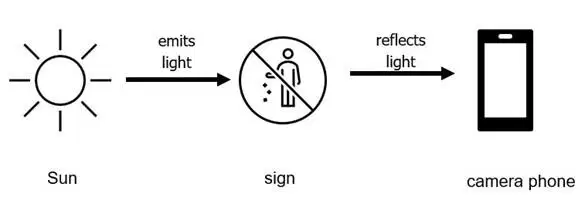
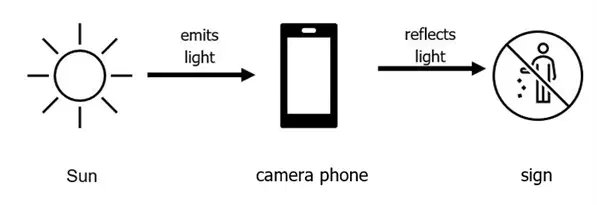
Eyeglasses help a nearsighted person see as a result of
Refraction
Reflection
Absorption
Which object best reflects light?
Gray door
Black sweater
White carpet

From left to right, what types of materials are these?
translucent, opaque, transparent
transparent, translucent, opaque
opaque, translucent, transparent

___ is the current outdoor conditions.
Precipitation
Thermometer
Wind vane
Weather
1. (a) : Rain, snow, sleet, or hail that falls from clouds in the sky
2. (b) : A tool that measures the amount of rain at a location
3. (c) :A tool used to measure temperature
4. (d) : A tool that shows wind direction
True or false? Snow is an example of precipitation.
true
false

Look at the weather forecast. Which day has lowest predicted temperatures?
Monday
Tuesday
Wednesday
Thursday

The image shows the temperature of five different cities in Texas. Which city was the warmest?
Dallas
Lubbock
San Antonio
Houston
Austin

Which of the following statements best describes the term photosynthesis?
When plants absorb the energy from the sun.
How plants reproduce.
The process by which plants make their own food.
The process by which animals make their own food.

