
 Worksheets
Project Time Management Quiz - Topic 6
Total questions: 98
Worksheet time: 1hrs 4mins
A 222 percent time overrun means that a project that was planned to take one year ended up taking 1.22 years to complete
True
False
Schedule control involves analyzing activity sequences, activity duration estimates, and resource requirements to create the project schedule
True
False
Ideally, the project team and key stakeholders first define the project budget and then the time or schedule for the project
True
False
The WBS is often dissected during the activity definition process as the project team members further define the activities required for performing the work
True
False
Determining the relationships or dependencies between activities has a significant impact on developing and managing a project schedule
True
False
Discretionary dependencies are sometimes referred to as hard logic
True
False
Most project management software uses the precedence diagramming method
True
False
Duration relates to the effort estimate, not the time estimate
True
False
Gantt charts normally do not show relationships among project activities, as network diagrams do
True
False
A slipped milestone means the milestone activity was actually completed earlier than originally planned
True
False
Even though the critical path is the longest path, it represents the shortest time it takes to complete a project
True
False
There cannot be more than one critical path on a project
True
False
The main disadvantage of fast tracking is that it can end up lengthening the project schedule since starting some tasks too soon often increases project risk and results in rework
True
False
It is impossible to find the critical path for a project without considering resource allocation
True
False
Critical chain scheduling assumes that resources do not multitask.
True
False
PERT is the best probabilistic method for assessing risk
True
False
Not every single item on the WBS needs to be on the network diagram
True
False
As a rule of thumb, all arrowheads should face toward the left on an AOA network diagram
True
False
The critical path is concerned only with the time dimension of a project, not with the most critical activities
True
False
Project time management is often cited as the main source of conflict on projects.
True
False
Budget is the variable that has the least amount of flexibility on a project.
(a)
The triple constraint of project management involves balancing scope, time, and social goals.
(a)
The three project time management processes of activity definition, activity sequencing, and activity duration estimating are the basis for creating a project schedule.
(a)
Activity definition usually results in the project team developing a more detailed WBS and supporting explanations.
(a)
Controls or tasks are elements of work performed during the course of a project: they have expected durations, costs, and resource requirements.
(a)
After defining project activities, the next step in project time management is activity budgeting.
(a)
Mandatory dependencies are sometimes called soft dependencies. (soft = discretionary)
(a)
Discretionary dependencies should be used with care since they may limit later scheduling options.
(a)
Network diagrams are the preferred technique for showing activity sequencing.
(a)
Malleable activities have no duration and no resources but are occasionally needed on AOA network diagrams to show logical relationships between activities.
(a)
Gantt charts provide a standard format for displaying project schedule information by listing project activities and their corresponding start and finish dates in a calendar format.
(a)
The sudden start date for an activity is the earliest possible time an activity can start based on the project network logic.
(a)
Primary chain scheduling is a method of scheduling that considers limited resources when creating a project schedule and includes buffers to protect the project completion date.
(a)
Multitasking occurs when a resource works on more than one activity at a time.
(a)
Gantt's Law states that if something can go wrong, it will.
(a)
Feeding buffers are additional time added before tasks on the critical chain that are preceded by non-critical-path tasks.
(a)
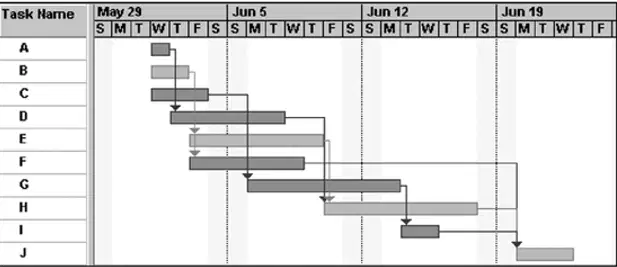
The figure above is an example of a(n) PDM chart for Project X.
(a)
The activities on the Gantt chart should coincide with the activities on the WBS.
(a)
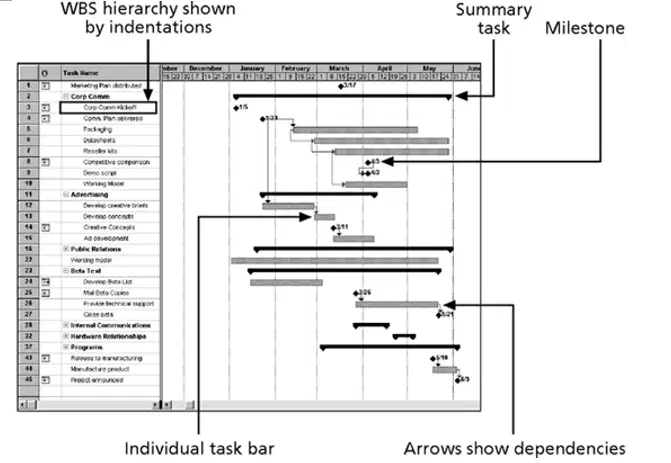
In the figure above, the arrows show alliances.
(a)
According to the 1995 CHAOS report, unsuccessful information technology projects that were planned to take one year ended up taking ____ years to complete. (Avg Time Overrun = 222%)
1.4
1.8
2.2
2.6
Overall, ____ issues cause the most conflict over the life of a project.
budget
schedule
planning
verification
There are ____ main processes involved in project time management.
*Planning & Controlling
two
four
five
ten
Activity ____ involves identifying the specific activities that the project team members and stakeholders must perform to produce the project deliverables.
conflict
modification
verification
definition
Activity ____ involves identifying and documenting the relationships between project activities.
duration
development
sequencing
control
Activity ____ estimating involves estimating the number of work periods that are needed to complete individual activities.
duration
development
sequencing
control
Schedule ____ involves analyzing activity sequences, activity duration estimates, and resource requirements to create the project schedule.
sequencing
development
duration
control
Schedule ____ involves managing changes to the project schedule.
sequencing
development
duration
control
Activity ____ involves reviewing the activities in the detailed WBS, detailed product descriptions, assumptions, and constraints to determine the relationships between activities.
budgeting
definition
sequencing
management
There are ____ basic reasons for creating dependencies among project activities.
three
five
eight
nine
____ dependencies are inherent in the nature of the work being done on a project.
Mandatory
Discretionary
External
Relationship
____ dependencies are defined by the project team.
Mandatory
Discretionary
External
Relationship
____ dependencies involve relationships between project and non-project activities.
Mandatory
Discretionary
External
Relationship
A project ____ diagram is a schematic display of the logical relationships among, or sequencing of, project activities.
Gantt
bar graph
schedule
network

In the figure above, the letters A through J represent activities with ____ that are required to complete the project.
dependencies
schedules
budgets
deliverables
A PDM, or ____ diagramming method (PDM) is a network diagramming technique in which boxes represent activities.
precedence
predictive
parallel
primary
____ is a relationship in which the "from" activity cannot start until the "to" activity is started.
Finish-to-start
Start-to-start
Finish-to-finish
Start-to-finish
____ is a rarely used relationship in which the "from" activity must start before the "to" activity can be finished.
Finish-to-start
Start-to-start
Finish-to-finish
Start-to-finish
An example of a ____ relationship is when quality control efforts cannot finish before production finishes, although the two activities can be performed at the same time.
Finish-to-start
Start-to-start
Finish-to-finish
Start-to-finish
The number of workdays or work hours required to complete a task is called ____.
duration
length
effort
time
On a Gantt chart, a(n) ____ is a significant event on a project with zero duration.
marker
goal
milestone
inning
The critical path method (CPM) also called critical path ____ is used to predict total project duration.
requirements
divisions
therapy
analysis
Slack or ____ is the amount of time an activity may be delayed without delaying a succeeding activity or the project finish date.
flotsam
float
excess
padding
A(n) ____ pass determines the early start and early finish dates for each activity.
forward
backward
late
early
____ is a technique for making cost and schedule trade-offs to obtain the greatest amount of schedule compression for the least incremental cost.
Costing
Creating
Crashing
Culling
____ tracking involves doing activities in parallel that you would normally do in sequence.
Parallel
Simultaneous
Slow
Fast
The Theory of ____ (TOC) is based on the fact that, like a chain with its weakest link, any complex system at any point in time often has only one aspect that limits its ability to achieve more of its goal.
Complaints
Constraints
Constructs
Conventions
____ Law states that work expands to fill the time allowed.
Parkinson's
Murphy's
Gantt's
Stevenson's
Lucent Technology's Outside Plant Fiber Optic Cable Business Unit used critical chain scheduling to reduce its product introduction interval by ____ percent.
20
30
40
50
____ Technologies Group successfully implemented critical chain scheduling to manage more than 200 concurrent projects in nine locations.
Lucent
Synergis
Antarctic
U.S.
ADM stands for ____ diagramming method.
advanced
assertive
arrow
anchor
____-on-arrow (AOA) is a network diagramming technique in which activities are represented by arrows and connected at points to illustrate the sequence of activities.
Activity
Advances
Arrow
Articles
A(n) ____ pass is a project network diagramming technique that determines the late start and late finish dates for each activity in a similar fashion.
forward
backward
fast
slow
A(n) ____ is when a single node is followed by two or more activities on a network diagram.
start
milestone
arrow
burst
A(n) ____ occurs when two or more nodes precede a single node on a network diagram.
mesh
merge
milestone
burst
The equation for the PERT ____ average is: (optimistic time + 4(most likely time) + pessimistic time)/6.
weighted
slack
probabilistic
constraint
A(n) ____ Gantt chart is a Gantt chart that compares planned and actual project schedule information.
information
singular
tracking
inverted
One of the first ____ checks a project manager should make is to review the draft schedule usually included in the project charter.
time
progress
reality
account
____-coding involves entering all activity dates manually instead of letting the software calculate them based on durations and relationships.
Cold
Hard
Hot
Slow
The 2001 CHAOS report showed that time overruns (a) between 1995 and 2000.
Part of the reason schedule problems are so common is that (a) is easily and simply measured.
An activity or (a) is an element of work normally found on the WBS that has an expected duration, a cost, and resource requirements.
The goal of the activity (a) process is to ensure that the project team has complete understanding of all the work they must do as part of the project scope.
Activity (a) results in supporting detail to document important product information as well as assumptions and constraints related to specific activities.
The project team should review the revised WBS and supporting detail with project (a) before moving on to the next step in project time management.
A(n) (a) or relationship shows the sequencing of project activities or tasks.
Even though the delivery of the new hardware may not be in the (a) of the project, you should add an external dependency to it because late delivery will affect the project schedule.
(a) includes the actual amount of time worked on an activity plus elapsed time.
SMART criteria are guidelines suggesting that milestones should be Specific, Measurable, Assignable, Realistic, and (a) .
In a Gantt chart, planned schedule dates for activities are called the (a) dates.
A(n) (a) path for a project is the series of activities that determine the earliest time by which the project can be completed.
Critical chain theory suggests that projects be (a) so people working on more than one project at a time know which tasks are most important.
A(n) (a) is additional time to complete a task.
PERT, or Program Evaluation and (a) Technique, is a network analysis technique used to estimate project duration when there is a high degree of uncertainty about the individual activity duration estimates.
PERT uses (a) time estimates, duration estimates based on using optimistic, most likely, and pessimistic estimates of activity durations.
In an AOA diagram, a(n) (a) represents the starting or ending point of an activity.
Although (a) shortens the time it takes to finish a project, it often increases the project's total costs.
The main disadvantage of (a) tracking is that it can end up lengthening the project schedule since starting some tasks too soon often increases project risk and results in rework.
" (a) march" projects are ones that are doomed to failure from the start, due to unrealistic expectations.

